Specialty Insurance Products: Market Trends, Challenges and Technology
Surplus lines grew 10.4% in 2025 while filings outran premium in 2026. What specialty products ask of a PAS, and five tests to run before you buy one.
Where insurers can innovate in 2026: embedded insurance, custom claims and policy apps, AI analytics, personalized products and specialty lines.

Insurance innovation increasingly depends on how quickly a business can turn its underwriting expertise into a product customers can buy, understand, and use.
The opportunities are substantial: coverage for emerging exposures, products designed around specific industries, insurance embedded into commercial transactions, and services that help policyholders prevent losses. Delivering them requires close coordination between product design, distribution, policy administration, and claims.
AI is already changing parts of that work. EIOPA’s 2026 research found that 64% of reported generative AI use cases focused on internal productivity, including information extraction, content generation, and underwriting assistance. These applications address the administrative effort that can make launching and servicing a specialist product expensive. EIOPA’s generative AI survey.
For insurers and MGAs, the opportunity is to connect these operational improvements to a clear customer need. A product becomes more commercially attractive when it combines relevant coverage with efficient distribution, manageable servicing costs, and a process for learning from experience.
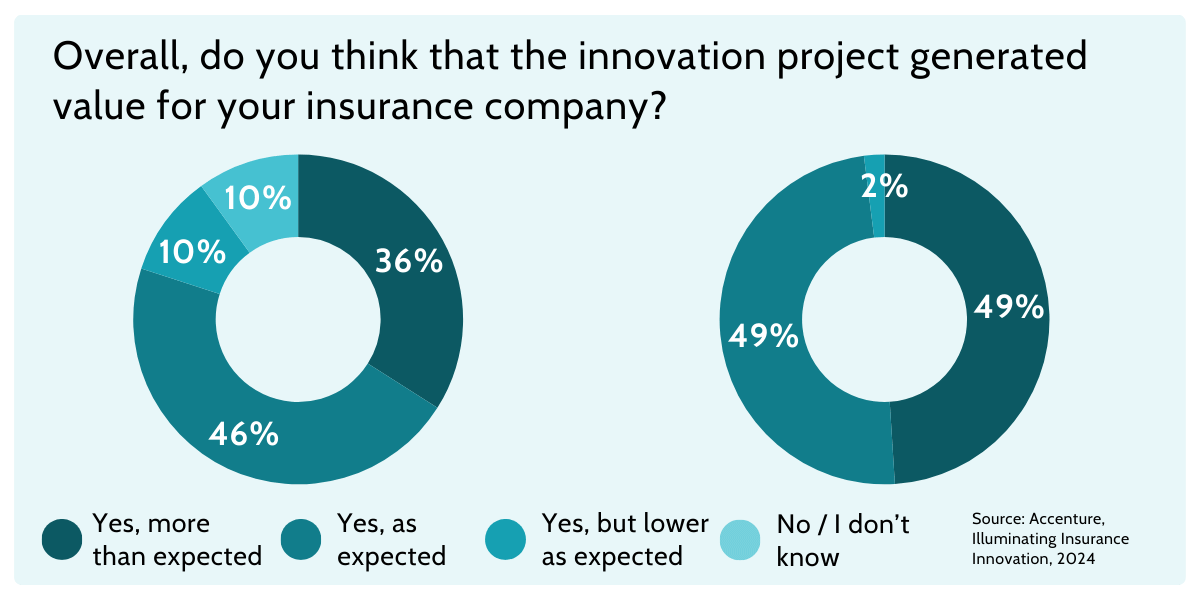
Accenture asked insurers whether their innovation projects had paid off. Most said yes, but the interesting split is between the firms that went in with a defined proposition and those that did not.
Before committing to a new insurance product, establish:
These questions help turn an interesting concept into a proposition the business can evaluate.
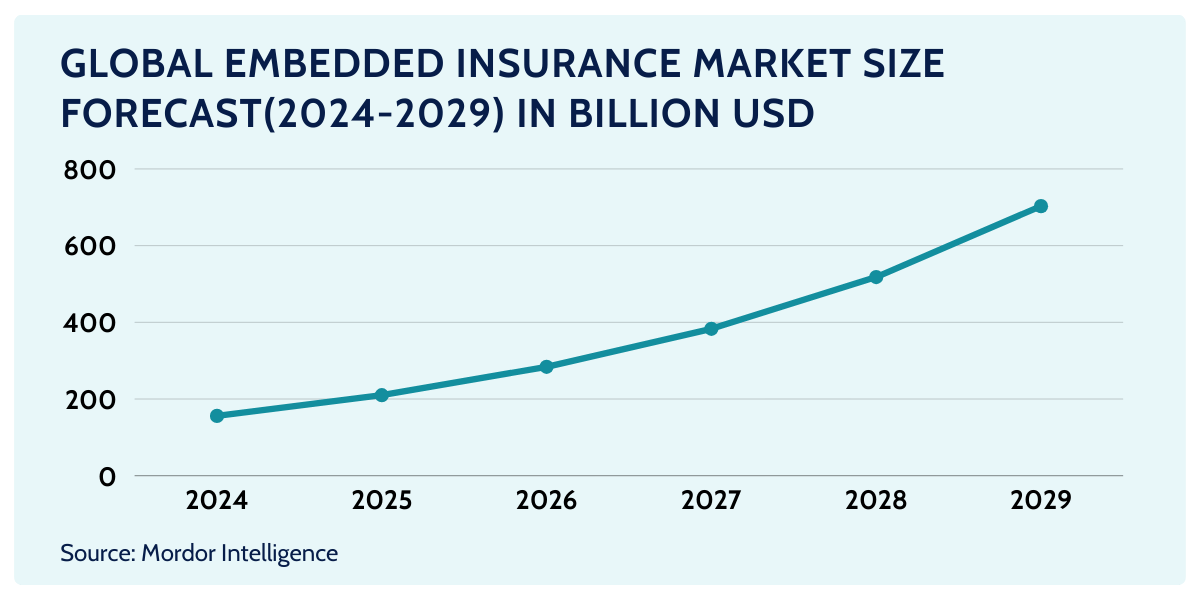
Embedded insurance creates opportunities to offer protection when customers are already making a relevant purchase or business decision.
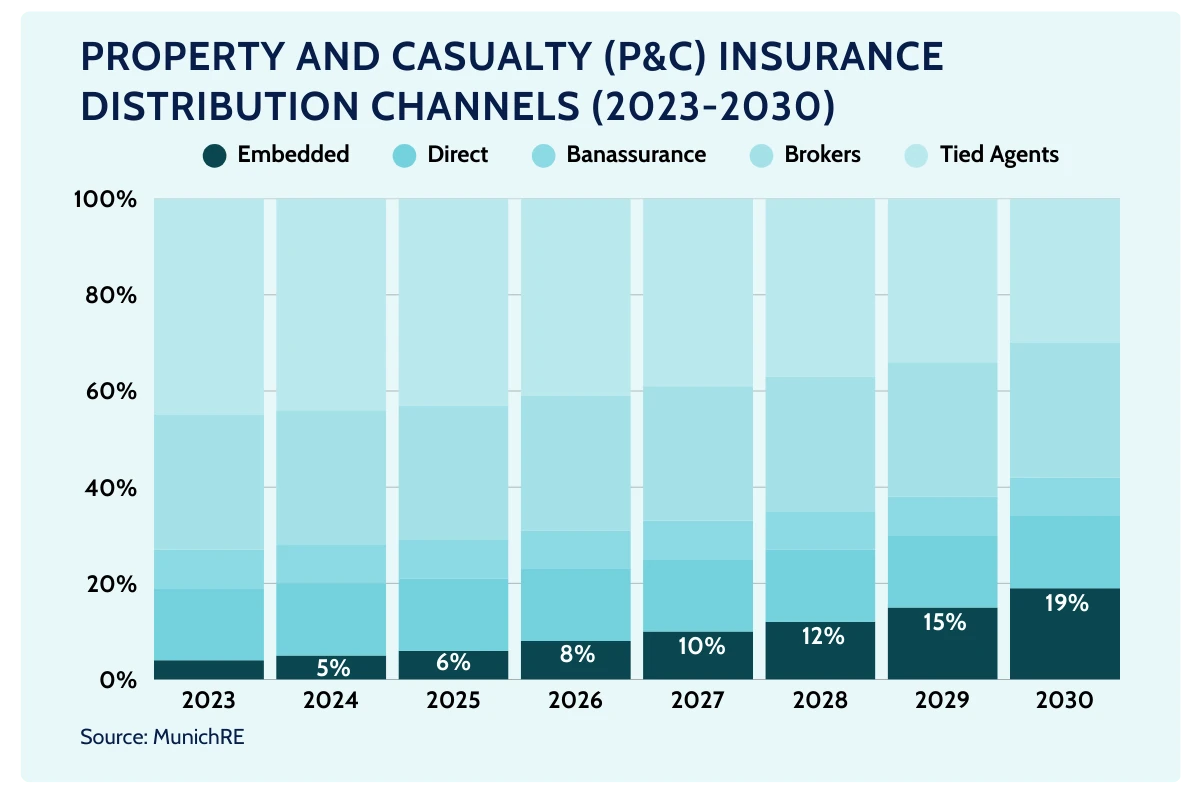
Potential applications include equipment cover within a leasing journey, shipment protection during freight booking, or travel insurance alongside a reservation. The distribution partner may already hold information needed for a quote, reducing the amount customers must enter.
The operational design deserves as much attention as the purchase journey. A booking amendment, returned item, or cancelled subscription may require a corresponding insurance transaction. Customers also need a clear route to policy documents, support, and claims after leaving the partner’s website.
For insurers, useful performance measures therefore extend beyond the proportion of customers who buy cover. Cancellation rates, service demand, claims experience, and partner remuneration all affect the economics.
Consider flight-delay protection offered during booking. A product could provide a predefined benefit when an approved flight-data source confirms that the delay threshold has been reached, subject to the policy terms.
The design work includes deciding which delay measurement applies, how connecting flights are treated, and what happens when data is unavailable or corrected.
The trigger must also reflect the customer’s likely need. Parametric products carry basis risk: the payout and the policyholder’s actual financial loss can differ. Clear benefit design and communication are essential to the proposition. Swiss Re’s explanation of parametric insurance.
Claims innovation can make a specialist product easier to operate and more valuable to customers. The strongest opportunities often sit in specific workflows: collecting the right evidence, identifying missing information, routing cases, and keeping policyholders informed.
There are already practical examples. Allianz reports that 49.7% of claims in its German pet insurance business were processed fully automatically in 2025. Its described approach extracts information from documents, checks key fields against policy data, and routes uncertain cases to human specialists. Allianz’s claims automation example.
A custom claims application can support:
Claims information should also help product teams improve the offering.
Repeated requests for the same missing evidence may indicate a weak notification form. Frequent questions about a particular exclusion may justify clearer wording or better sales communication. A concentration of claims within one activity or customer segment may warrant further underwriting analysis.
Connecting these observations to policy and product data makes claims a useful source of feedback throughout the product’s life.
Product innovation places specific demands on policy administration. A specialist scheme may need unusual risk fields, several insured assets, optional extensions, different referral paths, and documents that change according to the selected cover.
Openkoda is a complete, highly customizable PAS designed to accommodate these requirements. It brings product configuration, rating, underwriting, policy administration, claims, billing, documents, and reporting into one connected system. Teams can shape the software around their products and operating processes rather than the other way round. Explore the Openkoda feature set.
The teams closest to a product understand it better than any vendor does. Openkoda is a policy administration system they configure themselves, with AI drafting the changes, and they own the code at the end of it.
Michał Głomba, CEO, Openkoda
For insurers and MGAs developing differentiated products, relevant capabilities include:
These capabilities support ongoing servicing as well as the initial launch.
Openkoda’s visual workflow automation engine adds control over how work moves between stages. A process can evaluate underwriting rules, wait for approval or payment, generate documents, and issue a policy. Teams can simulate workflows before activation, while cases already underway retain their original workflow version.
Consider an MGA designing a package for specialist contractors. The application may need to capture trade activities, turnover, equipment values, and work at height. Certain activities could require underwriting referral, while selected extensions would affect pricing and policy documents.
A configurable PAS allows the team to connect those requirements across the application, underwriting process, policy record, and servicing journey. As the scheme develops, new options and revised rules can be introduced through controlled product changes.
The practical value of flexibility becomes especially clear after launch, when real submissions reveal requirements that the original specification missed.
Product teams need to understand how a proposition is performing and translate that understanding into deliberate changes. Openkoda supports both activities through Reporting AI and AI Product Builder.
Openkoda’s Reporting AI lets users describe the information they need in everyday language. It generates and runs the query, returns the report, and displays the query behind the result. Reporting respects the organization’s data boundaries, with configurable dashboards, reusable reports, and Excel export.
For example, a product manager could ask:
Show quote-to-bind conversion by distribution partner for our contractor product over the last quarter.
With the relevant quote, policy, and partner information recorded, the report can help identify where further investigation is needed. A follow-up analysis might examine referral volumes or the time between quotation and binding.
The business interpretation remains important. Lower conversion could reflect pricing, the risks submitted, slow referrals, or differences in how a partner presents the product. Reporting makes those questions easier to investigate.
Openkoda’s AI Product Builder allows product managers and underwriters to describe a new product or a proposed change in plain English. It can draft changes to coverages, limits, deductibles, rating formulas, underwriting rules, and workflows for review and approval.
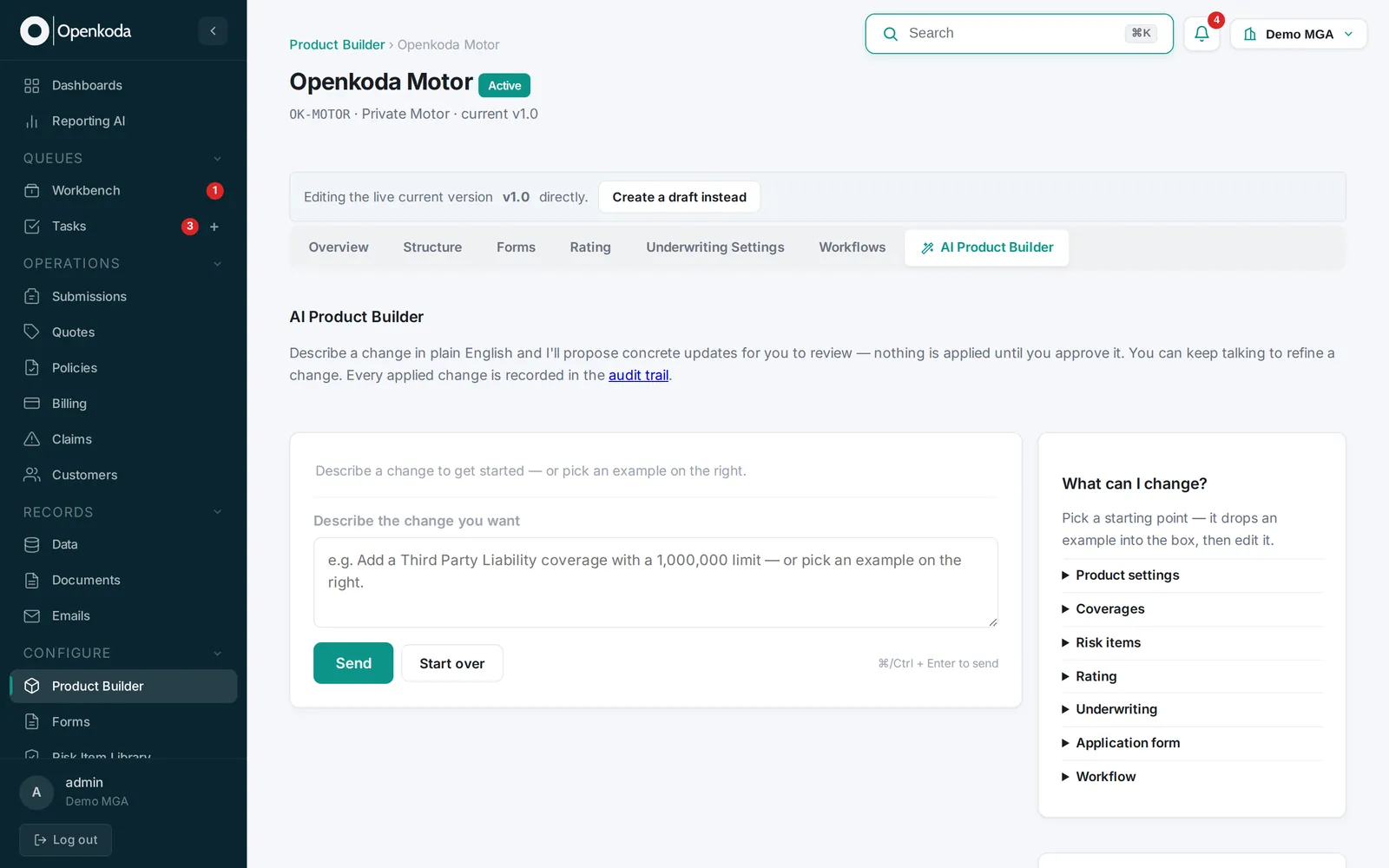
An illustrative instruction might be:
Add optional portable equipment cover to our contractor product, with a £10,000 limit and £250 excess. Refer applications requesting higher limits to an underwriter.
The team can then:
This shortens the path from a defined requirement to a working configuration. Underwriters and product specialists still determine whether the proposed coverage, pricing, and rules are appropriate.
The same approach extends to products that did not exist a year ago. This walkthrough builds cover for an AI agent, from the risk definition through to a bindable quote.
Together, Reporting AI and AI Product Builder support a practical improvement cycle: investigate performance, agree on a change, review its implementation, and measure the results.
Personalization can address several aspects of an insurance product: the coverage selected, the period of protection, the information requested, and the service provided.
Useful approaches include:
Usage-based motor insurance provides an established example. Progressive’s Snapshot uses driving information to determine a personalized rate, with results reflected at renewal. The timing matters: collecting data continuously does not necessarily mean changing the premium continuously. Progressive’s Snapshot explanation.
For product teams, personalization should have a clear customer benefit. Every additional question, data connection, and coverage option adds complexity. The design challenge is to use information that improves the proposition while keeping purchasing and servicing understandable.
A useful starting point is one well-defined segment with a distinctive need. That gives the insurer a clearer basis for deciding which variations are worth supporting.
Specialty opportunities reward a detailed understanding of a particular exposure, industry, or operating model.
Established areas such as cyber, marine cargo, renewable energy, and specialist liability already demonstrate the breadth of this market. Munich Re Specialty’s offering, for example, spans these fields alongside aviation, construction, and emerging technologies. Munich Re Specialty’s insurance lines.
Product ideas worth examining include:
Data quality is especially important where a product depends on an external measurement. Swiss Re’s recent work on parametric flood insurance highlights the value of combining sources such as sensors, satellite imagery, and models to improve reliability and reduce basis risk. Swiss Re’s research on parametric flood protection.
Before scaling a specialty proposition, teams should be able to explain how they will monitor exposure, identify concentrations, manage exceptions, and revise assumptions as experience develops. The software needs to capture enough detail to support those decisions throughout the policy lifecycle.
Successful insurance innovation connects a specific customer need with sound underwriting and a workable operating model. Start with a focused proposition, make its performance measurable, and build the ability to improve it into the launch plan.

Surplus lines grew 10.4% in 2025 while filings outran premium in 2026. What specialty products ask of a PAS, and five tests to run before you buy one.
Six of the best policy management software systems for 2026, split by what they actually do: insurance policy administration, or internal policy governance.
What to actually test in a mutual insurer's policy, claims, billing, portal and reporting systems, and which platforms are worth a shortlist.
Book a live, personalized demo with our product team - tell us your use case and see the platform work with your data. No commitment.