P&C Insurance Software
The full policy lifecycle for risk-bearing insurance carriers
Support all core insurance operations from one place - administer products, underwriting, policies, claims and billing end to end - with the reporting and controls a carrier needs, on a single configurable core.
One core, whole lifecycle
Product, underwriting, policy, claims and billing run on one configurable platform and one data model, in place of systems that reconcile with each other overnight.
Change without projects
Products, pricing, rules and process are configuration your own teams change, so a rate revision or a new form ships on your schedule rather than a vendor's release plan.
Enterprise controls
Role-based access reaches down to field level, and every quote, bind, payment and override is logged with who did it: the evidence regulators and internal audit ask for.
One core for the whole business
Replace fragmented systems with a single, configurable core that spans the entire insurance lifecycle. Products, rating, underwriting, policies, claims and billing share one data model, so a bind, an endorsement, a first notice of loss and a payment all update the same record the moment they happen. In-force premium, open claims and reserves are read from that live record rather than reconciled overnight from three systems.
Customizable platform suited to carrier needs
Retire a legacy core without a big-bang migration
Run Openkoda alongside what you already have and move one line of business at a time. Modernizing stops being a multi-year programme with a single terrifying cutover, and starts being a series of changes you can actually reverse.
Bring underwriting, policy and claims onto one record
Risk, cover, servicing and loss data sit in the same system rather than in three that reconcile overnight. Exposure, loss ratio and reserve movements read from live data, so the numbers your board sees are the numbers your teams are working from.
Keep your own actuarial and regulatory logic
Rating rules, referral triggers and reporting are configured to your standards, not bent to fit a vendor's assumptions. Where you need something specific, our team extends the platform for you, and you can build it and still stay on the platform.
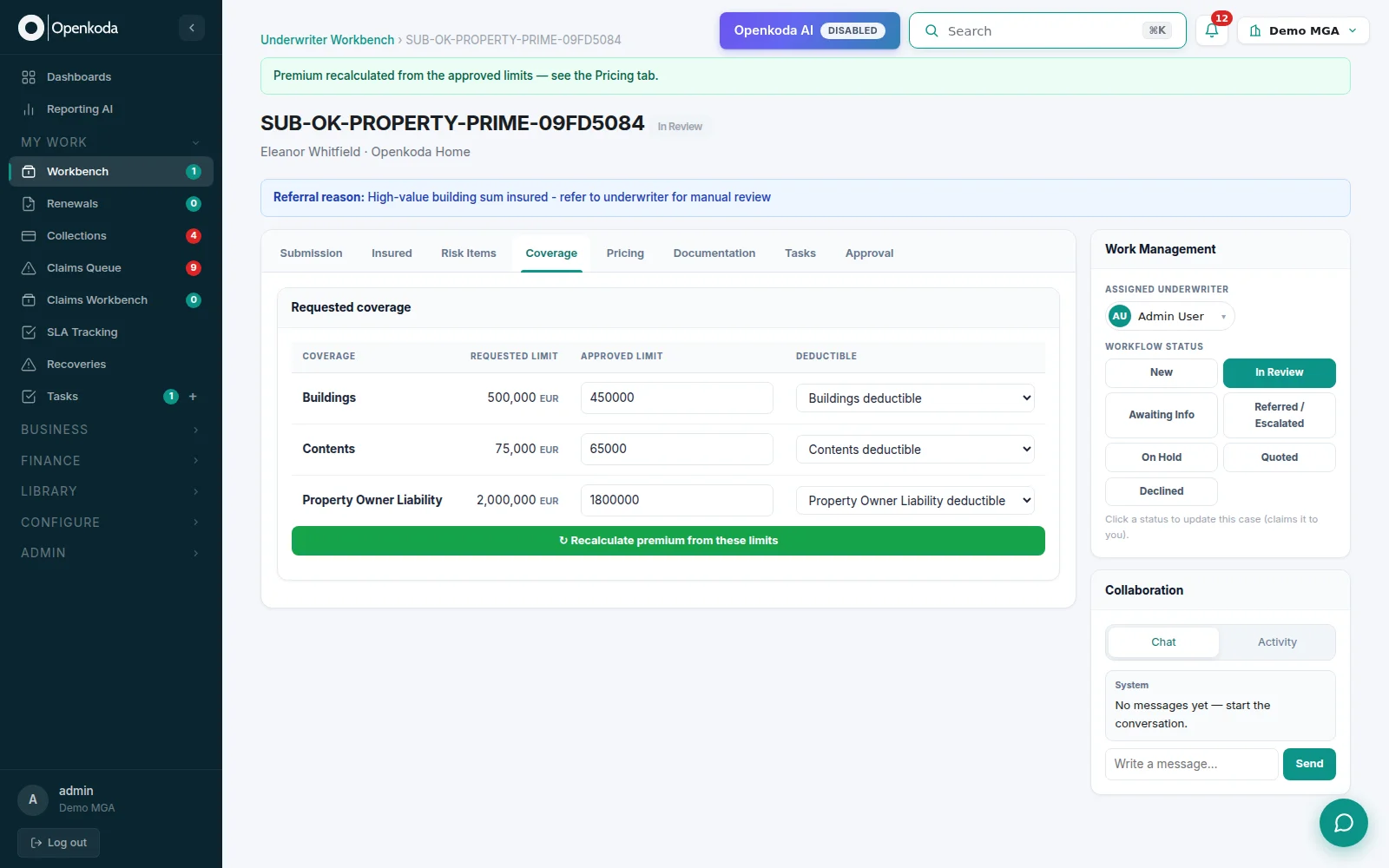
Everything you need in one carrier platform
Underwriting
Automated rules clear the straightforward business; a referral workbench gives underwriters the exposure, history and documents they need in one screen. Decisions and their reasoning stay on the record.
Policy administration
Quote, bind, endorse, renew, cancel - the full lifecycle in one system, with integration capabilities for third-party services like rating bureaus, agency management systems and document providers.
Security & audit
Role-based access down to field level, with a complete audit trail of every quote, bind, payment and override. Built for the questions regulators and internal audit actually ask.
Product & rating
Configure any line and its pricing - coverages, factors, tiers, territory. New products and rate revisions ship as configuration changes, so a filing deadline doesn't turn into a release schedule.
Rating engineClaims
First notice through settlement: intake, reserving, payments, recovery. Claims workflows route by severity and line, and claims management sits on the same data model as policy, so exposure is never a lookup.
Claims managementExecutive dashboards
Loss ratio, written premium, pipeline and reserve development across the whole book. Business intelligence built on live operational data rather than a warehouse extract that's already a week old.
Reporting & dashboardsUp and running, fast
Configure products
Model your lines and pricing.
Underwrite & issue
Automate the routine, review the rest.
Service & report
Settle claims; see the book clearly.
Launch a new line of business
A carrier wants to enter a new specialty line quickly and cleanly.
Configure the product
Model coverages, rating and underwriting rules.
Wire the process
Design the quote-to-bind and claims flows visually.
Go live & watch
Launch, then track performance on executive dashboards.
Illustrative example built on Openkoda's demo products.
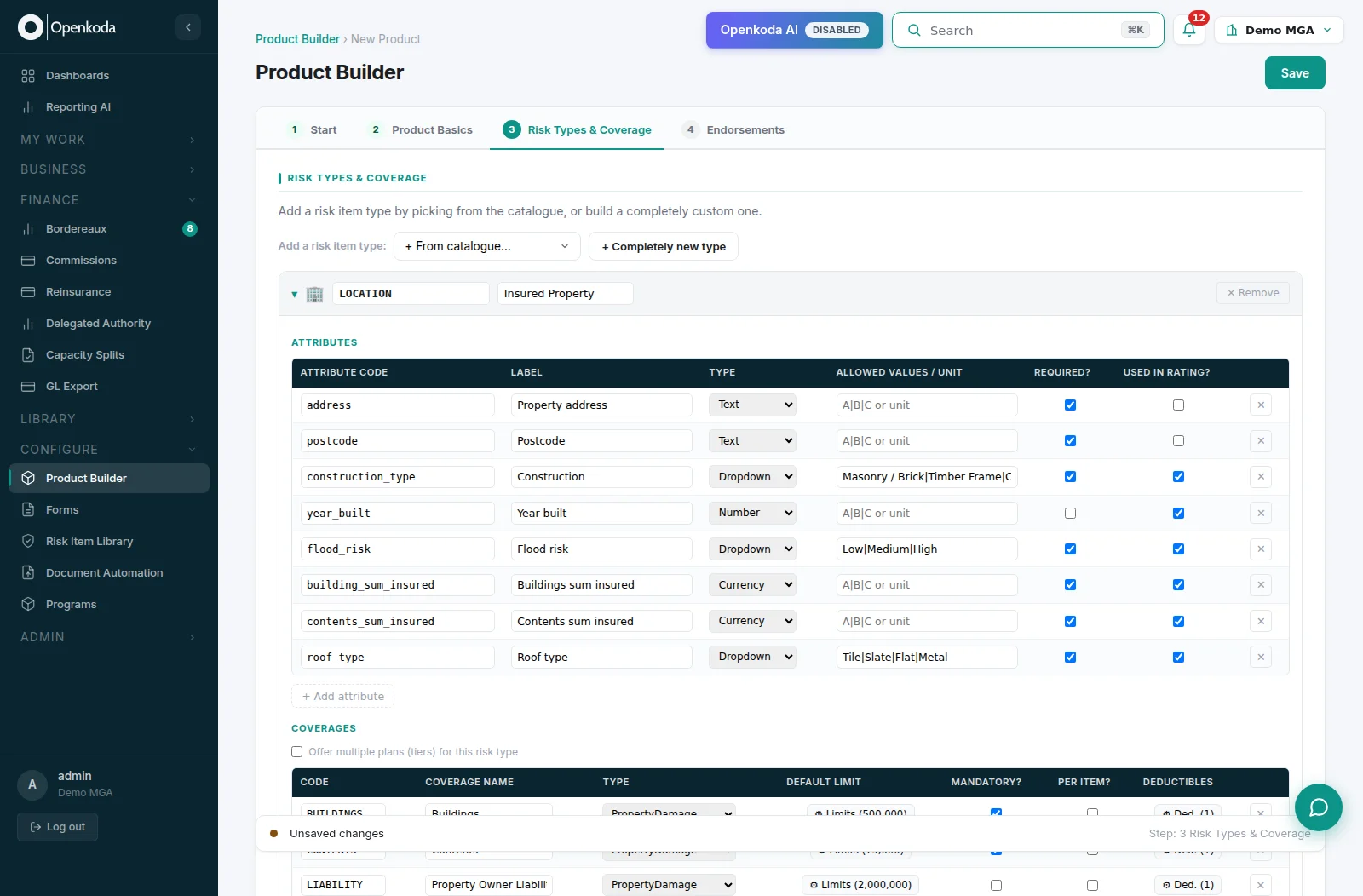
P&C Insurance Software Built for Your Team
Built for carriers and insurers modernizing a fragmented or aging core. Underwriting, policy servicing, claims and finance work from one record instead of systems that reconcile overnight, and you can move one line of business at a time rather than all at once.
Questions, answered
Can one platform cover our whole lifecycle?
How much needs developers?
Is it enterprise-grade?
Can we run many brands or entities on one platform?
How is it deployed, and do we own it?
Does it handle personal and commercial lines?
How does it integrate with our existing systems?
Where does it fit against a full core replacement?
See Openkoda in your context
Book a live, personalized demo with our product team - tell us your use case and see the platform work with your data. No commitment.