UK MGA Insurance Market Report 2026
UK MGAs wrote about £7.2bn of premium in 2025, up a fifth. Lloyd's, the FCA, the PRA and the capital behind MGAs spent the same year deciding how much of it to trust.
Six of the best policy management software systems for 2026, split by what they actually do: insurance policy administration, or internal policy governance.

The best policy management software systems make everyday work easier while giving an organization room to change.
For insurers and MGAs, that means supporting new products, underwriting decisions, policy servicing, and the flow of information between distribution, finance, and claims teams. For compliance teams, the priority is usually a different one: controlling internal policies, tracking approvals, and staying ready for an audit.
The two overlap in document management, version control, and audit trails. They lead to different software.
This guide compares six systems across both categories, so you can weigh them against the work your team actually does.
A useful evaluation starts with a real workflow. Take a policy change your team handles every week and follow it through the system in front of you. Who approves it, which records change, what happens to the previous version, and how does the outcome reach the people who need it?
For insurance policy administration, that might be a mid-term endorsement that changes a premium, generates revised policy documents, and triggers a billing adjustment. For internal governance, it might be an updated underwriting procedure that needs review, publication, and an acknowledgment from every employee it applies to.
Both are ordinary. Watching either one run end to end tells you more than a feature matrix will.
The term covers two different products, and the distinction decides which half of this list is relevant to you.
A document management system can serve either one by organizing files and controlling access. Insurance policy administration also has to manage coverage, pricing, effective dates, and the transactions sitting behind those documents.
The right policy management software should fit that operational scope, connect with the systems you already run, and let your team make changes without creating more manual work.
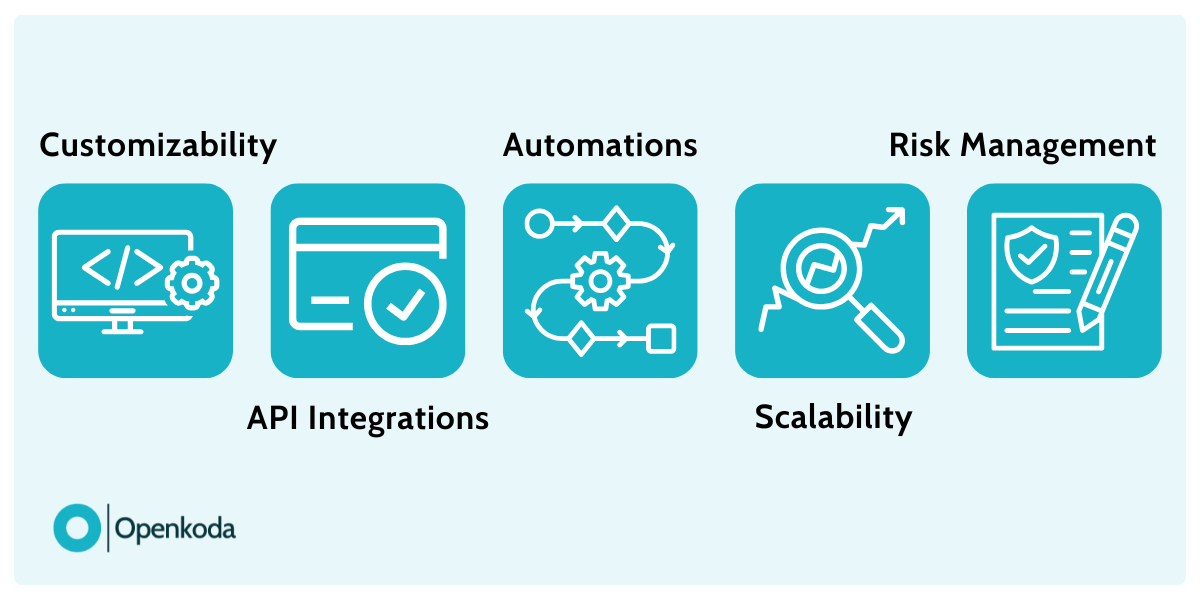
The pace of change in insurance products means your policy management system must be customizable enough to adapt to changes. Rigid platforms will hold you back.
Michalina Stark, Business Analyst at Openkoda
While every insurer or MGA has its own operational priorities, most modern platforms share a set of core capabilities that make them effective. A well-designed system not only stores and organizes documents but also actively supports risk management, streamlines policy and procedure management, and keeps teams on top of compliance tracking. Here are six key features to look for when evaluating solutions:
The selection below covers both categories. Openkoda and Guidewire PolicyCenter serve insurance operations; PowerDMS, LogicGate, ConvergePoint, and MetricStream handle organizational policies, procedures, and compliance.
Compare within the category that matches your requirement. Some insurers will need one of each.

Openkoda is a highly customizable PAS for insurers, MGAs, and insurtechs that want established insurance functionality without giving up control over how their products and workflows behave.
It covers the policy lifecycle end to end: quotation and binding, issuance, endorsements, renewals, and cancellations. Policy, customer, claims, and billing views keep the connected records one click apart, and a personalized policy dashboard puts the ones a given role needs on a single screen. Automated workflows fire documents, tasks, and follow-up actions as transactions progress.
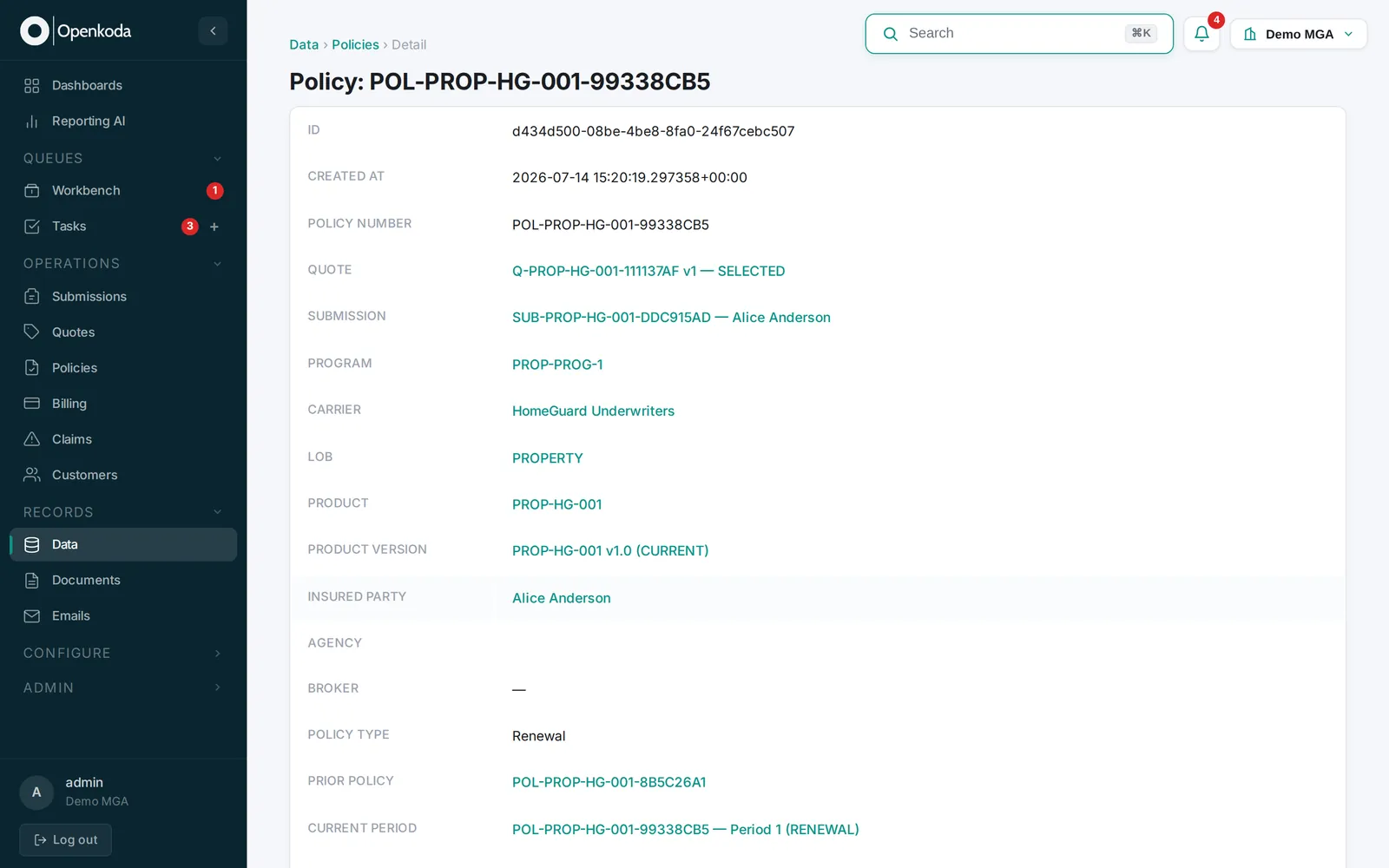
The value shows up when a business has specialist requirements. An MGA might need three extra risk questions, a carrier referral above a particular limit, or a renewal process that applies to one product and nothing else.
Openkoda lets teams configure those details around a PAS that already works, with ready modules for underwriting, rating, claims processing, billing, document generation, and bordereaux reporting. The full Openkoda feature set is published.
AI adds a second way to work with the system. The AI Product Builder turns plain-language instructions into proposed changes to coverages, limits, rating rules, and workflows. A product manager can ask for a new equipment coverage with a £5,000 limit and a referral rule above it; the system presents the change for review before anything is applied, and version control preserves the terms attached to policies already in force.
Reporting AI answers questions about the policy data in plain English - which policies renew in the next 30 days, grouped by broker - and returns the query alongside the report, so an analyst can check the number before it goes anywhere.
The Openkoda team can configure products, build custom workflows, and connect external systems. Customers keep ownership of their configuration and data, on managed cloud or on-premises.
Pros
Cons
PowerDMS is a cloud-based policy, training, and accreditation management platform that allows organizations to develop, review, approve, and distribute critical documentation all from a centralized system.
Originally built for public safety and healthcare sectors, PowerDMS now serves over 4000 public and private entities, offering a consolidated ecosystem for policy approval, training tracking, and compliance workflows for insurers and healthcare facilities.
Pros
Cons
Guidewire PolicyCenter is a policy administration system for property and casualty insurers, available on its own or as part of the bundled Guidewire InsuranceSuite.
As a policy management software embedded in this ecosystem, it supports the full policy lifecycle – from product design, quoting, underwriting, and issuance to endorsements, renewals, and even cancellations – while helping you efficiently maintain compliance and engage relevant employees through modern, streamlined workflows.
Pros
Cons
LogicGate Risk Cloud is a governance, risk, and compliance platform whose Policy & Procedure Management application supports internal policy drafting, review, approval, and employee acknowledgment. It is not a policy administration system and does not underwrite or issue insurance contracts.
Its Policy & Procedure Management application centralizes and automates policy creation, review, approval, and version control.
You can craft policy workflows and manage governance from a shared repository – even bringing in Spark AI for draft generation – while ensuring the right policies reach relevant employees and that attestations are clearly tracked.
Pros
Cons
ConvergePoint delivers a cloud-based system that slots neatly into your existing Microsoft 365 SharePoint environment.
It's designed for the entire lifecycle of the policy document – from drafting and review to approval, publication, and acknowledgement.
Built around deep Microsoft integrations (Microsoft Word, Outlook, Teams, Active Directory), it's particularly well-suited for insurers aiming to enforce compliance standards with minimal fuss. The platform lets you track progress with real‑time dashboards and audit trails, all within tools your team already uses.
Pros
Cons
MetricStream is an enterprise GRC platform whose Policy and Document Management product helps organizations manage their internal policies and connect them to risks, controls, and compliance requirements.
It's designed to streamline the creation, review, approval, and distribution of policies within large, regulated organizations.
The system supports linking policies to risks, controls, and audits, ensuring governance is consistent and traceable.
Pros
Cons
UK MGAs wrote about £7.2bn of premium in 2025, up a fifth. Lloyd's, the FCA, the PRA and the capital behind MGAs spent the same year deciding how much of it to trust.
Surplus lines grew 10.4% in 2025 while filings outran premium in 2026. What specialty products ask of a PAS, and five tests to run before you buy one.
What to actually test in a mutual insurer's policy, claims, billing, portal and reporting systems, and which platforms are worth a shortlist.
Book a live, personalized demo with our product team - tell us your use case and see the platform work with your data. No commitment.