Specialty Insurance Products: Market Trends, Challenges and Technology
Surplus lines grew 10.4% in 2025 while filings outran premium in 2026. What specialty products ask of a PAS, and five tests to run before you buy one.
What to actually test in a mutual insurer's policy, claims, billing, portal and reporting systems, and which platforms are worth a shortlist.

Mutual insurers are unusual entities in insurance. Unlike stock companies driven by shareholders, mutuals are owned by their policyholders. It's an approach that has stood the test of time – some mutual insurers have been around for more than a century – but in today's digital-first world, tradition alone isn't enough.
First digitalization challenge lies in the very nature of mutual insurance. These companies often operate under state-specific regulations that require precise compliance and reporting. On top of that, mutuals frequently insure highly specialized risks - anything from local businesses to farm equipment or niche property types. This diversity makes operations more complex and demands systems that can adapt to very particular product designs and compliance frameworks.
Unfortunately, many mutuals still rely on outdated technology stacks, legacy core systems, or, in some cases, even spreadsheets patched together to handle day-to-day operations.
The legacy technology problem in the mutual insurance sector runs deeper than just "old software." Many of these systems were built decades ago, designed for a time when member expectations were simpler and regulatory demands were less dynamic. Today, those same platforms act more like anchors than engines of growth.
One of the biggest issues is rigidity. Legacy systems often lack the flexibility to adapt to new products, updated regulations, or changing market conditions. Even something as straightforward as launching a new coverage option can require months of custom coding and testing.
Maintenance is another pain point. Supporting outdated systems usually involves high operational costs – not just in licensing, but also in specialized IT staff who know how to keep them running. In some cases, insurers are stuck with software that only a handful of people in the organization know how to operate.
A modern core platform lets mutual insurers spin up new software systems the way a software team deploys a feature release: configure, test, and push to production in days instead of quarters.
Arkadiusz Drysch, CTO at Stratoflow
Software investment should improve the economics of serving members without flattening the service and underwriting practices that make a mutual distinctive. Product mix, distribution, and geographic concentration shape the requirements as much as the ownership structure does.
The capabilities below may sit in one platform or in several connected systems. Either way, establish which system owns each record and how a change reaches the others. An endorsement, a payment, or a claim update should leave a consistent picture across the operation, which is the part of insurance legacy system modernization that tends to get underestimated.
A useful PAS evaluation goes well beyond how quickly a system can issue a policy.
The revealing test is how it handles change: a backdated endorsement, a revised rating structure, or a renewal prepared before new underwriting rules take effect.
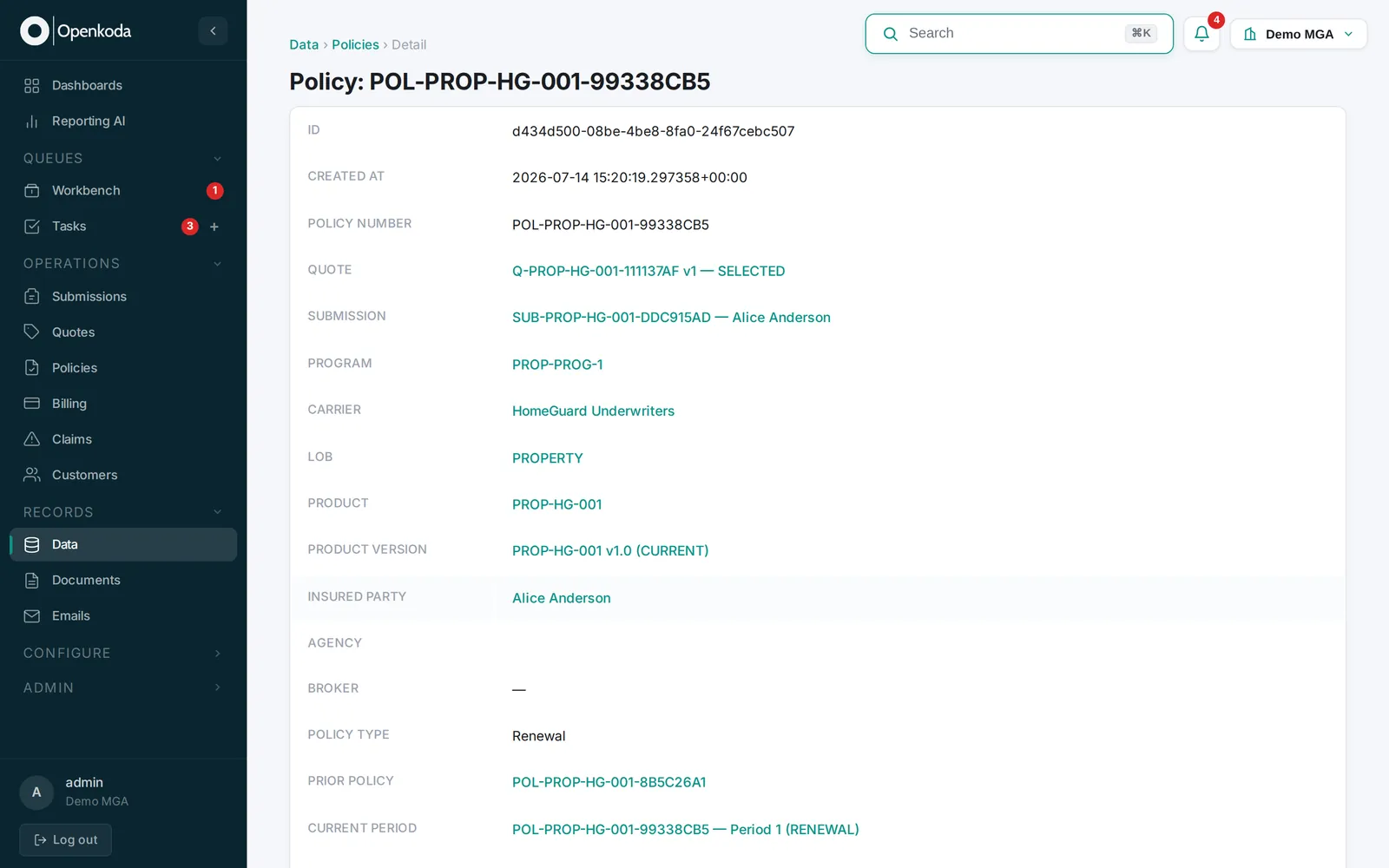
Look for effective-dated product versions, traceable rating decisions, and workflows that preserve the terms applicable to contracts already in force. For a mutual writing farms or specialist commercial risks, the data model should also carry multiple locations, scheduled assets, and separate coverage sections without pushing underwriters into free-text notes.
Member records deserve particular attention. One member may hold several policies, and the policyholder, insured entity, payer, and authorized contact can all be different parties. A modern insurance policy management software should represent those relationships explicitly and connect to whatever membership or governance records sit alongside them.
A strong demonstration follows one policy change through its pricing, documents, billing, and downstream data exchanges. That is what exposes the work that would otherwise land on operations after go-live.
The three things worth scoring in any policy management software:
In mutual insurance the claim carries more weight than it does elsewhere. Policyholders are also members and owners, so handling claims fairly and visibly is the model working as intended rather than a service target.
Claims management systems should make those service standards repeatable as the workload moves. That means efficient handling together with a clear record of the evidence, the authority, and the reasoning behind each decision.
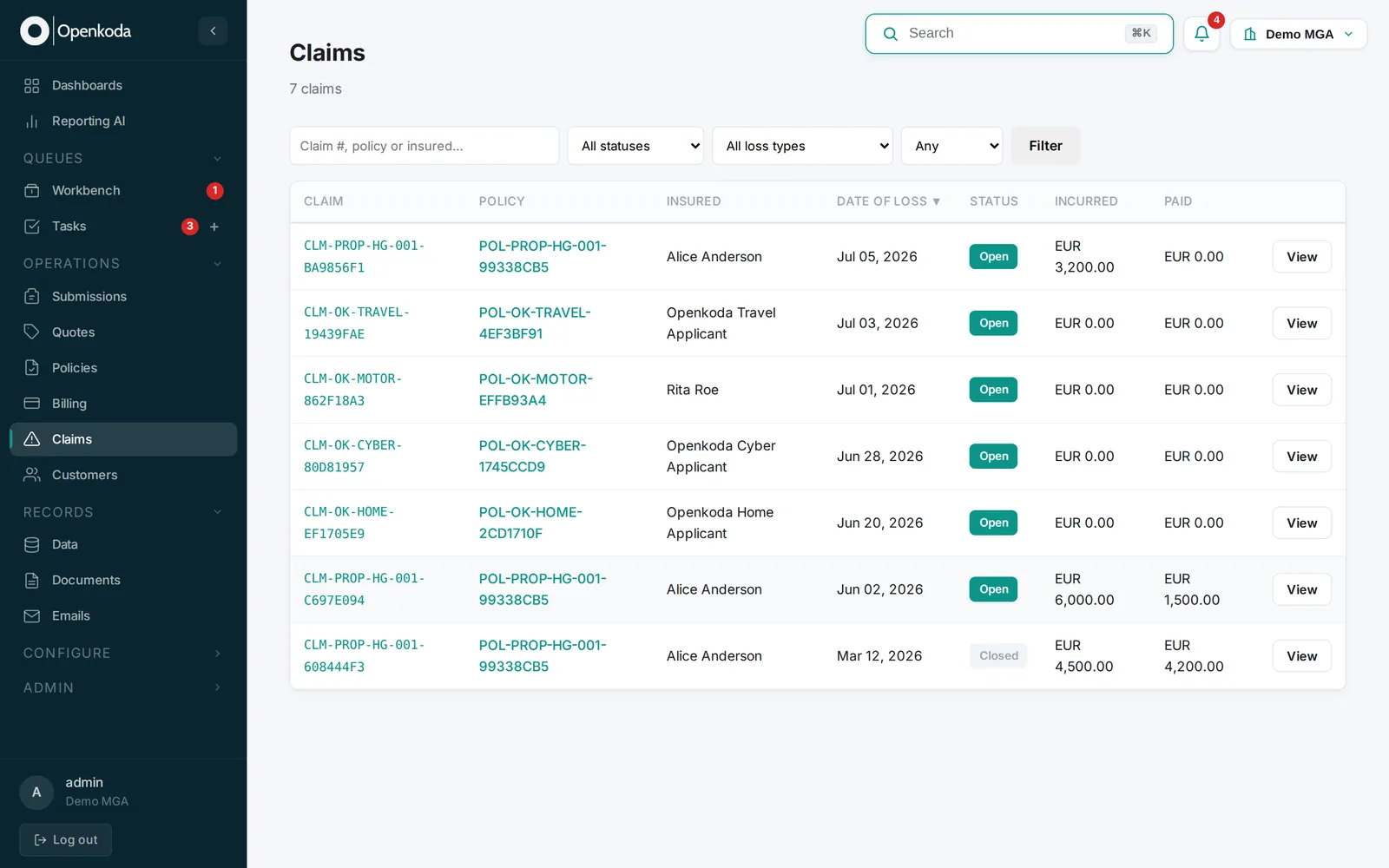
Assess how adjusters reach the coverage and wording applicable to a claim, how reserve movements are tracked, how payment approvals are managed, and how recoveries are pursued. Automation can take document requests, task allocation, and routine communications; exceptions should reach someone with the authority and the context to settle them.
For a geographically concentrated property book, test a catastrophe scenario as well as an ordinary claim. Can the system group losses by event, spread work across internal and external adjusters, and feed reliable figures into the reinsurance process? Can members still get useful updates while the team is under pressure?
Judge speed alongside reopened claims, complaints, decision consistency, and recovery performance.
A shorter workflow is worth little if it generates corrective work later.
Billing quality becomes visible the moment something changes.
A member adds equipment halfway through an instalment plan, cancels one policy inside a multi-policy account, or makes a payment that has to be allocated across several balances. Those are the scenarios that show how closely billing and policy administration actually work together.
Look for traceable adjustments, reliable payment allocation, and reconciliation with the finance ledger. Finance and service teams should be able to explain how a balance arose, down to the policy transaction that created it, without rebuilding the answer from separate exports.
Where the mutual pays policyholder dividends or other member distributions, settle early how eligibility, calculation, approval, and payment will be handled. Those processes often need a separate finance or actuarial integration, and a premium refund has to stay distinguishable from a member distribution in both the records and the letter that explains it.
Payment flexibility needs operational controls behind it: failed-payment handling, agreed exceptions, and a clean handoff to member support.
A useful portal connects members to the work being done on their behalf. After submitting a change or a claim they should be able to see what has been received, what is still outstanding, and whether the request is waiting on a review or has already taken effect. That is a higher bar than 24/7 access to a policy document, and it is the one that reduces calls.
Design access around the actual relationships. A member, a household contact, a business representative, and an intermediary may all need different permissions on the same policies. Where membership communications or voting services are offered digitally, work out how identity and eligibility connect to them.
The handoff to a person matters just as much. If a member calls after starting a request online, the service team should already see the documents and information supplied. Measure repeat contacts and completed journeys, not portal registrations, when judging whether digital insurance client portals are earning their place.
The first requirement is not a tool. It is agreement on what the numbers mean.
Underwriting, claims, and finance should be able to reconcile premium, exposure, and claims measures using the same definitions and valuation dates. A dashboard showing a loss ratio is only useful when the reader can see its basis, which expenses are in it, and how reinsurance has been treated.
For a mutual, reporting should connect financial resilience to member outcomes: retention by member cohort, cost to serve, claims experience, exposure concentrations, and the effect of a product or pricing change. Rising premium always deserves a second question. It could be growth, rate, or a shifting mix of risks, and the three point in different directions.
AI makes those questions cheaper to ask, and it still depends on reliable data. ICMIF's July 2026 review of AI adoption among mutual insurers names fragmented systems, data quality, and unclear ownership as the constraints that keep recurring (ICMIF).
So prioritize tools that let a user open the underlying records and the calculation, reproduce a historical report, and carry a finding back into underwriting or servicing rather than into a slide.
Replacing outdated systems is not a technology upgrade with a business case bolted on. For a mutual it is the mission made cheaper to run: serving members more efficiently, more transparently, and more fairly. The effect shows up across the whole organization rather than in one department.
Here are the most important benefits mutual insurers can expect:
The market for insurance software is broad, but not every platform might fit the unique needs of mutual insurers. Below are four notable software platforms that mutual insurers can consider - each with different strengths and approaches to modernizing policy, claims, billing, and member engagement.

Openkoda is a highly customizable PAS for mutual insurers that want ready insurance functionality and freedom in how they manage products and serve members. Policy administration, underwriting, rating, claims processing, billing, document generation, and reporting sit inside one configurable system rather than across four contracts. The full Openkoda feature set is published.
For a mutual writing specialist property or agricultural risks, that is a practical starting point. Teams adapt risk information, referral rules, and servicing workflows around an established PAS, with the Openkoda team taking on the deeper customizations and the integrations.
Key strengths for mutual insurers:
Scope the implementation around the mutual's own membership, finance, and reporting connections, and note that the AI features run on a separate subscription. Openkoda plans and pricing are published, including implementation services.

Guidewire is a well-established core insurance platform offering policy, claims, and billing solutions at an enterprise scale. For mutual insurers, it supports key business values like transparency and operational efficiency, while its broad functionality can help drive business growth through improved processes and digital capabilities.
The platform also opens up business opportunities by enabling integrations with third-party tools, analytics, and new distribution models. However, its scope and complexity often make it better suited for larger mutuals with the resources to manage a comprehensive system.
A smaller mutual weighing the fit should read the Guidewire alternative comparison before committing to a suite of that scope.

Insly is a cloud-based low-code insurance software platform designed primarily for brokers, MGAs, and smaller insurance companies. Compared to other core insurance systems its strength lies in simplicity and speed: insurers can set up policy administration, billing, and claims workflows quickly without heavy IT involvement.
For mutual insurers, Insly offers an accessible way to digitize core processes and reduce reliance on spreadsheets or outdated legacy tools. As a SaaS solution, it provides regular updates, lower upfront costs, and straightforward scalability, making it a good fit for organizations that want agility without managing complex infrastructure.

Sapnies is an insurance platform focused on policy and claims management, offering tools to support day-to-day operations for insurers of various sizes. It emphasizes usability and process efficiency, helping insurers handle member data, claims workflows, and compliance requirements in a more streamlined way.
For mutual insurers, Sapnies can provide a structured framework for managing specialized and innovative insurance products and ensuring regulatory alignment, particularly in environments with complex local rules. Its features aim to simplify administration and improve overall transparency in member interactions.
Modern software gives mutual insurers the tools they need to turn tradition into a competitive advantage. By replacing legacy systems with flexible, member-focused platforms, they can improve operations, adapt to complex regulations, and drive innovation. Most importantly, these upgrades strengthen trust and boost customer satisfaction, which is what keeps a mutual relevant as the market around it changes.
Surplus lines grew 10.4% in 2025 while filings outran premium in 2026. What specialty products ask of a PAS, and five tests to run before you buy one.
Six of the best policy management software systems for 2026, split by what they actually do: insurance policy administration, or internal policy governance.
What legacy systems actually cost an insurer, and a five-step route to a configurable PAS that moves one scope at a time while the book keeps running.
Book a live, personalized demo with our product team - tell us your use case and see the platform work with your data. No commitment.