UK MGA Insurance Market Report 2026
UK MGAs wrote about £7.2bn of premium in 2025, up a fifth. Lloyd's, the FCA, the PRA and the capital behind MGAs spent the same year deciding how much of it to trust.
How Openkoda, a highly customizable PAS with 12 ready modules, compares with Guidewire PolicyCenter on configuration, AI, deployment and ownership.

Choosing a policy administration system means deciding how your insurance business will operate, and how easily it can change.
Guidewire and Openkoda both provide substantial insurance functionality. The distinction becomes clearer when you examine how products are configured, how workflows evolve, and how much control your team retains after implementation.
For insurers looking for a Guidewire alternative, Openkoda offers a particular combination: a highly customizable PAS with ready insurance modules, AI-assisted configuration, and flexibility over deployment and data.
A smooth insurance experience depends on what happens behind the customer interface. A broker requesting an endorsement needs the revised premium, updated documents, and policy record to stay aligned. A customer renewing online expects the correct terms and payment options to be available immediately.
Those experiences depend on policy administration.
When routine transactions require manual coordination between underwriting, servicing, and finance, adding another digital channel only exposes the underlying friction. A modern policy administration system needs to connect those operations while accommodating the way your business writes and services risks.
The first product launch is only one test of a policy administration system.
The next tests arrive when underwriting appetite changes, a distribution partner requests a different application journey, or the business introduces a new coverage option.
A useful comparison therefore considers the entire cycle of change:
A PAS that gives your team practical control over those changes can keep delivering value long after go-live.
Legacy problems usually show up in the work surrounding the policy: duplicated data entry, separate spreadsheets for exceptions, manually assembled documents, and renewal processes held together by reminders.
Replacing those systems should reduce that operational complexity. It should also give the business more room to evolve.
That makes configurability a purchasing criterion with direct commercial consequences. Every recurring change request affects how quickly you can respond to a new opportunity, or to an emerging problem in the book. It is also where vendor lock-in is felt, because whoever controls the configuration sets the price of a change.
Guidewire PolicyCenter supports the policy lifecycle, including quoting, underwriting, endorsements, and renewals. It offers business-friendly product design tools, digital capabilities, and integration with Guidewire’s broader technology and partner ecosystem.
Within InsuranceSuite, PolicyCenter sits alongside applications such as ClaimCenter and BillingCenter. These are available individually or together, so insurers can define the scope of their implementation.
Openkoda is a highly customizable PAS with 12 ready modules covering product configuration and day-to-day insurance operations. See the full Openkoda feature set.
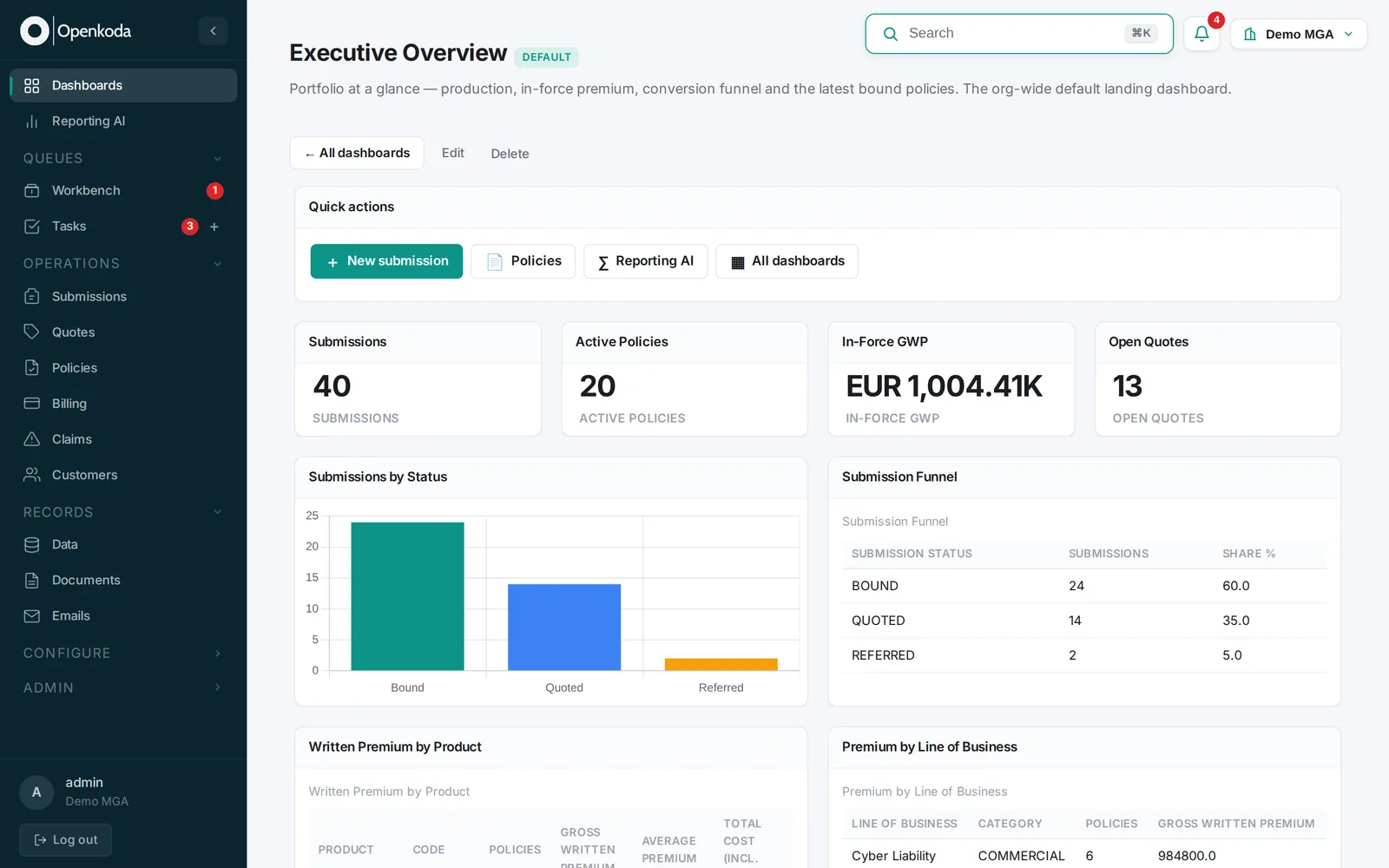
Its functionality includes the controls needed to administer live business: product versioning, role-based access, audit trails, underwriting rules, and connected policy records. Business users configure products and processes, while the Openkoda team provides deeper customization where required.
That combination suits a business that needs a complete insurance system adapted to distinctive workflows.
| Area | Openkoda PAS | Guidewire PolicyCenter and InsuranceSuite |
|---|---|---|
| Policy administration | Quoting, binding, issuance, endorsements, renewals, and cancellations | Comprehensive P&C policy lifecycle management |
| Ready functionality | 12 modules covering product configuration and insurance operations | PolicyCenter, with complementary applications including ClaimCenter and BillingCenter |
| Product customization | Configurable products, rating, rules, and workflows; AI can draft changes | Advanced Product Designer, configuration tools, and development tools |
| Business-user control | Direct configuration, visual workflows, and approval of AI-proposed changes | Business-friendly product design; further enhancements use Guidewire tooling |
| AI capabilities | AI Product Builder, Reporting AI, underwriting assistance, document extraction, and MCP connectivity | ProNavigator and broader Guidewire AI services |
| Deployment | Managed cloud or on-premises | Guidewire Cloud; existing self-managed deployments also exist |
| Data and configuration | Customer-owned configuration and data, exportable at any time | Validate export, migration, and configuration arrangements for the chosen deployment |
| Integrations | REST APIs, webhooks, built-in connections, and scoped custom integrations | Cloud APIs, product-specific APIs, and a substantial partner marketplace |
| Implementation approach | Configure an existing PAS, then add required extensions and integrations | Configure the selected applications and implement the required product and integration scope |
| Commercial model | Published: Business $2,000/month, Enterprise $4,000/month, on annual contracts | Not published; quoted per proposal. Guidewire’s own FY2026 results imply an average of roughly $2.2m per insurer per year, with implementation billed separately |
| Particularly compelling when | Product flexibility, deployment choice, and direct control over change are priorities | P&C application depth and the Guidewire ecosystem align with the insurer’s strategy |
Guidewire does not publish list prices, so the figure above is derived rather than quoted. Guidewire reported $1,242 million of annual recurring revenue at 31 July 2026 and says more than 570 insurers in 44 countries use its products, which averages to about $2.2m per insurer per year. Guidewire’s fiscal 2026 results.
Treat that as an order of magnitude, not a quote. The ARR spans InsuranceSuite, analytics and digital products rather than PolicyCenter alone, and it is spread across insurers ranging from state funds to global carriers, so the distribution around the mean is very wide. Implementation is a separate line again: Guidewire booked $269.9 million of services revenue in the same year, about 18% of its total.
Openkoda’s published prices exclude its separate AI subscription and scoped implementation work. Resource usage or additional instances can affect pricing, and on-premises terms are quoted separately. Enterprise adds capabilities including portals, multi-organization support, and MCP connectivity. See Openkoda’s pricing and plan details.
Guidewire. Guidewire deserves consideration where PolicyCenter’s P&C capabilities and the wider InsuranceSuite fit the insurer’s operating model. Existing investment in Guidewire applications, integrations, and expertise strengthens the case for expanding within that ecosystem.
Openkoda. Openkoda suits organizations whose differentiation depends on how they configure and distribute insurance products: specialty insurers, MGAs, program managers, and insurtech businesses.
Consider an MGA launching a specialist property product. Its requirements may combine unusual risk questions, specific referral thresholds, branded documents, and a partner distribution journey. Openkoda provides the operational modules around which those requirements are configured.
Its insurance product launch approach supports introducing and refining products on an existing PAS, so implementation effort concentrates on the details that make the business distinctive.
Guidewire. Guidewire’s Advanced Product Designer lets teams design, visualize, and generate insurance products using business-friendly tools and prebuilt content.
Further enhancements can involve Guidewire’s development environment. Its APD documentation describes extending generated products through PolicyCenter tools, including work on rating, underwriting rules, forms, and integrations.
Openkoda. Openkoda gives product and operations teams direct control over coverages, limits, deductibles, pricing, underwriting rules, and workflows.
The AI Product Builder extends that control. A product manager could request:
Add optional equipment cover with a £15,000 limit and refer applications above that limit to underwriting.
AI drafts the supported configuration changes and presents a before-and-after view for review. A person approves the changes before they are applied.
Product versioning preserves the configuration attached to existing policies, so new business can use updated terms without retroactively changing the in-force book.
This is the strongest practical reason to consider Openkoda: common product changes are handled by the people responsible for the product, through a defined approval process.
Guidewire. Guidewire combines policy administration with dedicated applications for claims and billing, plus additional pricing, underwriting, analytics, and digital capabilities. The breadth of that established ecosystem is its real strength, and Openkoda does not match it on a feature count.
Openkoda. Openkoda’s maturity shows in the functionality already available for implementation. Its modules cover product setup and the operational work that follows.
Those modules give customization a clear purpose: adapting established insurance functionality to the organization’s requirements.
The visual workflow automation engine, for example, can route a submission for approval, wait for payment, generate documents, and issue a policy. Teams simulate the process before activation, while cases already underway retain their original workflow version.
Guidewire. Guidewire offers AI within its insurance applications. ProNavigator provides contextual assistance, including policy summaries and answers grounded in organizational information, with permissions and traceability built into the experience.
Openkoda. Openkoda applies AI to several practical tasks around policy administration.
Alongside product configuration, Reporting AI lets a manager ask a question such as:
Show policies renewing next month, grouped by product, with their current premium.
The system generates and runs a query against the available data, returning the result with the query visible for inspection. Reports can be saved, added to dashboards, or exported.
The underwriting copilot surfaces relevant risk and pricing information during case review. Document extraction assists with capturing information from incoming files, with staff checking the proposed data.
Openkoda’s MCP server for insurance also connects compatible AI assistants to policies, claims, billing, and reports. Users request information or supported actions through conversation. Requests follow user permissions, and changes require explicit confirmation.
Guidewire. Guidewire Cloud provides managed infrastructure and connected cloud services, with ongoing investment in APIs, AI, and developer tools. It is the central direction of Guidewire’s current offering.
Openkoda. Openkoda offers a choice between managed cloud and deployment in your own environment.
On managed cloud, Openkoda handles hosting and upgrades. On-premises, the customer controls the environment and the upgrade cadence.
Products, configuration, and data remain customer-owned and exportable. Those are concrete elements of the Openkoda technology and deployment model.
For an insurer weighing long-term freedom, the value is practical: more control over where the system runs, and continued access to the configuration that represents its insurance business.
Guidewire. Guidewire has a substantial marketplace of complementary products and integrations. Its Cloud APIs support connections with external applications, including APIs generated for configured lines of business. That ecosystem is valuable where suitable integrations and experienced partners already exist.
Openkoda. Openkoda supports connections through REST APIs, webhooks, and configurable distribution journeys.
Its insurance API integrations let the same product configuration serve branded websites, embedded journeys, and partner submissions, which keeps product behavior consistent as distribution expands.
Enterprise capabilities include payment and email integrations, while connections to carrier systems, external rating services, accounting tools, or other specialist applications are scoped with the Openkoda team.
Guidewire. The implementation should be assessed against the selected applications, product portfolio, migration requirements, and integration scope. Guidewire’s consulting and implementation ecosystem provides access to specialist delivery expertise. The same assessment should cover future changes: which tasks your internal team will own, and which will need specialist support.
Openkoda. Openkoda implementations begin with a working PAS and a discussion about how it should support the business.
The engagement moves from initial scoping to product and workflow configuration, required integrations, testing, and deployment. The Openkoda team includes experienced insurance technology professionals, and offers custom development services for requirements beyond standard configuration.
A focused implementation can target around three weeks, with the delivery schedule agreed against the actual scope. Portfolio migration, complex integrations, and substantial bespoke functionality require their own estimates.
After launch, business users continue maintaining supported product and workflow configuration. That ongoing control is central to Openkoda’s value: customization stays part of operating the system.
Guidewire is a strong candidate when its P&C application depth, complementary products, and partner ecosystem fit your wider technology strategy. That case gets stronger when your organization already has relevant Guidewire expertise and integrations.
Openkoda is compelling when freedom and customizability are the leading selection criteria. It deserves close attention when you want to:
During evaluation, ask both vendors to demonstrate a realistic change using your own requirements. Introduce a new coverage, adjust a referral rule, process an endorsement, and show what happens to an existing policy.
Then ask your own team to repeat part of the process. That exercise reveals far more about usable flexibility than a long feature checklist.
Openkoda makes its case as a Guidewire alternative by combining ready operational depth with real control over customization.
Its policy administration, underwriting, claims, billing, and supporting modules provide a substantial starting point. Product configuration, AI assistance, and deployment choice give insurers room to reshape that system as the business evolves.
For organizations that value that freedom, Openkoda is a practical route to a highly bespoke PAS, and to keeping it improving after launch.
UK MGAs wrote about £7.2bn of premium in 2025, up a fifth. Lloyd's, the FCA, the PRA and the capital behind MGAs spent the same year deciding how much of it to trust.
Surplus lines grew 10.4% in 2025 while filings outran premium in 2026. What specialty products ask of a PAS, and five tests to run before you buy one.
Six of the best policy management software systems for 2026, split by what they actually do: insurance policy administration, or internal policy governance.
Book a live, personalized demo with our product team - tell us your use case and see the platform work with your data. No commitment.