UK MGA Insurance Market Report 2026
UK MGAs wrote about £7.2bn of premium in 2025, up a fifth. Lloyd's, the FCA, the PRA and the capital behind MGAs spent the same year deciding how much of it to trust.
Surplus lines grew 10.4% in 2025 while filings outran premium in 2026. What specialty products ask of a PAS, and five tests to run before you buy one.

Specialty insurance products are the ones that need particular underwriting expertise, tailored coverage, or a different way of placing and servicing the risk. Cyber, marine, aviation, environmental liability, fine art, and complex commercial property are the familiar examples.
The common thread is an exposure that a broadly standardized product struggles to fit.
The market behind them is still growing faster than the rest of P&C. AM Best's September 2026 report puts total US surplus lines premium at $143.2 billion in 2025, up 10.4%, against 5.1% for the US property/casualty industry as a whole. Surplus lines is one channel for specialty business rather than the whole of it, and these are US figures, not a global sizing.
Surplus lines grew twice as fast as the US P&C market in 2025
Direct premium written, change on 2024.
AM Best, US surplus lines report, September 2026
The slower middle bar is the detail worth noticing. US domestic surplus lines insurers grew 8.9% to $105.9 billion, which AM Best notes ended a seven-year run of double-digit growth. More detail sits in our specialty lines statistics.
Individual lines have substantial global reach too. IUMI reported $24.2 billion in marine cargo premium for 2025, up 6.9%, in its September 2026 cargo update, and was plain about where the growth came from:
The depreciation of the US dollar against European currencies has accounted for much of this growth rather than underlying market development.
Mike Brews, Chair of the IUMI Cargo Committee
Which is why a premium figure only means something read alongside pricing, exposure, and profitability.
For insurers and MGAs, the opportunity is to turn specialist knowledge into coverage that can be quoted, underwritten, and serviced efficiently. That depends on software that handles both what makes the product distinctive and the ordinary insurance operations around it.
Specialty insurance covers established classes and emerging products alike. The specialization can come from the asset, from what the policyholder does, from the coverage structure, or from the expertise needed to assess a loss.
Typical examples include cyber, aviation, marine, environmental risks, financial lines, fine art, and political risk, the spread a specialist market such as Chubb Global Markets writes. What each one asks of a system differs:
| Product area | Information and processes the system may need to support |
|---|---|
| Cyber and technology liability | Security controls, external risk assessments, business dependencies, and coverage-specific referral rules. |
| Marine and aviation | Vessel or aircraft schedules, operating territories, cargo details, changing asset values, and specialist claims handling. |
| Environmental and professional liability | Activities performed, contractual exposures, retroactive dates, coverage triggers, and tailored exclusions. |
| Specialist property and energy | Location-level exposure, construction and occupancy details, equipment schedules, and catastrophe-model inputs. |
| Fine art, valuables and collections | Item-level descriptions, valuations, storage conditions, transit arrangements, and changes to scheduled assets. |
| Political risk and trade credit | Country and counterparty exposures, contract terms, payment obligations, and portfolio concentrations. |
The software implications go well beyond adding fields to an application form. Risk information has to stay usable in rating, underwriting, documents, endorsements, claims, and portfolio reporting for the whole life of the policy.
The value of specialist cover lies in how closely it responds to the insured's actual exposure. A tailored wording, the right limit structure, or access to specialist claims expertise matters more than a convenient purchase journey.
An aviation supplier, for instance, may need its manufacturing activities, product liability, and related business exposures considered together. Chubb's aviation-supplier package does exactly that, as one multi-line policy with specialist coverage sections and extensions.
For the insurer, delivering that fit consistently means keeping the underwriting decision, the contractual terms, and the operational records aligned as the risk changes.
Specialty insurers face a demanding combination: detailed underwriting, products that keep changing, and pressure on the cost of every transaction.
The latest US stamping-office figures show the tension. Across the 15 reporting states, WSIA's midyear 2026 figures put first-half surplus lines premium at $47.6 billion, up 2.8%, while items filed rose 16.9%.
In 2026 filings kept climbing while premium growth stalled
Surplus lines business reported to the 15 US stamping offices, first half on prior-year first half.
WSIA stamping office midyear reports, 2025 and 2026
A year earlier the two moved together. These are filing counts, not newly issued policies, but the split suggests administrative activity can grow far faster than the premium paying for it.
The main challenges include:
Specialty Insurance Products: The Main Operational Challenges
The last of those is the one launch budgets miss. Repeated document preparation, rekeying, and reporting corrections can consume the margin on a niche product, so servicing costs deserve as much attention as the cost of getting it live.
Start by separating the insurance operations you need from the requirements that make your product distinctive. Quotation, issuance, endorsements, renewals, billing, and document generation are established functions. Your differentiation sits somewhere else: a particular risk model, a rating approach, a referral process, or a distribution partnership.
That makes a highly customizable PAS a strong starting point for many specialty programs. Openkoda takes this approach: ready policy administration and supporting insurance modules, configured and extended around the product, so the implementation team starts from a working operational system.
A custom build can be justified where essential requirements fall outside what any available system does, and general-purpose development tools can support the applications around it. Either way, price in the work of maintaining insurance transactions, historical versions, integrations, and audit records for years.
When evaluating a PAS, run five practical tests:
The strongest demonstration uses your own product and its awkward cases.
It should leave you knowing what is already supported, what needs configuration, and what needs additional development.
Openkoda is a highly customizable policy administration system with ready modules for underwriting, rating, policy servicing, claims processing, billing, document generation, and reporting. Specialty insurers use that functionality as it stands and tailor the data, rules, and workflows around their book. The full Openkoda feature set is published.
The practical value is a more focused implementation. The work concentrates on how the product should operate: the information collected, the decisions referred, the documents issued, and the partners connected. The Openkoda team provides configuration support and custom development for requirements that need deeper changes.
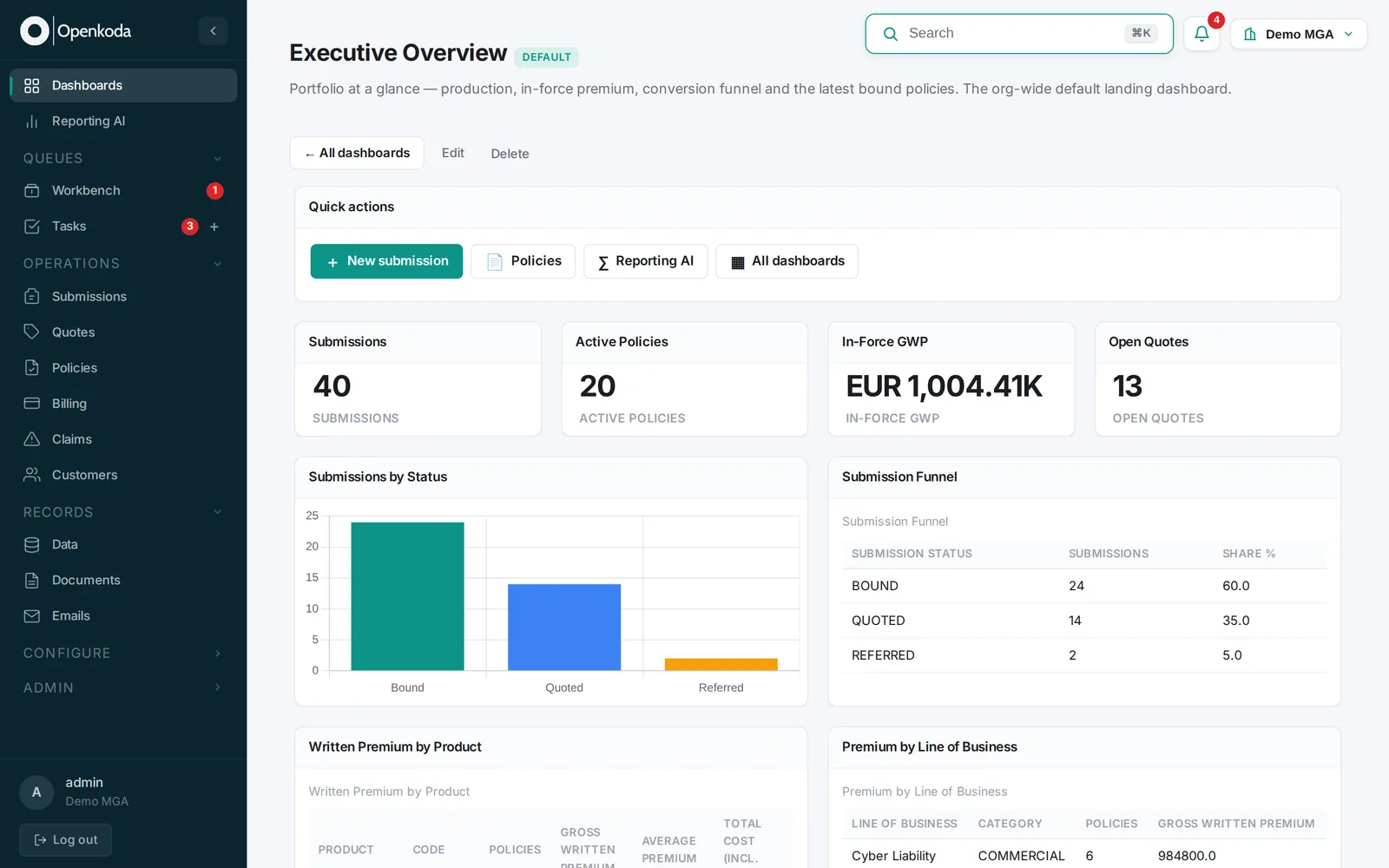
An equipment insurer wants to add an optional coverage and refer any submission requesting a limit above a set threshold. A product manager describes the coverage, the limit, and the referral rule to the AI Product Builder, reviews the configuration it proposes, and tests it before publication.
After launch, the team asks Reporting AI for last month's referrals by broker and product version, provided those fields are captured. That shows quickly whether the revised product is creating underwriting work nobody planned for.
The team still sets the appetite, approves the terms, and interprets the results.
AI features run on a separate subscription, and product setup, integrations, and any additional development are agreed as part of the implementation scope. Openkoda plans and pricing are published.
Specialty insurance rewards a precise understanding of risk and the ability to turn that expertise into a workable product. The right software keeps underwriting decisions, contractual terms, and daily operations connected as the business changes. Judge it on the complexity of servicing the book as carefully as on the speed of launching it.

UK MGAs wrote about £7.2bn of premium in 2025, up a fifth. Lloyd's, the FCA, the PRA and the capital behind MGAs spent the same year deciding how much of it to trust.
Six of the best policy management software systems for 2026, split by what they actually do: insurance policy administration, or internal policy governance.
What to actually test in a mutual insurer's policy, claims, billing, portal and reporting systems, and which platforms are worth a shortlist.
Book a live, personalized demo with our product team - tell us your use case and see the platform work with your data. No commitment.