Custom Insurance Software Development: Pros, Cons & Best Practices
Where a bespoke insurance build earns its cost, where a configurable PAS gets there sooner, and what the next product change will cost you either way.
What insurance claims management software is, its must-have features, ready-made vs. custom approaches, and the key criteria for choosing the right platform.

Insurance claims management software is a specialized tool designed to streamline and automate the process of handling insurance claims from initial notification to final resolution.
These systems serve as the operational backbone of claims departments, enabling insurers to process individual claims faster, more accurately, and with greater transparency and operational efficiency.
At its core, this type of software helps insurers receive, assess, track, and settle claims – all within a single, integrated platform.
The goal is to reduce manual work, eliminate paperwork, and create a smoother experience for internal teams and improve customer satisfaction.
As the claims routing process and investigation unfolds, the system keeps every data point – from photos and medical bills to repair‑shop estimates – tethered to the same record. Adjusters don't need to hunt for documents or re‑key information; APIs fetch everything from vehicle‑valuation services to medical‑bill review vendors, ensuring evidence is both complete and auditable.
Once the investigation is complete and the payout is approved, the system can automatically trigger payment processing and close the case.
A modern claims platform automates the grunt work, from FNOL intake to payment. It lets adjusters spend their time on judgment calls, not data entry, cutting average cycle time by days.
Michalina Stark, Business Analyst at Openkoda
In the insurance world, claims are where promises are tested.
For policyholders, it's often the only time they truly interact with their insurer.
That's why the claims handling process plays such a central role in shaping the customer experience – and ultimately, the reputation of the company.
Modern claims processing software helps insurers deliver on these promises.
A digital, well-orchestrated claims workflow minimizes delays, reduces errors, and ensures every claim is handled with consistency and care. It also helps insurers maintain full control over sensitive customer data, ensuring compliance with regulatory requirements and safeguarding policyholders' trust.
Customer satisfaction hinges on speed, clarity, and fairness.
If the claims process process is slow, confusing, or filled with repetitive paperwork, frustration builds fast. On the other hand, a smooth and transparent claims experience, where communication is clear, updates are automatic, and payouts are handled promptly, leaves a lasting positive impression.
In many ways, the claims department is the frontline of your brand.
With modern claims software, insurers can not only meet expectations but often exceed them.
Effective claims management software supports the entire journey from reporting a loss to settlement and recovery. When comparing systems, look for features that help adjusters make informed decisions, keep customers updated, and maintain control over claims costs.
Digital intake lets customers and brokers report losses, upload evidence, and provide essential details without lengthy email exchanges. Look for forms that adapt to the claim type, identify missing information, and create a claim record ready for the next step.
Adjusters need access to the policy terms that apply to the reported loss, including relevant dates, limits, deductibles, and endorsements. The system should support coverage checks and flag cases that need closer review before processing continues.
Different claims require different handling. Configurable workflows should route cases according to complexity, exposure, workload, and staff authority. Teams should also be able to set approval stages, reminders, and escalation rules, and test changes before applying them to live claims.
Keep photographs, estimates, correspondence, adjuster notes, and supporting documents together in a searchable claim file. Version histories and clear document ownership help teams work from the right information when several people contribute to a case.
Look for tools to establish reserves, record adjustments, and track the reasons behind financial changes. Recovery management should also cover money recovered from responsible third parties and proceeds from damaged assets, helping insurers understand the final net cost of each claim.
AI can help extract information from documents, summarize claim histories, and draft correspondence. Evaluate how handlers review and correct these outputs, whether supporting information remains accessible, and where human approval is required. Openkoda’s insurance AI capabilities illustrate how these functions can fit into everyday workflows.
Claims software should help teams flag suspicious cases, record supporting evidence, and refer claims for specialist investigation. Check whether fraud screening is built in or requires an external service, and how investigation findings return to the claim file.
Managers need visibility into outstanding claims, settlement times, reserve changes, recovery results, and adjuster workloads. Configurable dashboards should let teams investigate the records behind a metric. Natural-language reporting can make this information accessible to colleagues who do not write database queries.
Customers should receive consistent updates through their preferred channels, with correspondence saved against the claim. Self-service access can reduce routine status enquiries. Payment capabilities should connect settlement approvals with disbursement and make payment status visible to the people handling the case.
Evaluate connections to policy administration, finance, payment providers, document services, and external assessors. Well-designed integrations should keep records synchronized and surface failed transfers so teams can resolve them before they delay a claim.
Access controls should reflect each person’s responsibilities, including external partners. Look for a clear history of changes to claim records, decisions, reserves, and payments. Confirm that the system can provide the evidence your internal reviewers and auditors need.
The right shortlist depends on your insurance products, claims complexity, and existing technology. These five systems offer different approaches to managing claims, from dedicated claims applications to broader insurance systems with integrated claims capabilities.
Guidewire ClaimCenter supports property and casualty insurers throughout the claims lifecycle, from intake to closure. It combines claims handling with automation, analytics, and embedded guidance for adjusters, making it a candidate for insurers managing complex operations across multiple products.
Key features:
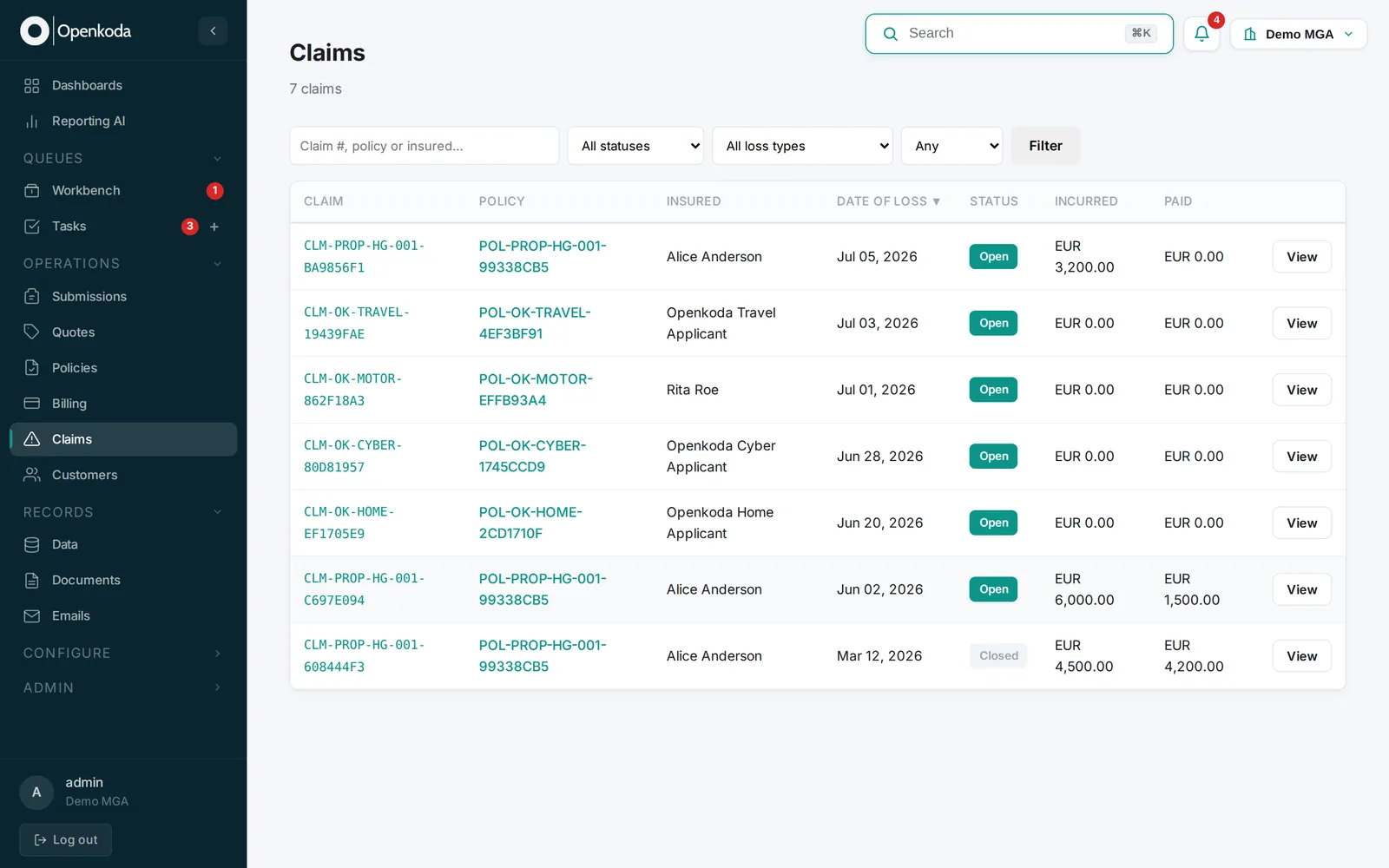
A straightforward motor claim and a complex commercial loss need different processes. Openkoda gives insurers the flexibility to build both within a policy administration system (PAS) with a deeply configurable claims module.
Teams can tailor claim types, statuses, routing rules, and workbench layouts to their operations. The claims module supports the journey from intake and coverage verification through reserving, approvals, settlement, and recoveries. Alongside Openkoda’s policy, underwriting, and billing modules, it gives insurers a connected system for their day-to-day work.
Key features:
Duck Creek Claims is a cloud-delivered claims system for property and casualty insurers. It supports configurable handling across the claims lifecycle, allowing insurers to automate suitable low-complexity cases and route more demanding claims to adjusters.
Key features:
Origami Risk offers configurable claims administration with tools for intake, investigation, financial management, and closure. Its coverage verification, recovery tracking, and quality assurance capabilities make it worth considering for organizations seeking detailed oversight of claims handling.
Key features:
Snapsheet combines claims handling, communications, and financial activity in one workspace. Its no-code workflow tools let teams configure processes using rules and conditions, while integrations connect the application with existing systems and external providers.
Key features:
The five sit in different places. This table is a summary of where each one tends to fit, not a score.
| System | Best suited to | Claims scope | How it is configured |
|---|---|---|---|
| Guidewire ClaimCenter | P&C insurers running complex operations across several products | Full lifecycle, intake to closure, with adjuster guidance built in | Vendor and partner configuration, plus a marketplace of applications |
| Openkoda | Insurers and MGAs whose handling differs by product or programme | Claims module inside a wider policy administration system | Configured by the business, with a visual workflow engine and AI assistance |
| Duck Creek Claims | P&C insurers automating high volumes of low-complexity claims | Full lifecycle, cloud delivered | Configurable rules for assignment, tasks and escalation |
| Origami Risk | Teams that want close oversight of handling quality | Intake, investigation, financial management, closure and audits | Configurable, with connected data sources for coverage checks |
| Snapsheet | Teams wanting handling, correspondence and payment in one workspace | Claims handling, communications and disbursement together | No-code workflow rules and conditions |
One thing worth saying plainly, since this list sits on our own site. Openkoda does not carry the accumulated claims functionality of a suite like ClaimCenter, and on a feature-count comparison against one it does not win. What it offers instead is a claims process shaped to your products with no ceiling on customization, and your configuration and data exportable at any time. That is the right trade for some claims teams and the wrong one for others.
Start with the claims your team actually handles. Ask shortlisted vendors to demonstrate a routine case, a complex exception, and a claim requiring several approvals. This makes it easier to judge how the software will work in practice.
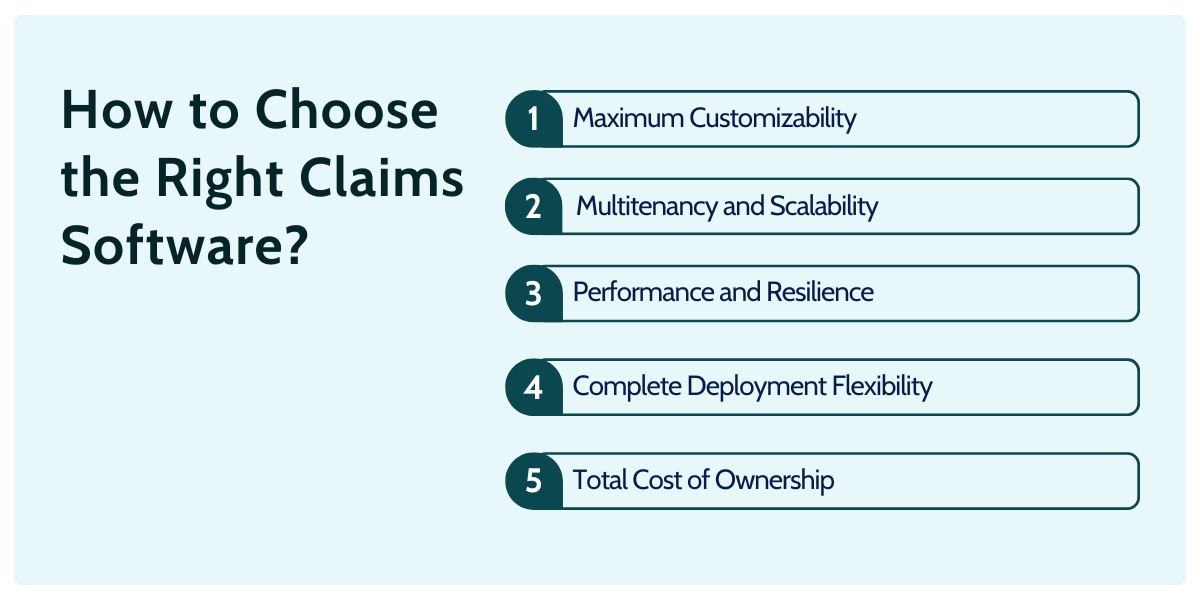
Your system should accommodate your products, authority limits, and handling procedures. Check which changes your team can make directly and which require development support.
Ask the vendor to demonstrate a workflow change, including testing and approval. Also establish how customizations are maintained when the software is upgraded.
Consider both business growth and sudden increases in demand. A catastrophe can bring more claims, documents, customer enquiries, and simultaneous users.
Evaluate how the system handles that combined workload, how additional capacity becomes available, and what it costs. Include external adjusters and service providers in your planning.
Test everyday activities such as searching for a claim, opening documents, updating reserves, and approving payments under realistic workloads.
Request clear service commitments, documented backup procedures, and evidence of recovery testing. Agree on acceptable downtime and data loss for your operation before signing a contract.
Choose a deployment model that fits your security requirements, data location needs, and internal resources. Confirm which cloud or on-premise options the vendor actually supports.
Clarify who manages updates, backups, monitoring, and incident response. Make sure you can export your records and documents in usable formats if your needs change.
Compare the full cost of implementation and ongoing operation. Include data migration, integrations, configuration, training, support, storage, upgrades, and any additional AI charges.
Model costs at your current volume and during a busy claims period. Understand how pricing changes as you add users, partners, claims, or new products, and what future modifications will cost.
Where a bespoke insurance build earns its cost, where a configurable PAS gets there sooner, and what the next product change will cost you either way.
What a life PAS has to do over a policy that runs for decades, five systems worth shortlisting, and the three things to test before you sign.
UK motor rejects about 1% of claims. US homeowners closes 31% without payment. The gap is mostly definitional, not behavioural.
Book a live, personalized demo with our product team - tell us your use case and see the platform work with your data. No commitment.