UK MGA Insurance Market Report 2026
UK MGAs wrote about £7.2bn of premium in 2025, up a fifth. Lloyd's, the FCA, the PRA and the capital behind MGAs spent the same year deciding how much of it to trust.
Definition, key features, and buying advice for insurance policy management software, plus how custom, off-the-shelf, and insurtech platform approaches compare.

Policy management software is the backbone of modern insurance operations.
At its core, it's a centralized system designed to handle the entire lifecycle of an insurance policy – from initial issuance to renewal or cancellation. It acts as a central location for all policy data, documents, and processes, enabling insurers to deliver accurate, compliant, and timely services to policyholders.
In practical terms, a policy management system (PMS) ensures that all policy-related activities – underwriting, endorsements, premium billing, claims linkage, compliance tracking, and customer communication – are streamlined and connected. This reduces manual work, minimizes errors, and creates a single source of truth for the business, especially compared to old, unoptimized legacy systems, and Excel sheets – a way that a surprising amount of insurers still run their business still in 2025.
From an industry perspective, the key aspects of effective policy management software include:
For insurers, brokers, and MGAs, the value of a PMS lies not only in operational control but also in its ability to integrate with other systems – CRM, claims management, payment gateways, or analytics tools – creating a connected ecosystem that supports both strategic decision-making and day-to-day execution.
While every insurer's needs will vary depending on product lines, distribution channels, and operational scale, there are core capabilities that any robust policy management system should offer.
These features ensure that policies are issued, maintained, and serviced efficiently, while keeping risk under control and maintaining full regulatory compliance.
A strong policy management system provides a structured way to store, organize, and retrieve all policy-related documents in one central location. This includes policy schedules, endorsements, renewal notices, and communication records. Advanced systems also support version control, ensuring users always have access to the latest approved document while retaining an auditable history of changes.
This module links policy data with customer profiles, giving underwriters, agents, and service teams a complete view of the insured's history. From basic contact details to full coverage portfolios, it helps the entire organization deliver consistent service, improve retention, and spot opportunities for cross-sell or upsell.
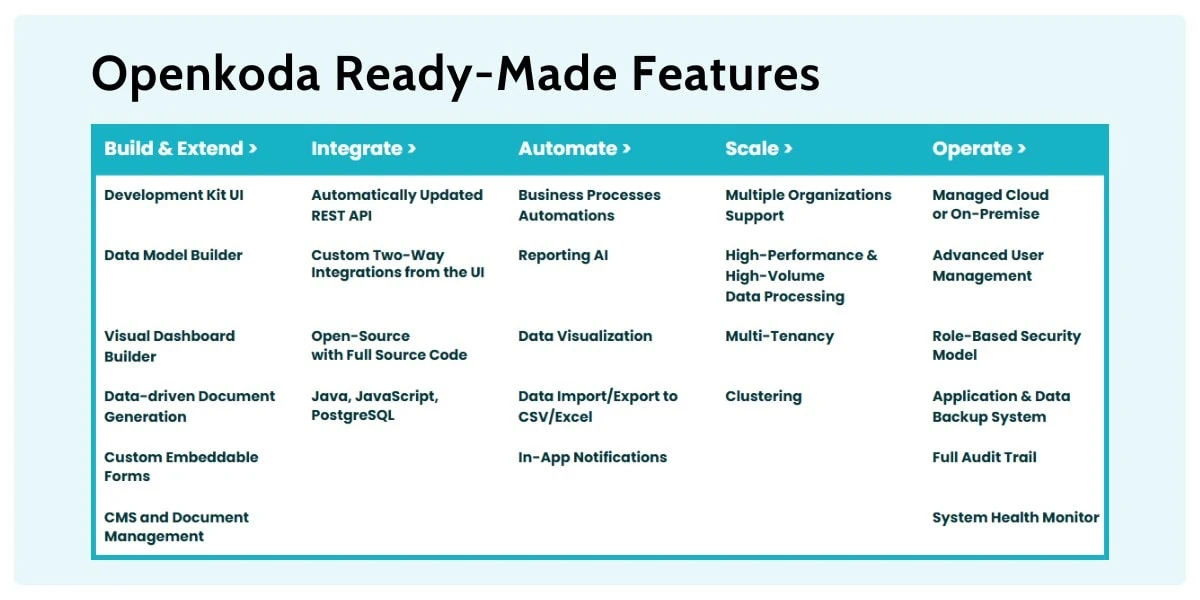
Built-in analytics capabilities allow insurers to track key metrics such as premium growth, lapse rates, and claims ratios. Increasingly, insurers are adopting AI-powered tools to enhance this process – for example, Reporting AI by Openkoda uses large language model (LLM) technology to generate SQL queries for tailored reports without manual data mining. This not only accelerates decision-making but also makes advanced analytics accessible to non-technical team members.
By automating the review process for applications, eligibility checks, and pricing, a policy management system accelerates time-to-quote and reduces manual errors. Underwriters can focus on complex cases while standard risks move quickly through automated insurance workflows.
Integrated payments and billing functionality ensure accurate premium collection and reduce administrative overhead. Features like automated reminders, flexible billing schedules, and reconciliation tools keep the process efficient and transparent for the entire organization.
For compliance and governance, an audit trail records every change made to a policy - who made it, when, and why. This supports the review process during audits and gives full visibility into the policy's history.
No piece of insurance software lives on its own. In practice, it's part of a network of systems – claims management, CRMs, accounting tools, rating engines, customer portals – that need to "talk" to each other efficiently. Modern policy management solutions use API integrations to connect these systems, ensuring smooth data exchange, eliminating duplicate entry, and keeping all teams aligned through one central location for reliable, up-to-date information.
Choosing the right approach to policy management technology is all about balancing cost, speed to market, flexibility, and long-term control. Insurers typically have three main options: ready-made solutions, fully custom software, or modern insurtech platforms that blend the best of both worlds.
Ready-made policy management software comes pre-built with core features, allowing insurers to get up and running quickly. It's a popular choice for smaller organizations or those with less complex product lines.
Pros:
Cons:
On the other side of the spectrum, we've got custom policy insurance software development.
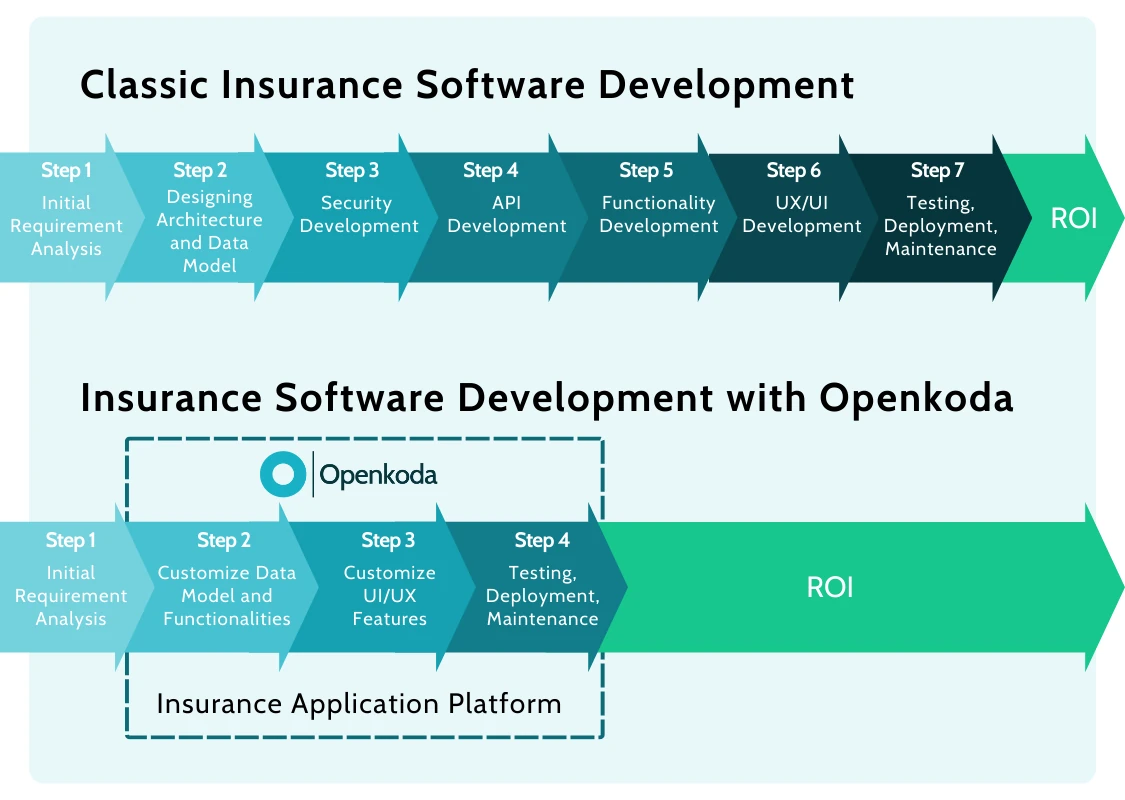
A custom-built policy management application is tailored exactly to your products, workflows, and compliance requirements. It can be designed to fit the way your entire organization works, from underwriting to claims linkage. However, this precision comes with trade-offs: development can take many months (or years) and requires significant financial investment, as well as ongoing resources for updates, security, and maintenance.
Modern insurtech platforms, such as Openkoda, offer a compelling alternative to the two extremes of ready-made and fully custom software. They are built to launch quickly while still allowing insurers to shape the system to their exact requirements over time but up to 60% faster compared with greenfield development.
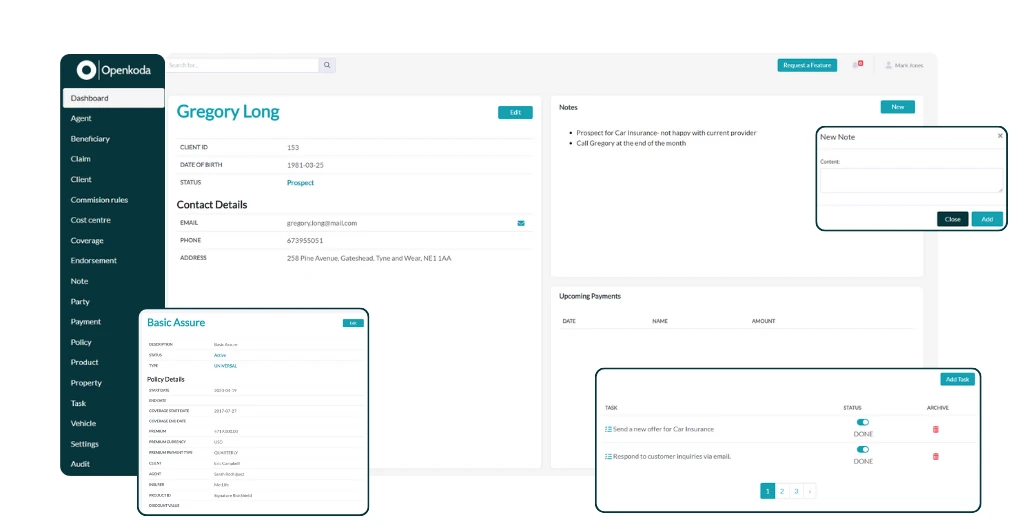
Instead of starting from scratch, you get a functional policy management environment from day one, complete with essential capabilities like document handling, quoting, billing, and analytics – all designed to be extended and reconfigured without costly rebuilds.

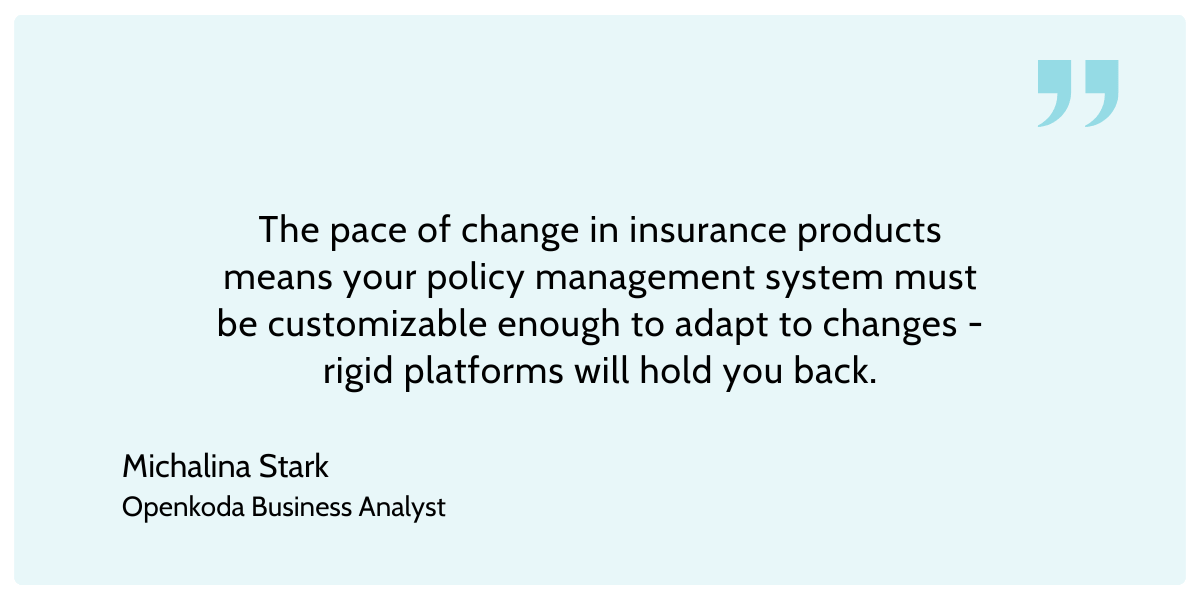
Unlike rigid off-the-shelf products, these systems are designed to evolve, supporting new distribution channels, product variations, or regulatory changes without forcing a complete technology overhaul.
Another significant advantage is control. With platforms like Openkoda, insurers don't just rent software – they own the products, rules and data they configure in it. It means that their software is truly theirs, build upon a popular enterprise-grade tech stack, they can customize it, deploy and do with it whatever they want – there's no such option with ready made SaaS policy management application.
In short, modern insurtech platforms combine the speed to market of ready-made solutions with the customization and ownership benefits of custom development. They offer a practical, scalable approach to building a robust policy management system without sacrificing agility or long-term control.
Selecting the best policy management software is not just about picking the system with the most features – it's about ensuring the technology aligns with your current operations and can grow with your business.
The insurance market is dynamic, with changing customer expectations, evolving regulatory demands, and constant product innovation. The software you choose should be able to keep pace with all of that.
When evaluating options, pay particular attention to these three factors:
A well-chosen policy management system streamlines everything from policy creation to renewals, ensuring accurate data and smooth workflows. With easy access to key information across teams, insurers can respond faster to market changes and customer needs. The right platform acts as a foundation for long-term operational efficiency and growth.
UK MGAs wrote about £7.2bn of premium in 2025, up a fifth. Lloyd's, the FCA, the PRA and the capital behind MGAs spent the same year deciding how much of it to trust.
Surplus lines grew 10.4% in 2025 while filings outran premium in 2026. What specialty products ask of a PAS, and five tests to run before you buy one.
Six of the best policy management software systems for 2026, split by what they actually do: insurance policy administration, or internal policy governance.
Book a live, personalized demo with our product team - tell us your use case and see the platform work with your data. No commitment.