UK MGA Insurance Market Report 2026
UK MGAs wrote about £7.2bn of premium in 2025, up a fifth. Lloyd's, the FCA, the PRA and the capital behind MGAs spent the same year deciding how much of it to trust.
How automated underwriting systems work, why fast customization matters, their key benefits and limitations, and the future role of human underwriters.

Underwriting is the silent core of every insurance carrier. It determines whether the organization will write profitable business or slowly accumulate hidden risk. Yet much of today's underwriting still runs on email threads, desktop spreadsheets and lengthy referral chains.
The result? Cycle times measured in days (sometimes weeks), inconsistent decisions, and a frustrating experience for both distribution partners and end customers.
What if those friction points could be removed without sacrificing control? That is the promise of an Automated Underwriting System (AUS).
At its core, an Automated Underwriting System (AUS) is designed to streamline and partially or fully digitize the decision-making process. Whether it's personal lines, commercial policies, or even parametric coverage, automation is changing how insurers evaluate applications in a big way. It allows carriers to respond faster, underwrite more consistently, and scale without proportionally increasing operational costs.
Why does speed matter? These days policyholders can abandon applications at the first sign of friction, and competitors with faster quote‑to‑bind workflows gradually capture market share. Shaving even a single day off the decision window can add measurable premium and lift conversion rates, particularly in small commercial and personal lines where margins are thin and volumes are high.
In this article we will unpack how automated underwriting engines actually work, why rapid development cycles have become possible, and which business outcomes executives should expect.
Automated underwriting systems (AUS) operate at the intersection of data, rules, and decision intelligence. Their primary function is to assess risk and make underwriting decisions: making credit risk assessments, improving the loan process, and enhancing decision accuracy.
But what actually happens under the hood?
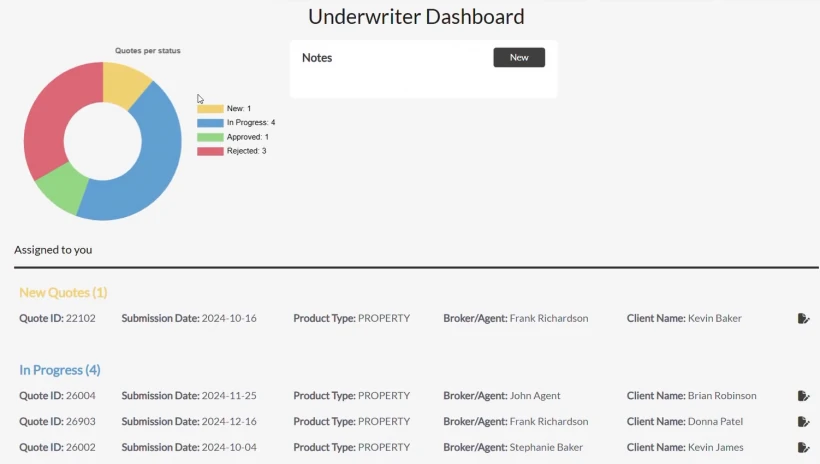
At a high level, the process begins when an application is submitted - either by an agent, broker, or directly by the customer.
The process starts with applicant data, and lots of it.
Application answers arrive through APIs, but also through OCR on scanned forms or RPA wrappers around legacy terminal interfaces (often referred to as 'green‑screen terminals') - whatever keeps the submission flowing. An enrichment engine then pulls in third‑party signals: credit bands, telematics pings, IoT sensor streams, geospatial hazards, payroll data, you name it.
This customer data is normalized, evaluated, and fed into a set of predefined business rules and scoring models.
These calculation rules, crafted by actuaries, underwriters, and product teams, reflect the carrier's risk appetite, underwriting guidelines, and regulatory constraints, and can be adjusted if the risk profile changes.
The system then outputs two figures executives care about: expected loss ratio and probability to bind.
Ultimately, the power of automated underwriting lies in its ability to replicate expert-level decisioning at scale, while preserving auditability, transparency, and control.
Ask any chief underwriter what slows their team down and you'll hear something along the lines of: "The tool doesn't match our workflow."
Every carrier has its own rating factors, referral trees, data providers and tolerance for risk.
Force‑fitting those nuances into a generic platform only shifts the bottleneck from spreadsheets to makeshift work‑arounds.
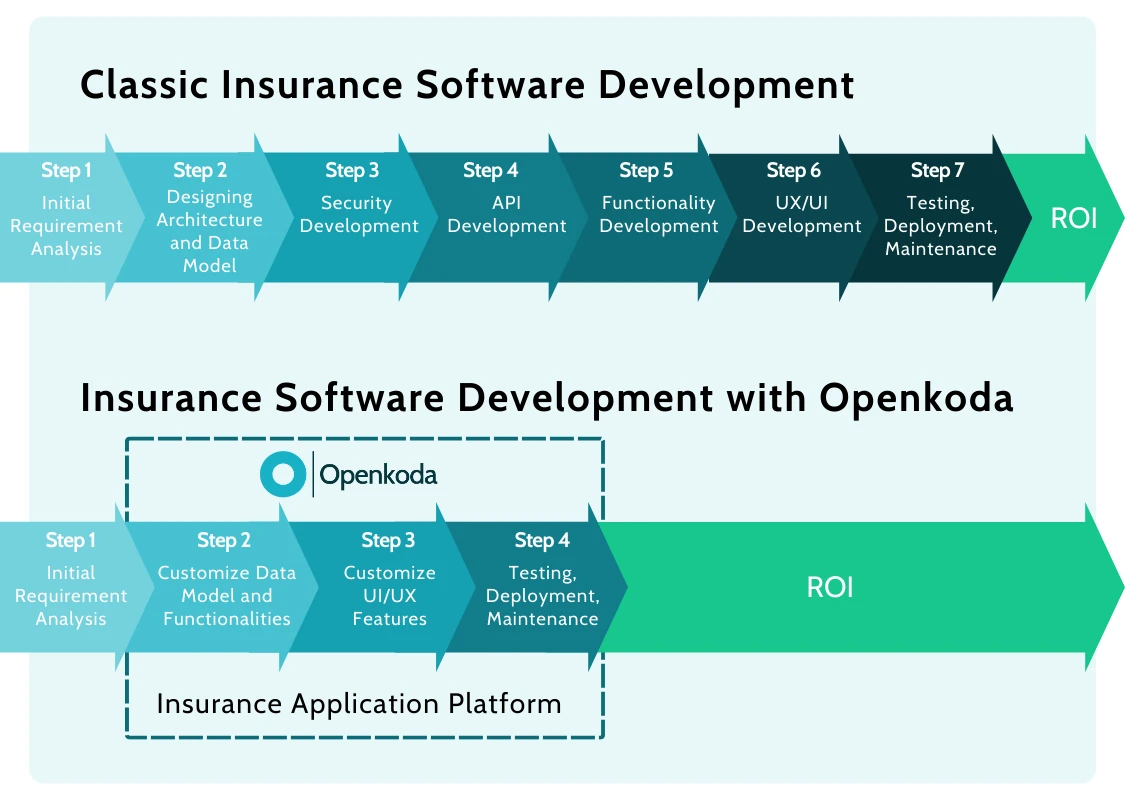
Historically, tailoring a system to that degree meant a multi‑year core‑replacement project. Today the bar is higher: markets move faster, product cycles are shorter, and capacity providers expect instant MI.
If your digital roadmap still measures releases in quarters, you are already losing ground.
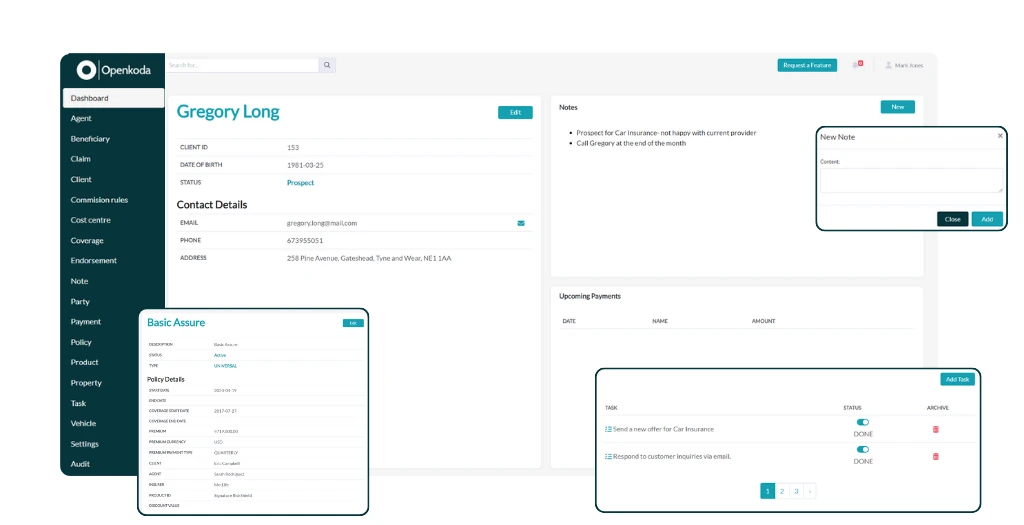
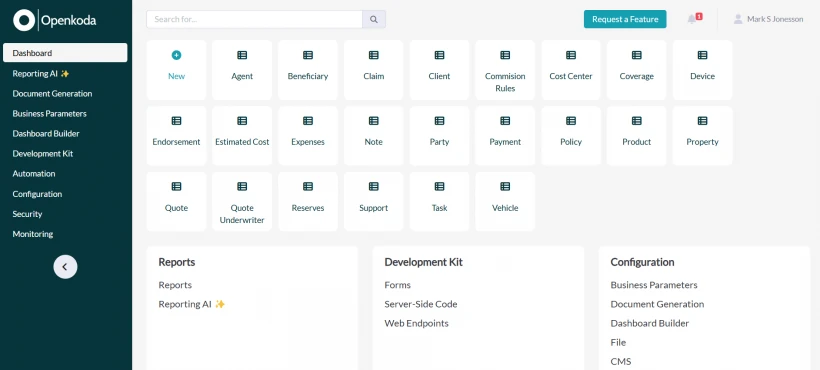
However, in 2025 platforms like Openkoda are revolutionizing the way insurers build custom insurance apps by offering pre-built components that serve as building blocks for creating tailored underwriting dashboards.
Openkoda provides a robust foundation that includes essential features such as:
Openkoda's platform is designed with flexibility and scalability in mind. Its configuration-first design and modular architecture allow insurers to build insurance applications faster and scale their systems as their business needs evolve.
This approach also reflects a broader industry trend: insurers are modernizing their legacy insurance software on a large scale and moving away from obsolete monolithic architectures.
The pressure to bring niche insurance products to market quickly and to respond to shifting customer expectations has made speed and adaptability a strategic priority.
As discussed earlier, platforms like Openkoda allow insurers to develop tailored systems rapidly.
But what does this translate to in real-world outcomes?

Now let's zoom out and quantify the upside once those dashboards are live in production.
In the lending industry, speed, accuracy, and consistency in decision-making are essential.
Automated underwriting systems play a key role in evaluating a borrower's credit risk with greater precision and speed than manual methods.
By instantly pulling data from credit reporting agencies and assessing an applicant's credit report, income details, and historical behavior, the system can generate a decision or risk score within seconds.
Speed is money when a bank or insurer fights to keep an applicant from shopping around.
An AUS collapses the loan approval process from days to minutes by clearing the low‑risk tier without waiting for human underwriters.
A smart queue then flags only edge cases for a loan officer review, breaking the legacy pattern where every file waited in the same pile.
Human underwriters are still involved, especially in edge cases or higher-risk scenarios, but their role shifts from processing all loan applications to oversight over the automated process, focusing on quality assurance and complex decision-making where experience and judgment matter most.
Automated systems make it easier to track, audit, and refine risk models over time. Because every decision is data-driven and logged, insurers and lenders can perform retrospective analysis to identify trends or anomalies in borrower behavior.
Moreover, built-in alerts and scoring mechanisms can flag potentially fraudulent or high-risk applications early in the process - before resources are spent on deeper underwriting or loan origination.
Each automated decision carries a machine‑readable explanation: which rule fired, which model scored the risk, who overrode it, and why.
When regulators or reinsurers knock, compliance teams can export a complete audit file in seconds instead of stitching one together from e‑mail trails. Fines avoided and reputation protected, both hard to see in a spreadsheet, but painfully obvious in hindsight.
By automating routine underwriting tasks, organizations free up skilled personnel to focus on strategic initiatives or more complex cases.
This optimization leads to cost savings, higher employee satisfaction, and the ability to scale operations without a linear increase in staffing.
In sectors like consumer lending or insurtech-driven microinsurance, where volume is high and margins are tight, operational efficiency is not just a bonus - it's a requirement for viability.
While automated underwriting systems offer undeniable advantages in speed, scalability, and consistency, they are not without challenges. For insurers and lenders considering or already implementing such systems, it's essential to understand the practical limitations and risks involved.
Insurance automation is a powerful tool - but like all tools, it must be used thoughtfully and with clear boundaries.
Some of the most pressing challenges include:
Will the algorithm finally replace the underwriter?
The short answer is no, at least not any time soon.
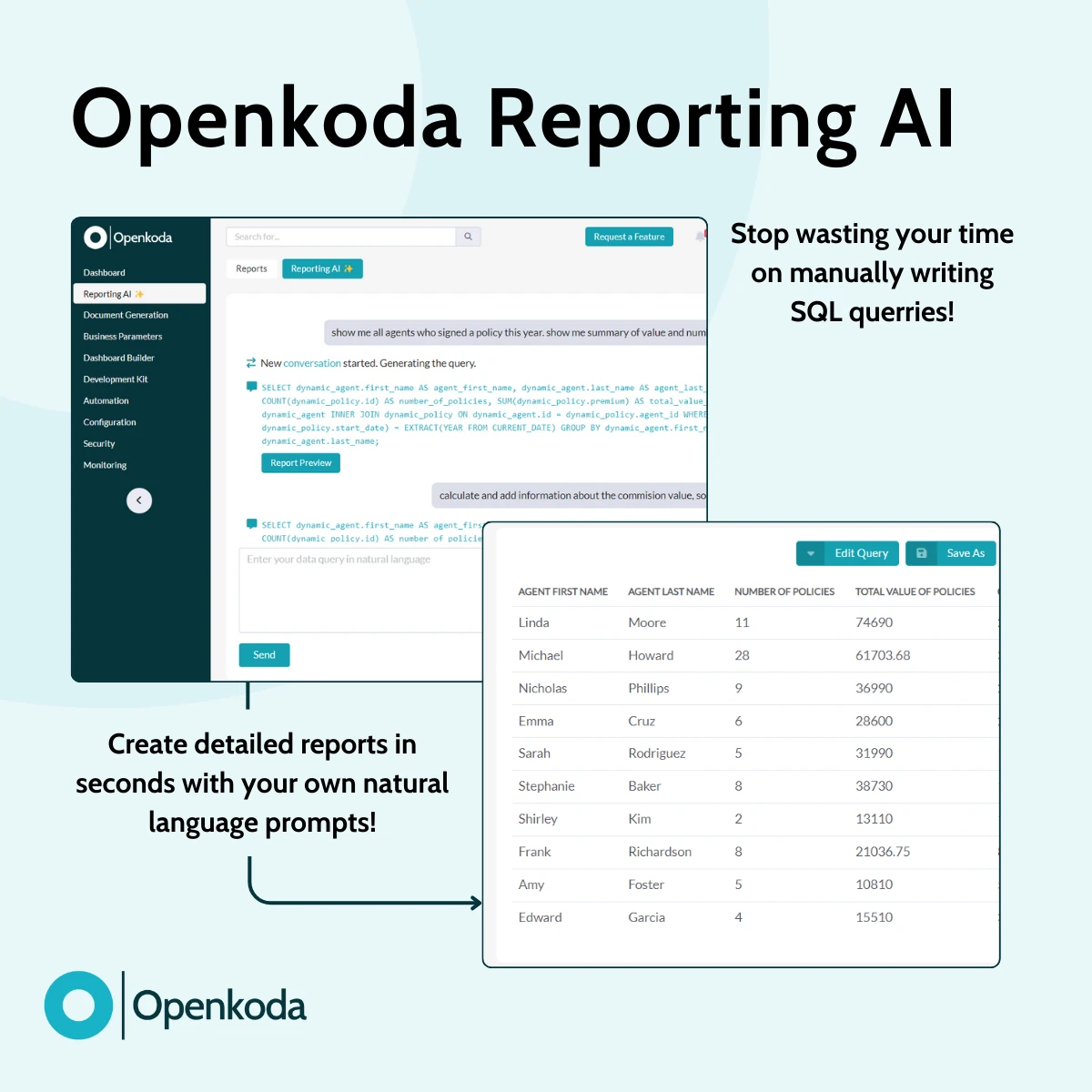
AI reporting tools are already parsing submissions, merging an applicant's credit report with telematics, satellite imagery and unstructured notes, then drafting the coverage rationale or loan memorandum in seconds.
McKinsey estimates the productivity prize at nearly $1 trillion a year for global banking and several hundred billion for insurance once AI is scaled across front‑ and back‑office decision flows.
Deloitte's 2025 survey of U.S. carriers shows three‑quarters have a generative‑AI pilot in underwriting, yet nearly all retain mandatory human sign‑off loops to satisfy board‑level risk appetites and growing regulatory scrutiny.
Supervisors are heading the same way: the IAIS draft Application Paper on AI supervision and state rules such as New York DFS Circular 7 explicitly require a human‑in‑the‑loop for high‑impact decisions.
The emerging consensus is therefore augmentation, not replacement: algorithms will handle 80‑90 % of routine submissions, surface anomalies and explain their reasoning, while seasoned underwriters and credit officers concentrate on edge cases, portfolio steering and ethical governance.
In that world, AI doesn't replace the human but rather it elevates them.
UK MGAs wrote about £7.2bn of premium in 2025, up a fifth. Lloyd's, the FCA, the PRA and the capital behind MGAs spent the same year deciding how much of it to trust.

Surplus lines grew 10.4% in 2025 while filings outran premium in 2026. What specialty products ask of a PAS, and five tests to run before you buy one.
Six of the best policy management software systems for 2026, split by what they actually do: insurance policy administration, or internal policy governance.
Book a live, personalized demo with our product team - tell us your use case and see the platform work with your data. No commitment.