UK MGA Insurance Market Report 2026
UK MGAs wrote about £7.2bn of premium in 2025, up a fifth. Lloyd's, the FCA, the PRA and the capital behind MGAs spent the same year deciding how much of it to trust.
Ten AI-powered reporting tools reshaping data analysis in 2026, from Openkoda AI Reporting and Tableau to Domo, Glean and ChatGPT.

The world of data reporting is evolving - fast. What was once the domain of spreadsheets, static dashboards, and manual number crunching is now being reshaped by the rising tide of artificial intelligence.
In 2026 AI reporting is entering a phase that it's widely accessible and can provide real and tangible value to analysts.
Where traditional reporting methods relied heavily on analysts interpreting charts and tables, today's systems use machine learning algorithms to uncover patterns, surface trends, and even predict future outcomes. Artificial intelligence is being used not only to accelerate how data is processed, but to enhance the way it's understood and acted upon.
AI can now generate real-time summaries of complex data sets, flag anomalies automatically, and answer business questions phrased in everyday language. Need a breakdown of regional sales performance or customer churn indicators? A modern AI report generator can deliver that in seconds.
Perhaps most importantly, AI reporting tools democratize access to insights.
They remove the technical barriers that once separated business users from raw data. Instead of waiting days for a custom report, teams can now ask their systems directly - and get actionable insights in real time.
What follows is a curated list of ten AI-powered reporting tools leading the charge in 2026.
Each offers a different perspective on how artificial intelligence is redefining data analysis and reporting workflows.

Openkoda AI Reporting is part of Openkoda's broader suite of enterprise-ready features such as claims and policy management templates and embedded insurance designed to accelerate digital transformation and data analysis - particularly in highly regulated, process-heavy industries like insurance.
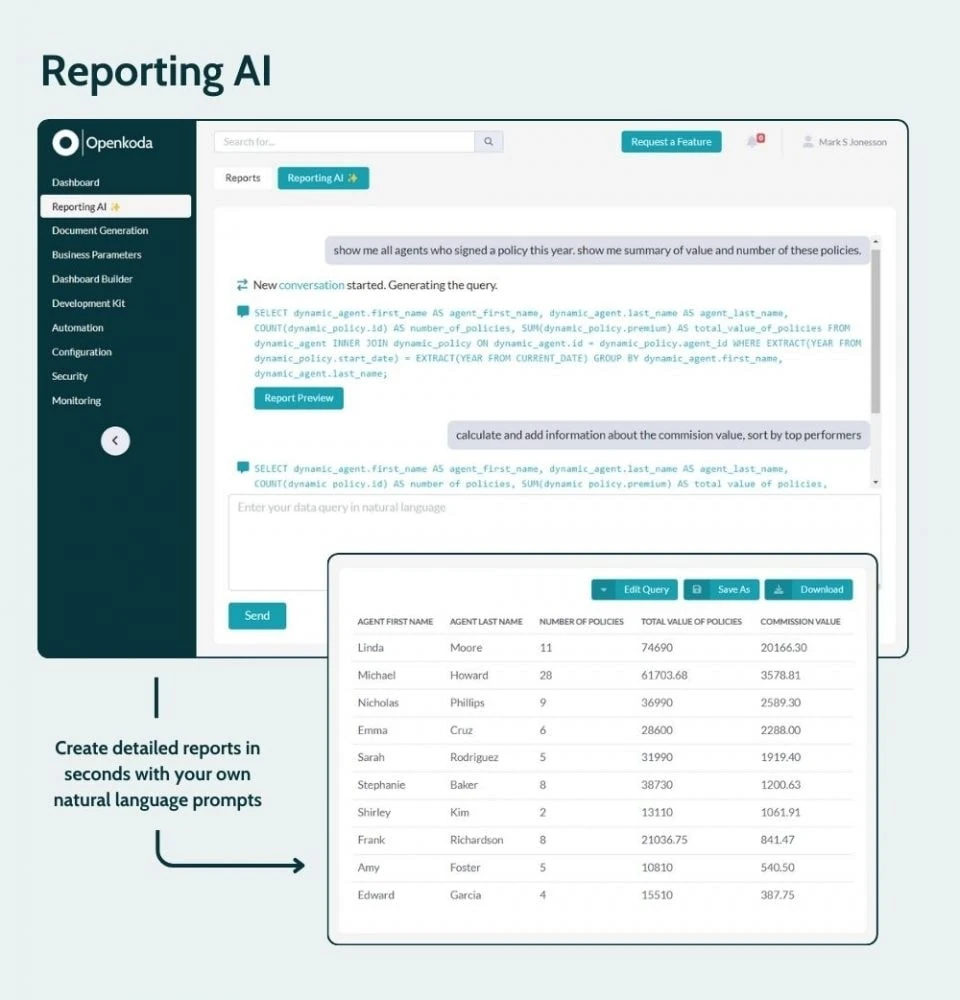
At its core, Reporting AI allows users to generate insightful, real-time data reports simply by describing what they need in natural language.
It's not just a standalone tool, but a deeply integrated feature within the Openkoda application development platform, tailored for building scalable, internal systems like claims management platforms, policy dashboards, or broker portals.
For insurers, this is a game-changer.
C-level decision-makers no longer need to rely on technical teams to sieve through complex data.
With Reporting AI, underwriting managers, operations executives, or product owners can ask, "Show me this quarter's claims by region and risk level," and get instant, accurate reports and actionable insights.
These reports can then be visualized in custom dashboards or exported into detailed, client-ready formats.

Klipfolio is a cloud-based business intelligence and dashboard platform designed to help organizations visualize and track their key performance indicators (KPIs) in real time.
With over 130 native data connectors, including integrations with Google Analytics, Salesforce, and HubSpot, Klipfolio enables users to consolidate data from various sources into customizable dashboards gaining meaningful insights faster.
Its drag-and-drop interface allows users to create dashboards without extensive coding knowledge, while more advanced users can leverage Excel-like formulas for data manipulation. Klipfolio also supports automated reporting, enabling scheduled delivery of reports in PDF format or via shareable links.

Taskade is an artificial intelligence productivity platform that combines task management, real-time collaboration, and intelligent automation.
It offers a unified workspace where teams can plan, organize, and execute projects with the assistance of AI agents.
Taskade's AI capabilities include generating task lists, ability to create reports, summarizing documents, and automating workflows, making it a versatile tool for enhancing team efficiency.

Tableau has long been recognized as a leader in data visualization and business intelligence.
In 2026, it continues to evolve by integrating advanced AI capabilities that transform how organizations interact with their data. These enhancements aim to simplify complex data analysis, enabling users to derive actionable insights more efficiently.
A standout feature is Tableau Agent, an AI report generator that facilitates data exploration through natural language interactions. Users can describe desired calculations or visualizations in everyday language, and Tableau Agent translates these requests into actionable data queries. This functionality streamlines the process of converting raw data into meaningful reports, making data analysis more accessible to non-technical users.

Domo AI is a data platform that combines data processing capabilities with AI-powered analytics.
It is designed to support organizations in turning raw data into insights that can inform decisions at various levels.
At the heart of Domo AI is its robust AI reporting capability. Users can leverage natural language processing to interact with their data, enabling the generation of complex reports without the need for extensive technical expertise. This AI report generator simplifies the creation of customized dashboards and visualizations, reporting process, making data analysis more accessible and efficient.
One component, Agent Catalyst, provides a framework for building AI agents that can perform tasks such as analyzing data, producing reports, or initiating business processes. Integrating these agents into workflows may help automate routine operations and improve efficiency.

When discussing AI reporting, we cannot forget about good old ChatGPT. Even though it is a general-purpose tool, it offers great value for data analytics using natural language prompts. While not a specialized BI platform, ChatGPT can be leveraged as a powerful AI report generator - especially for those looking to move quickly from raw data to actionable insights without traditional dashboards or complex interfaces.
By inputting structured or semi-structured data and asking the right questions, users can summarize trends, identify anomalies, and even simulate traditional data analysis methods like segmentation or comparative reporting. Its flexibility also makes it useful for brainstorming report structures, generating SQL queries, or rephrasing dense data outputs for broader audiences.

Jenni AI serves as an intelligent writing assistant, particularly adept at transforming raw data and research materials into coherent, structured content. While not a traditional business intelligence tool, its capabilities in AI reporting make it a valuable asset for professionals seeking to generate comprehensive reports with minimal effort.
Jenni AI then assists in drafting content, providing suggestions for structure, phrasing, and citations, thereby streamlining the report-writing process.

Sembly AI is an AI-powered meeting assistant that's increasingly being used for light AI reporting tasks - especially when it comes to transforming conversations and meeting notes into structured, shareable insights.
While its roots are in transcription and summarization, its growing capabilities as an AI report generator make it useful for teams that want to extract key outcomes and action items from spoken content.

Glean is an enterprise AI platform that transforms how organizations access and analyze data. By integrating with over 100 business applications - including Salesforce, Jira, and Databricks - Glean enables users to perform real-time data analysis using natural language queries.
Its AI reporting capabilities allow users to generate valuable insights from both structured and unstructured data sources. For instance, a sales manager can query open opportunities directly from Salesforce, view prospect engagement data from Slack, and identify positive buying signals from Gong calls - all within a single interface.
Glean's AI report generator simplifies the creation of reports by summarizing various data points into concise narratives. This approach reduces reliance on traditional data analysis methods, making data-driven decision-making more accessible across the organization.

Texta AI is an AI-powered content generation platform designed to streamline the creation of various documents, including reports, articles, and summaries. Its AI report generator enables users to produce structured reports efficiently by inputting topics or data points, which the AI then expands into comprehensive documents.
In terms of AI reporting, Texta AI offers customizable templates and automated formatting, facilitating the generation of professional-looking reports without extensive manual effort. This approach simplifies traditional data analysis methods by allowing users to focus on interpreting deeper insights rather than formatting documents.
UK MGAs wrote about £7.2bn of premium in 2025, up a fifth. Lloyd's, the FCA, the PRA and the capital behind MGAs spent the same year deciding how much of it to trust.
Surplus lines grew 10.4% in 2025 while filings outran premium in 2026. What specialty products ask of a PAS, and five tests to run before you buy one.
Six of the best policy management software systems for 2026, split by what they actually do: insurance policy administration, or internal policy governance.
Book a live, personalized demo with our product team - tell us your use case and see the platform work with your data. No commitment.