Embedded Car Insurance: State of the Market and How to Build It
Carmakers and dealers have sold insurance with cars since 1939. The 2026 market figures, and how to put a car insurance quote form on a partner's site.
Underwriters spend 40% of their time on admin, Accenture found. What insurance underwriting software should take off their desk, and seven systems to test.

A broker's email reaches a commercial property desk at four in the afternoon. Attached: an ACORD application, a schedule of values as a spreadsheet, five years of loss runs as a scanned PDF, and a note asking for terms by Friday.
Before anyone decides whether the risk is any good, someone has to read all of it, check the account is not already being quoted through another broker, key the locations into a rating sheet and find out whether the building values sit inside their own authority.
Most of that is clerical work, and it is the work insurance underwriting software is meant to take off the desk.
Insurance underwriting software is the system underwriters work in between a submission arriving and a quote going out: it captures the submission, checks it against appetite, prices it, routes anything outside a rule or an authority limit for referral, and records why each risk was accepted, referred or declined.
In commercial and specialty lines the product is usually called an underwriting workbench. It is narrower than a policy administration system, which carries the policy after binding through endorsements, renewals and cancellation, and wider than a rating engine, which only prices.
The case for it is the underwriter's calendar.
Accenture's underwriter survey, published by Michael Reilly of Accenture Strategy in February 2022, found that "the average underwriter in our study spends 40% of their time on administrative tasks", 30% on negotiation and sales support, and 30% on actual underwriting.
Underwriters spend 30% of their time underwriting
How the average underwriter's time divides, Accenture study
Accenture, Why underwriters don't underwrite much, February 2022.
That would matter less if underwriters were easy to hire. The US Bureau of Labor Statistics counts about 125,600 insurance underwriter jobs in 2025 and projects a 4% decline by 2035, at a median wage of $81,370. Carriers plan to push more submissions through the desks they already have, a point the insurance talent shortage makes from the hiring side.
Every vendor demo covers the same eight capabilities. What separates them is who can change each one, and how fast.
The workbench should read emails, ACORD forms, schedules of values and loss runs into structured fields. Bring a messy real submission to the demo, not the vendor's sample, and count how many fields an underwriter still corrects by hand.
Duplicate checks across brokers, sanctions screening and a first appetite score should run before a person opens the file. Ask how the triage order is set, and whether a portfolio manager can change it without a vendor ticket.
Rules decide which risks quote straight through, which refer and which decline. Ask who writes them. If tightening one referral trigger after a bad quarter needs a release cycle, the appetite on paper and the appetite in production will drift apart.
Some workbenches rate natively, others call an external rating engine or an actuarial model. Check that the price, the factors behind it and any underwriter override are stored on the submission, so a reviewer can see what moved the number.
Each underwriter's authority, by line, limit and territory, should be enforced by the system rather than remembered. Test a risk just over someone's limit and watch where it goes, and how the referral reaches the senior underwriter.
Every accept, refer and decline needs the rule, the data and the person behind it, kept with the file. Regulators, reinsurers and delegated-authority auditors ask for exactly this. Ask to see the trail for a declined risk from six months ago.
Underwriters should see how a risk changes aggregate exposure, rate adequacy and line-size targets before they quote it. A workbench that only shows the single submission leaves portfolio steering to a separate report run weekly.
A quote has to bind into a policy without rekeying. Ask which policy systems the workbench integrates with in production today, not on the roadmap, and what happens to an endorsement that needs re-underwriting mid-term.
Underwriting Workbench: Capabilities to Test
In the order a submission moves through the desk.
Vendor demos are rehearsed on clean data. Three requests break the rehearsal.
Send a real submission a week before the call, with the loss runs as a scan, and ask the vendor to run it live. Ask a business user, not the vendor's engineer, to change a referral threshold during the meeting and then quote a risk that the change affects. Then ask for the audit record of that quote.
The answers tell you more than the feature matrix. A rule a business user can change in a meeting is a rule your team can change the week a market hardens.
The seven below cover the main shapes on the market: workbenches from core-system suites, specialist commercial and specialty tools, an underwriting module on a general workflow platform, and a full PAS with underwriting built in.
Guidewire's UnderwritingCenter is a cloud-native workbench for commercial lines underwriters, from middle market to large commercial and specialty, running on Guidewire Cloud Platform. It is built on Guidewire's agent framework: a Submission Ingestion Agent extracts data from unstructured documents, a Triage Agent flags out-of-appetite submissions, and clearance runs broker licence, sanctions and regulatory checks before an underwriter sees a unified risk summary.
The first lines are commercial auto, workers' compensation and E&S general liability, and Guidewire was still recruiting for its early access programme when this was written. Referrals, pricing and portfolio views are not listed on the product page, so ask how much of that stays in PolicyCenter.
Key features:
Best for: large commercial carriers already on Guidewire InsuranceSuite.
Openkoda is a highly customizable, AI ready insurance policy administration system, founded in 2022 and based in Wrocław, Poland. Underwriting is one of its ready modules, alongside rating, policy administration, claims, billing and documents, so a submission that is accepted binds into a policy in the same system.
The underwriting dashboard puts referred cases in one shared queue, each opened on a workbench laid out for its product: risk, coverages, pricing, history and documents in one view. Straight-through rules issue the business that meets appetite.
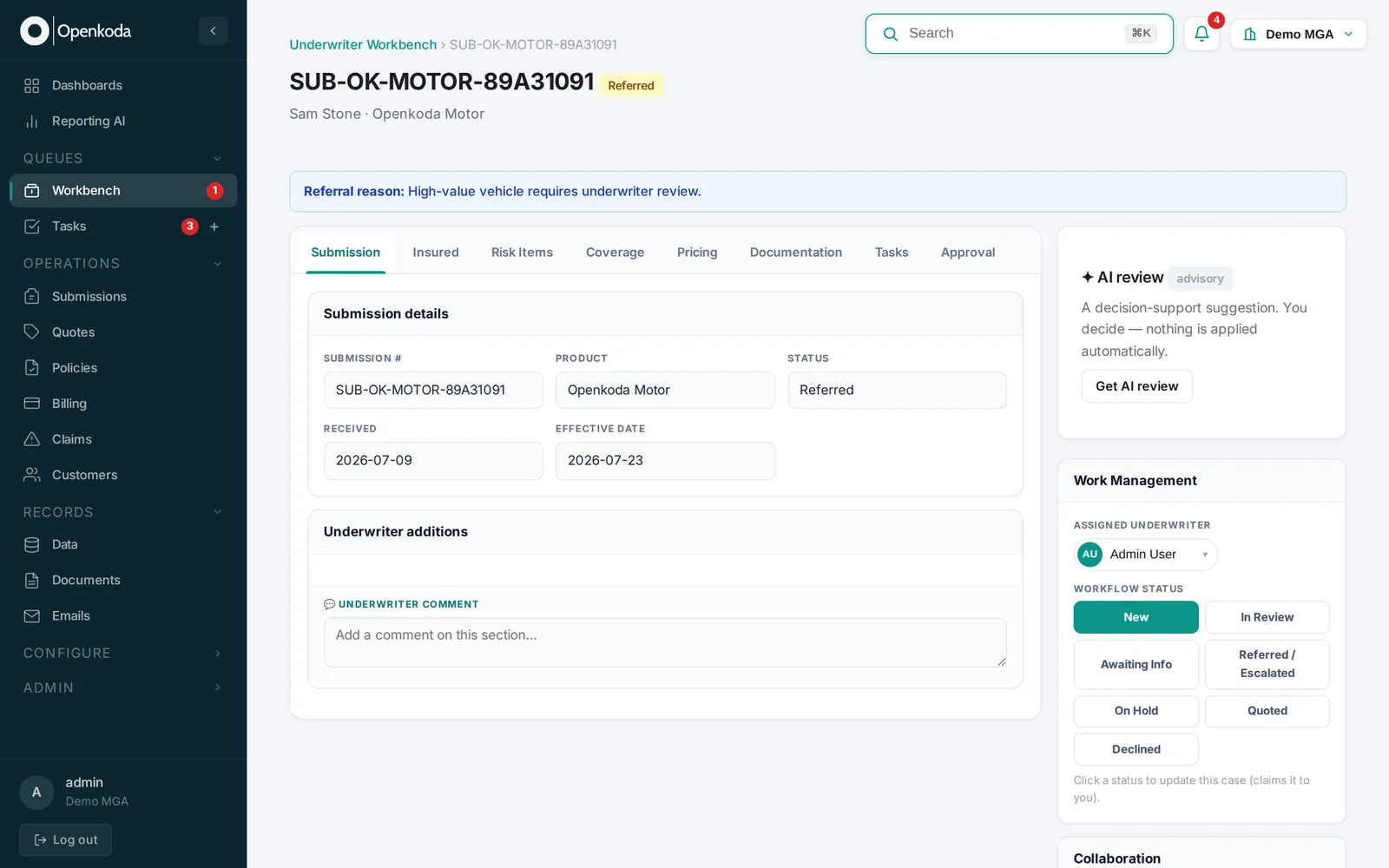
Underwriters write referral, decline and pricing rules themselves, so a change applies to the next submission rather than the next release, and every outcome is recorded with the rule and data behind it.
Guidewire and Sapiens carry decades of accumulated underwriting functionality and long lists of carrier references, and on feature count Openkoda does not match them.
What Openkoda offers instead is full ownership: your configuration and data are exportable at any time, the data model and workflows are reshaped to your lines rather than the other way round, and published pricing has no per-seat, per-policy or percentage-of-premium fees. It suits MGAs and carriers that want control over their underwriting rules and a first deployment measured in weeks.
Key features:
Send, with offices in London and New York, builds an underwriting workbench for commercial and specialty lines, aimed at insurers, MGAs and reinsurers in the London Market and the Americas. Its platform covers submission management, the quote and rate lifecycle, rules and automation, binder management, post-bind processing and bordereaux ingestion, with separate products for direct, delegated and reinsurance underwriting.
Duck Creek announced its acquisition of Send on 7 July 2026 and says Send continues as a standalone orchestration engine. Duck Creek's own Agentic Underwriting Workbench is in early access with general availability planned for 2027, so buyers should ask how the two products will relate.
Key features:
Best for: London Market carriers, MGAs and reinsurers writing delegated business.
Sapiens sells its P&C workbench through AdvantageGo, a Sapiens company focused on specialty and commercial lines: cyber, energy, marine, property and political violence. Version 3.0, launched in October 2025, ingests and triages submissions from email and attachments inside Outlook and Teams, and lets users change workflow stages and risk-appetite rules.
Sapiens names Chubb Global Markets as a live customer. Life and annuity underwriting is a separate product, UnderwritingPro.
Key features:
Best for: specialty and London Market carriers already on Sapiens.
Pega, founded in 1983, offers underwriting for commercial lines as an application on its workflow and decisioning platform. It extracts submission data from emails and documents, runs licensing and duplicate checks, applies triage and appetite rules, and routes work by underwriter specialization and capacity. Pega names Zurich Santander, Tokio Marine and QBE among its insurance customers.
Its strength is routing and case management at volume. Pricing and the policy record sit in other systems, so integration is part of the project.
Key features:
Best for: large carriers with a Pega estate and in-house platform teams.
hyperexponential builds hx, a platform for pricing and underwriting commercial P&C risks that covers clearance, triage, risk assessment, appetite and pricing. Its roots are in pricing, and its calculation engines are where carriers' pricing models run. It raised a $73 million Series B in January 2024 led by Battery Ventures, and lists Markel among its carrier partners in the US and Bermuda.
Key features:
Best for: specialty carriers, MGAs and reinsurers where pricing sophistication is the bottleneck.
Federato, whose founders met at Stanford in 2020, sells RiskOps as an underwriting platform for carriers, MGAs and the London Market. Its centre is what Federato calls real-time portfolio steering in the Control Tower module, which puts the portfolio's position beside each submission an underwriter considers. The platform has since added policy administration, billing, claims and partner portals around that core.
Key features:
Best for: carriers that want triage driven by portfolio targets rather than first-in, first-out.
| System | Best for | Deployment | Strength |
|---|---|---|---|
| Guidewire UnderwritingCenter | Large commercial carriers on Guidewire | Guidewire Cloud | Agent-based intake and triage |
| Openkoda | MGAs and carriers wanting control | Managed cloud or on-premises | Underwriting, rating and policy in one system you own |
| Send (Duck Creek) | London Market, delegated authority | Not stated | Binders and bordereaux |
| Sapiens Underwriting Workbench | Specialty and London Market | Not stated | Email-native submission triage |
| Pega Underwriting | Carriers with a Pega estate | Not stated | Routing and case management |
| hyperexponential hx | Specialty pricing teams | Not stated | Actuarial pricing models |
| Federato RiskOps | Carriers steering a portfolio | Not stated | Portfolio-aware triage |
For underwriting as part of a full policy system rather than a standalone workbench, the policy administration software and MGA insurance software roundups cover the wider field.
AI in underwriting has so far meant reading. Extraction from submissions is what Cytora, which lists Zurich, Chubb and Beazley as customers, built its business on before Applied Systems acquired it in September 2025, and it is the first capability every workbench above now advertises.
The carriers furthest along describe the gain as capacity rather than headcount. Peter Zaffino, AIG's Chief Executive, told analysts on the company's fourth-quarter 2025 call in February 2026, as reported by Insurance Journal:
“We're seeing a massive shift in our ability to process a significant submission flow way beyond our expectations without additional human capital resources.”
Peter Zaffino, Chief Executive Officer, AIG
The decision still sits with the underwriter, and the rules around it still need an owner.
A model that reads a submission in seconds does nothing for a desk whose referral thresholds take a quarter to change. Asked in a demo, who can edit the rules tells a buyer more than which model the vendor uses. The automated underwriting piece goes further into what straight-through decisions can and cannot cover.
Underwriting software handles the decision before binding: intake, triage, pricing, referral and authority. A policy administration system carries the policy afterwards. Some systems, Openkoda among them, do both, which removes the rekeying between quote and policy.
An underwriting workbench is a single screen where an underwriter sees a submission's data, documents, price, referral status and portfolio impact, and records the decision. The term is used mostly in commercial and specialty lines.
For risks that fit a rule, yes: straight-through rules quote or bind them without a person. Complex commercial risks still go to an underwriter, and good software makes that referral faster rather than removing it.

Carmakers and dealers have sold insurance with cars since 1939. The 2026 market figures, and how to put a car insurance quote form on a partner's site.
The phases, costs and realistic go-live dates of a custom claims system build, and how much of it a configurable PAS already has in place.
A dashboard nobody opens is wallpaper. The dashboards insurance teams use every day, the data each one needs, and how to tailor them in your PAS.
Book a live, personalized demo with our product team - tell us your use case and see the platform work with your data. No commitment.