Specialty Insurance Products: Market Trends, Challenges and Technology
Surplus lines grew 10.4% in 2025 while filings outran premium in 2026. What specialty products ask of a PAS, and five tests to run before you buy one.
How to evaluate MGA insurance software for delegated authority, plus a comparison of Openkoda, Guidewire, Genasys, SANDIS, and Expert Insured.

Managing General Agents sit in a strange, busy crossroads of the insurance industry. They look a bit like insurers, because they underwrite and manage parts of the insurance lifecycle. They look a bit like insurance agencies, because they work with brokers and distribution partners. But in reality they're a third thing: an MGA operates on delegated authority and has to prove to the capacity provider that every decision was made inside that authority.
That single fact changes how their tech should look.
Plain "policy admin" software often isn't enough and why purpose-built mga systems are getting so much attention. An MGA has to receive submissions from different channels, rate them, sometimes enrich them with third party data providers, bind, produce documents, and then send clean data back to the carrier.
So when we talk about the "best MGA insurance software systems in 2026," we're in fact looking for tools that understand this middle position.
Here's the core problem: an MGA is judged not only by growth, but by how clean its data and processes are. Every quote, every endorsement, every bordereau can be audited. That means your mga systems must make compliance the default, not an afterthought.
On top of that, MGAs launch products fast. New niche in commercial, new partner, new state - the business can't wait six months for IT.
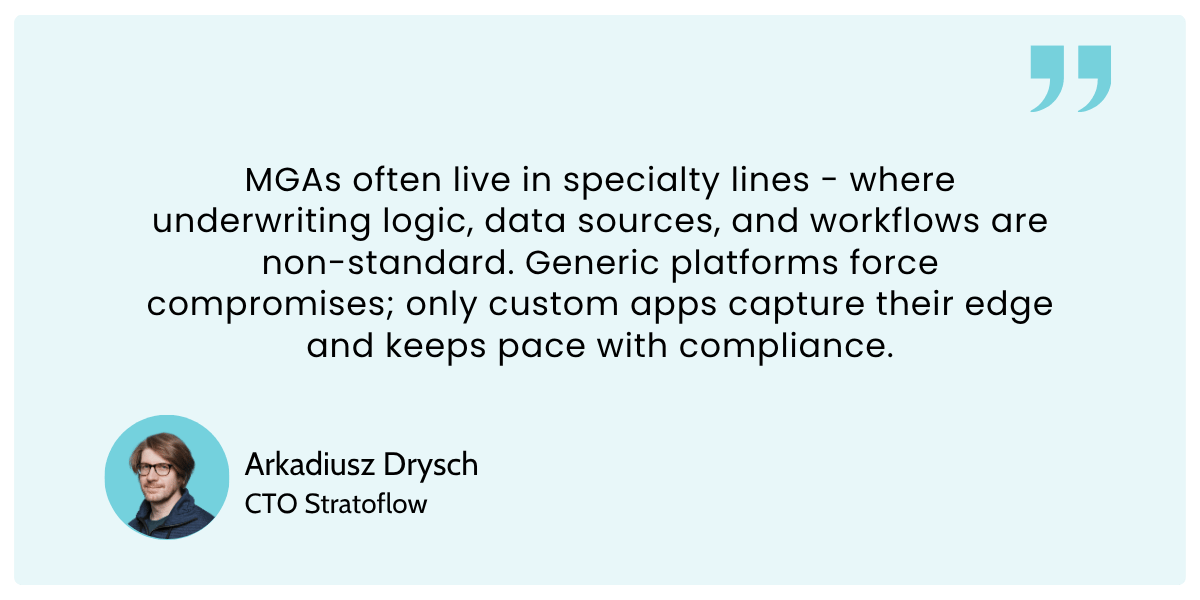
So the right mga software must be highly configurable or even developer-friendly, so that product people can change rating, forms, or distribution rules without blowing up the whole stack.
Integrations are another big one.
MGAs don't live in isolation; they constantly push and pull data with carriers, TPAs, accounting tools, and those third-party data providers that enrich risks.
A solid MGA insurance software has to be connectable by exposing APIs and webhooks, letting you plug the MGA into the wider insurance industry ecosystem. Integration speed has become a commercial argument in its own right, and distribution partners increasingly pick carriers on how fast they can connect.
Choosing software is where MGAs usually slow down – not because they don't know what they want, but because the market keeps shifting under their feet.
So before we look at actual platforms, it helps to agree on what "good" looks like in 2025. Below is a quick, working checklist you can use to compare different mga systems and spot which ones are really built for delegated authority and which ones are just repackaged agency tools.
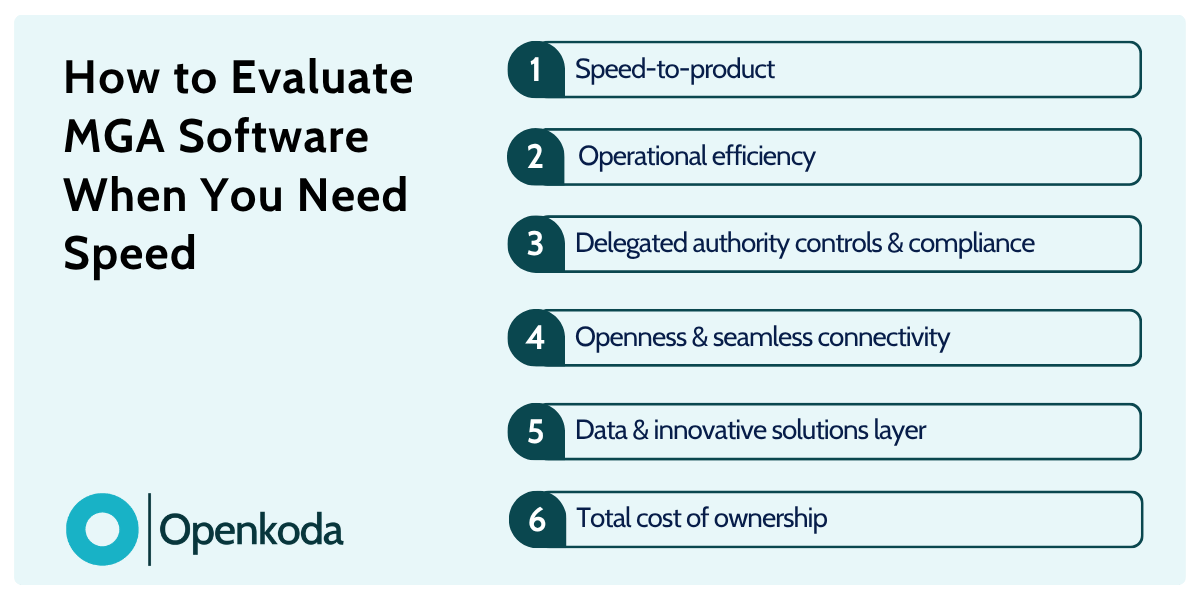
MGA software needs to connect product development, underwriting, distribution, policy servicing, and carrier reporting. The following systems offer different approaches to managing those responsibilities, from broad insurance suites to software focused on delegated authority and distribution.

Guidewire InsuranceSuite brings together policy administration, billing, and claims through its PolicyCenter, BillingCenter, and ClaimCenter applications. For MGAs, it is worth evaluating where the requirements include complex P&C products, extensive integrations, or close alignment with a carrier’s technology environment.
Key features:

Openkoda is a highly customizable policy administration system (PAS) designed to support the full range of day-to-day insurance operations. Its ready-to-use modules cover product configuration, rating, underwriting, policy administration, claims, billing, payments, document generation, reporting, and team collaboration.
For an MGA, this means the same system can support a submission arriving from a broker, an underwriting referral, policy issuance, premium collection, an endorsement, and the resulting carrier report. Teams work with connected records and configure the processes around their own products, distribution arrangements, and delegated authority. Explore Openkoda for MGAs.
Working with Openkoda’s implementation team, a focused launch can move from concept to production in as little as three weeks, depending on scope. Visual configuration and AI assistance help teams define products and workflows, while the implementation team handles more specialized requirements.
Openkoda also connects with existing carrier systems, external rating engines, data providers, finance tools, and distribution partners through APIs and webhooks. Its team can build custom integrations where needed. Flat-rate subscriptions under annual contracts carry no per-seat, per-policy, or percentage-of-premium fees. AI subscriptions, implementation services, resource usage, and additional instances are priced separately as applicable. See deployment, integrations, and pricing.
Key features:

Genasys provides insurance software for MGAs running wholesale broker channels, direct customer journeys, or a combination of both. Its product configuration tools, policy workflows, documents, and reporting make it relevant to teams that want to manage multiple programs and distribution arrangements within one system.
Key features:

SANDIS focuses on insurance distribution and policy operations for MGAs, coverholders, and agencies. Its ability to use existing Excel rating models makes it particularly relevant to teams moving established products into digital sales channels. It also supports complex broker and agent networks through configurable distribution hierarchies.
Key features:

Expert Insured combines policy management, documents, workflow tools, and insurance accounting for MGAs, MGUs, wholesalers, and carriers. Its operational focus makes it worth considering where teams need tighter control over submissions, issuance, financial transactions, and work moving between departments or external partners.
Key features:
The table summarises how each system tends to behave on the three questions MGAs ask most often. These are broad characterisations rather than scores, and the right answer depends on your programs, your carriers and the state of your current stack.
| System | Speed to product | Delegated authority & compliance | Openness and integrations |
|---|---|---|---|
| Guidewire | Strong with accelerators, though the implementation itself is heavier | Carrier-grade governance and controls | Integrates well in enterprise environments, with a partner marketplace |
| Openkoda | Fast, since products and workflows are configured rather than built | Binding limits, referral rules and bordereaux configured per program | API-first with webhooks; configuration and data stay exportable |
| Genasys | Quicker than a classic carrier stack | Built with MGAs and delegated authority in mind | Open APIs, on a more packaged platform |
| SANDIS | Very good for launching new products and distribution partners | Suited to lightly delegated arrangements | Built to connect distribution and policy flows |
| Expert Insured | Good once the workflows are defined | Strong on guided workflows and audit trails | Integrates to keep quote, bind and issue in one place |
One caveat worth stating plainly, since this comparison sits on our own site. Openkoda is the newest of the five and does not carry the accumulated feature depth of the established suites; on a feature-count comparison against Guidewire it does not win. What it offers instead is configuration with no ceiling, full ownership of your configuration and data, and no lock-in. That suits MGAs who value control and speed over the breadth of a managed suite, and it is the wrong trade for those who would rather buy depth off the shelf.
MGAs win when they can adapt quickly to new products, new partners and new reporting asks from carriers.
That is only realistic if the technology fits the rest of your stack instead of creating another silo. Start from the operating model you want, then choose the system that removes the most friction on the way there.
Surplus lines grew 10.4% in 2025 while filings outran premium in 2026. What specialty products ask of a PAS, and five tests to run before you buy one.
Six of the best policy management software systems for 2026, split by what they actually do: insurance policy administration, or internal policy governance.
What to actually test in a mutual insurer's policy, claims, billing, portal and reporting systems, and which platforms are worth a shortlist.
Book a live, personalized demo with our product team - tell us your use case and see the platform work with your data. No commitment.