Embedded Car Insurance: State of the Market and How to Build It
Carmakers and dealers have sold insurance with cars since 1939. The 2026 market figures, and how to put a car insurance quote form on a partner's site.
When AWS went down for 14 hours in October 2025, cloud became a supplier question. Who holds the code, data and upgrade schedule in cloud insurance software.

At 11:48 PM Pacific on October 19, 2025, a latent race condition in the DNS management system behind Amazon DynamoDB wrote an empty record for the service's endpoint in AWS's US-East-1 region. Services that depended on it began failing.
AWS's post-event summary puts the end of the event at 2:20 PM the next day. That is fourteen and a half hours, across a US business morning.
CyberCube's preliminary estimate, reported by Insurance Journal on October 27, put the insured loss at between $38 million and $581 million, most likely toward the lower end. Modest for cyber insurers. For anyone running a quote portal or a claims intake on that region, it was a morning of being unable to do anything about it.
That is the part of cloud insurance software that rarely makes the sales deck. Moving a core system to the cloud moves a set of decisions to other people: who can change the code, where the data lives, when the next upgrade lands, and what happens if you want to leave.
Cloud insurance software is a core insurance system, such as policy administration, rating, billing or claims, that runs on hosted infrastructure and is used through a browser and APIs rather than installed on the insurer's own servers. It is sold as multi-tenant SaaS, as single-tenant managed cloud, or as software the insurer deploys in its own cloud account.
The distinction buyers trip over is cloud-native versus cloud-hosted. A cloud-native system was built to run as many small services that scale on demand. A cloud-hosted one is an older application moved onto rented servers. Both are "in the cloud". Only the first changes how upgrades and scaling work.
The three delivery models differ less in technology than in who controls four things: the code, the data, the infrastructure and the calendar.
SaaS vs Managed Cloud vs On-Premises: Who Controls What
Code ownership is set by the license, not the hosting model. Check it separately.
Multi-tenant SaaS puts many insurers on one shared deployment. It is the cheapest to run and the fastest to start, and every customer gets the same release at the same time. The price of that is that nobody's change can break anybody else's tenant, so customization stops at configuration.
Managed cloud gives you a dedicated instance that the vendor hosts and operates. You keep more room to extend the system, and upgrade timing becomes something you negotiate rather than something that happens to you.
On-premises (which today usually means your own AWS, Azure or Google Cloud account rather than a server room) hands you the infrastructure and the calendar, along with the people needed to run them.
Several vendors now sell both from one codebase. Socotra's cloud page describes exactly this split: clients can license "individual tenants from a shared environment" or take "exclusive access to the entire cloud environment" in which their own instance runs, all on AWS. The shared option is the cheaper one.
That choice is worth making deliberately. A program that needs heavy API integration with a carrier partner, or data that must stay in one jurisdiction, often outgrows the shared tier before it outgrows the product.
Upgrades are where cloud delivery has changed core systems most.
On a legacy system, a version upgrade was a project: months of regression testing, frozen configuration, a weekend cutover.
Cloud vendors now ship continuously. Socotra says its customers "upgraded 100 times while experiencing less than 60 minutes of total downtime" across 2023 and 2024. Duck Creek's site describes its cloud delivery as a way to "eliminate upgrade cycles" on a "continuously updated, cloud-native SaaS platform."
For a carrier with a standard book, that is a straightforward gain. Security patches and regulatory changes arrive without a project attached.
It is less straightforward when your differentiation lives in the system. A specialty MGA with a bespoke rating algorithm, an unusual endorsement workflow or a partner-specific document set needs every release to leave those untouched.
On a shared SaaS tier, the vendor decides when releases ship and you test against their schedule. On managed cloud or on-premises, you can hold a release until your own tests pass.
Ask any vendor two questions here: how much notice you get before a release, and whether you can defer one.
European insurers have had a formal answer since January 17, 2025, when the Digital Operational Resilience Act (DORA) began to apply. It replaced EIOPA's 2020 guidelines on outsourcing to cloud service providers, which EIOPA revoked from the same date to avoid overlap.
DORA requires insurers to keep a register of their ICT third-party arrangements and to have exit strategies for those supporting critical or important functions. A policy administration system is about as critical as functions get.
On November 18, 2025, the European Supervisory Authorities published the first list of critical ICT third-party providers that now fall under their direct oversight. Law firm summaries of the list, including Morgan Lewis's, count 19 providers, the hyperscale cloud providers among them.
That oversight covers the hyperscaler. It does not cover the core system vendor running on top of it, and it does not move the insurer's own obligation to prove it could leave either one.
In the US, the closest equivalent for New York-licensed insurers is section 500.11 of the NYDFS cybersecurity regulation, which requires a written policy for the security of third-party service providers that can access the insurer's systems or nonpublic information.
An exit strategy on paper is easy. One that works depends on what you get back when the contract ends.
Data comes first. Ask for a full export in a documented format, including policy history, transactions and audit trail, not only the current state of each policy. Then configuration: products, rating tables, rules, workflows and document templates. If those exist only inside a vendor's proprietary designer, you can take your data and still have to rebuild every product somewhere else.
Code is the hardest. Most SaaS contracts give you no rights to the code at all, which is the textbook route to vendor lock-in. That is a reasonable trade for a carrier that wants a managed suite and has no intention of changing what it does. It is a poor one for a business whose products are the point.
Cloud Insurance Software: What to Get Back at Exit
Ask for each in a documented format before you sign.
Pricing belongs in the same conversation. Many core systems charge on a percentage of written premium or a per-policy fee, which means the bill grows with the book whether or not the work does.
Openkoda's terms answer those questions directly. It is a highly customizable, AI ready policy administration system with ready modules for policy management, rating engine logic, claims management and billing and payments, delivered on Openkoda Managed Cloud or deployed on-premises in your own environment.
The published pricing is a flat monthly fee, with no per-seat, per-policy or percentage-of-premium charges, and configuration and data are exportable at any time. Moving from managed cloud to on-premises is a change of plan, not a rebuild.
There is a trade-off. Openkoda does not carry the decades of accumulated functionality that the large suites do, and on a feature-count comparison it does not win. What it offers is full code ownership and customization with no ceiling, so the data model, workflows and screens change to fit the business rather than the other way round. It suits insurers and MGAs that value control and speed over the breadth of a managed suite.
The six below differ mainly in the delivery models they offer and how much of the system the customer can change. They are listed by delivery model, not ranked. For a wider list, see our roundup of policy administration systems.
| System | Delivery model | Built for |
|---|---|---|
| Openkoda | Managed cloud or on-premises | Insurers, MGAs and brokers wanting code ownership |
| Socotra | Shared or dedicated SaaS on AWS | Carriers and MGAs launching products via API |
| Duck Creek OnDemand | SaaS, module by module or full suite | P&C carriers |
| Guidewire Cloud Platform | Vendor-run cloud | Mid-size and large P&C carriers |
| EIS OneSuite | Cloud-native, on-premises or hybrid | Multi-line insurers |
| Sapiens CoreSuite | Cloud details not published per product | Life and pensions insurers |
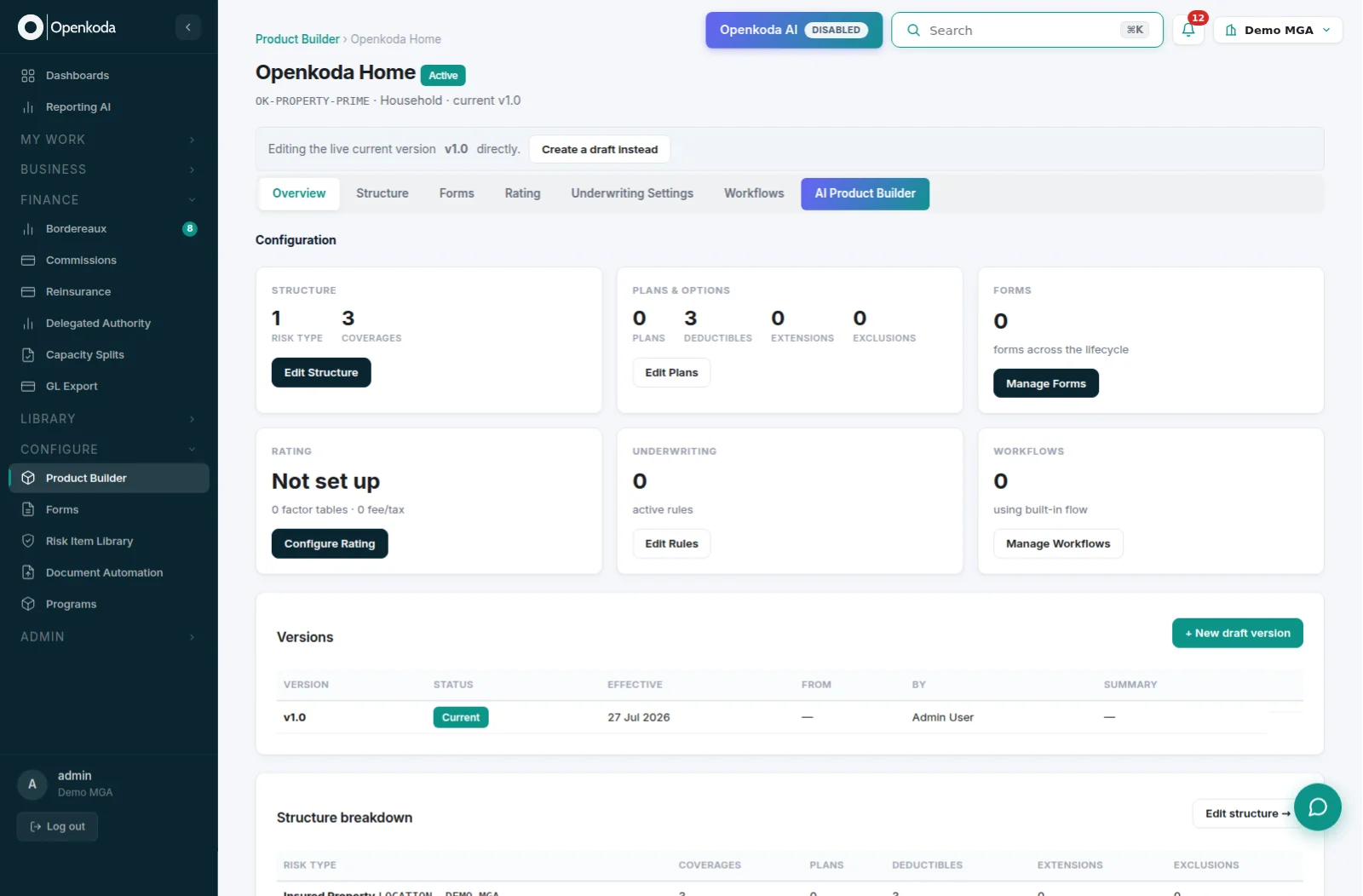
Openkoda is a highly customizable, AI ready policy administration system covering policy, underwriting, rating, claims, billing, documents, reporting and bordereaux. It was founded in 2022 and is based in Wrocław, Poland. The Business and Enterprise plans run on Openkoda Managed Cloud on annual contracts; On-Premise is a custom contract that runs in the insurer's own data center or cloud account, with its own upgrade cadence.
The AI Product Builder turns plain-language instructions into product changes that are reviewed before they apply, and Reporting AI answers questions in plain English and shows the SQL behind each answer. Configuration and data can be exported at any time, so moving from managed cloud to on-premises, or away altogether, does not mean rebuilding products somewhere else.
Key strengths:
Limitation: a smaller accumulated feature set than the established suites, and fewer reference customers.
MGAs, insurtechs and insurers that want to own their system and decide their own upgrade calendar, and that value speed and control over the breadth of a managed suite.
Socotra is an API-first policy and billing core that runs on AWS, founded in 2014 in San Francisco. Its company page says insurers in 10 countries have selected it, across personal, commercial and life lines, with AXA, IAG, MS Amlin, Omaha and Symetra among the logos. On its cloud page customers choose between licensing tenants in a shared environment and taking a dedicated environment of their own.
Socotra publishes unusually specific operating figures: ">99.994% uptime", weekly releases with "zero downtime" rolling updates, at least 60 days' notice of breaking API changes, and an AWS-audited load test of 11,500 policies per minute.
Key strengths:
Limitation: no on-premises option on its published pages, claims is not part of the platform, and product configuration is developer-led.
Carriers and MGAs with an engineering team that want to launch products through APIs and are comfortable on a shared release train.
Duck Creek OnDemand is the SaaS delivery of Duck Creek's P&C suite. Its April 2026 release lists policy, billing, claims, rating, loss control, reinsurance, distribution management and payments, available individually or as a full suite, and describes the platform as continuously updated and cloud-native. Duck Creek is based in Boston.
The same release names Millers Mutual, Indigo, Encova, Frankenmuth and Medical Assurance Society among OnDemand customers, and Duck Creek used the event to unveil an agentic AI platform. In July 2026 it also bought Send, a London underwriting workbench, to connect underwriting to its core.
Key strengths:
Limitation: built for carriers, so a small MGA will be paying for suite breadth it does not use.
Mid-size P&C carriers that want a complete suite run for them and will standardize on the vendor's release schedule.
Guidewire Cloud Platform is how Guidewire now delivers InsuranceSuite (PolicyCenter, BillingCenter and ClaimCenter) as a service, run by Guidewire. The company was founded in 2001 and reported annual recurring revenue of about $1.24 billion for its fiscal year ended July 31, 2026, in its September 2026 results.
It brings decades of accumulated P&C functionality and a large partner and integrator network. Insurers comparing it with lighter options can see how we set out the differences in our Guidewire alternative post.
Key strengths:
Limitation: implementations are long and partner-led, and the cost suits mid-size and large carriers rather than MGAs or new programs.
Mid-size and large P&C carriers already on InsuranceSuite, or replacing a legacy core with a system they expect to run for a decade.
EIS, founded as Exigen Insurance Solutions and based in San Francisco, launched OneSuite in October 2025 as a modular, API-first core that "operates seamlessly across any line of business". Its CoreGentic layer adds AI agents and natural-language control on top of the core, tied to a knowledge base built around compliance and human review.
Unusually for a cloud-native product, EIS supports deployment whether the infrastructure is cloud-native, on-premises or hybrid. In November 2026 Amdocs announced it was acquiring EIS for about $340 million, its first move into insurance.
Key strengths:
Limitation: pricing and customer counts are not published, and the product roadmap now sits with a new owner.
Multi-line insurers that want one core for several lines and need the option to run it outside a vendor cloud.
Sapiens sells core platforms for property and casualty, life and pensions, reinsurance and global specialty, and CoreSuite is its life and pensions core. Its website reports more than 600 customers in 38 countries, and its SapiensAIP layer adds what it calls embedded agentic AI. Advent completed its acquisition of Sapiens on December 17, 2025, taking it private.
Key strengths:
Limitation: cloud delivery details are not published per product, so check which delivery model each module is actually sold on.
Life and pensions insurers, particularly outside the US, that want an established vendor with a large installed base.
The infrastructure layer is rarely the weak point; the hyperscalers run physical and network security at a scale few insurers match. The risk moves to access control and the vendor's own practices.
Ask for SOC 2 Type II or ISO 27001 reports, data isolation between tenants and a full audit trail. Our page on multitenancy and security sets out how Openkoda separates organizations.
SaaS is run by the vendor as a service, usually multi-tenant, with upgrades on the vendor's schedule. Cloud-hosted means an application, often an older one, running on rented infrastructure, which may be operated by the vendor, a partner or the insurer.
You can rehost it, which moves the servers but not the upgrade or customization constraints. Most insurers treat cloud as part of a wider software modernization that replaces the core system by line of business rather than in one cutover.

Carmakers and dealers have sold insurance with cars since 1939. The 2026 market figures, and how to put a car insurance quote form on a partner's site.
Underwriters spend 40% of their time on admin, Accenture found. What insurance underwriting software should take off their desk, and seven systems to test.
The phases, costs and realistic go-live dates of a custom claims system build, and how much of it a configurable PAS already has in place.
Book a live, personalized demo with our product team - tell us your use case and see the platform work with your data. No commitment.