P&C Insurance Billing Software: 9 Systems Compared for 2026
Billing is where a missed installment turns into a cancellation notice with a legal deadline. Nine P&C billing systems compared on bill types, delivery and pricing.
Lemonade's bot handles about 55% of its claims. Chubb wants 85% of major processes automated. What insurance automation software runs today, and where people stay.

A Canadian broker sends Hiscox the renewal of a sabotage and terrorism risk. Until 2024 an underwriter in London read that submission, keyed it and priced it by hand.
Now Google's Gemini model reads it first. Hiscox said in August 2024 that brokers can get a quote “in a matter of minutes” for that class, starting with US and Canadian renewals outside the New York and Chicago metro areas.
The underwriter is still there. Kate Markham, CEO of Hiscox London Market, described the gain as “freeing up our underwriters from manual tasks” so they can concentrate on work “where human expertise is critical”.
Buying insurance automation software means deciding where that line falls in your own book: which work the system does, and which a person keeps.
Insurance automation software runs insurance work without a person keying each step: reading a submission, rating a risk, issuing documents, chasing a renewal, paying a claim. It comes in three forms: workflow built into the core policy system, bots that drive other systems' screens (RPA), and AI that extracts data from documents.
Most carriers and MGAs end up with some of each. The difference that matters is where the automation acts: on the policy record itself, or on the screens around it.
Automation is furthest along where the data arrives structured and the decision is a rule. It thins out as soon as a document has to be interpreted or a judgment has to be defended.
Personal lines got there first. Harry Huberty, Research Director at Datos Insights, wrote in March 2021 that more than 80% of insurers selling personal lines and individual life had “at least some level of automated underwriting”, and that many personal lines insurers process straight through “more than three-quarters of the time”.
Small commercial and workers' compensation sat at what he called a “middle point”, with many products still underwritten by hand.
That middle is where the current wave of tools is aimed.
The submission arrives as an email with an ACORD form, a schedule of values and five years of loss runs, and AI extraction turns it into fields a rating engine can price. Hiscox's terrorism model is that pattern applied to the London market. Automated underwriting then means rules that decide which risks quote straight through and which go to an underwriting dashboard for referral.
Lemonade publishes the clearest numbers.
Its annual report for 2025, filed with the SEC, says that as of December 31, 2025, “roughly 55% of our claims were automated”, and that 96% of the time its bot, AI Jim, takes the first notice of loss “without human intervention”.
The same filing says AI Jim “triages and assigns claims he is not authorized to settle, or ones where he identifies concerns”. Intake is nearly all automated. Settlement is about half.
Further from a digital-first book, the figures are narrower. UiPath's insurance page credits Hiscox with automating 28% of claims triage, a vendor-reported figure for one step of the process rather than for whole claims.
These are the oldest automation targets and the least glamorous.
A bound policy produces a schedule, a certificate and a wording; an endorsement produces new versions of each. Most core systems now generate insurance documents from templates without anyone opening Word.
Renewals and collections are timers and rules. Ninety days before expiry, start the renewal; fifteen days after a missed installment, send the second notice. Our guides to policy renewal reminders and payment reminders set out the timing in detail, and the billing and payments side is where an automated dunning sequence turns into a cancellation for non-payment.
Delegated authority still runs on spreadsheets more than any other part of the market. Coverholders and MGAs send premium and claims bordereaux to carriers and Lloyd's syndicates every month, mapped to the Lloyd's Coverholder Reporting Standards. When the policy and claims data already sit in one system, bordereaux reporting becomes a scheduled export instead of a month-end job.
Chubb set the most aggressive public target. At an investor presentation in December 2025, as reported by Insurance Business, the company said it aims “to automate 85% of its major underwriting and claims processes”, with a workforce cut of up to 20% over three to four years and expense savings of about 1.5 points off the combined ratio.
Those are targets for the end of the decade.
Underwriters themselves are more measured.
A Convr survey of 200 underwriting professionals at manager level or above, reported by Insurance Business in May 2025, found that over half believe 25% to 50% of manual underwriting work could be automated.
Insurance Automation in Four Figures
Lemonade Form 10-K for FY2025; Chubb investor presentation, Dec 2025, via Insurance Business; Convr survey of 200 underwriting professionals, May 2025, via Insurance Business.
Three kinds of work keep coming back to a human: decisions outside a rule's authority, documents nobody has seen before, and anything a regulator or a court may later ask someone to explain.
Lemonade's filing draws the line in its own operations, with AI Jim passing on claims he is not authorized to settle. Its risk factors also note that AI used “without sufficient oversight and governance” could misprice policies or mispay claims.
Claire Davey, head of product innovation at Relm Insurance, put the same point to Insurance Journal in April 2025: AI could perform some underwriting stages, but “you would hope that there is still a human reviewing its output and sense-checking that.”
For a buyer, this means the referral path matters as much as the automated path. Software that cannot hand a case to a person with the reason attached will produce exceptions nobody can trace.
RPA arrived in insurance because core systems had no APIs. A bot logs into the green screen, copies a policy number, pastes it into the claims system and clicks submit, exactly as a clerk would.
On a system that cannot be changed, that is still the fastest way to remove keystrokes, and UiPath reports that USI cut placement data entry time by 80%.
The cost shows up later.
A bot depends on the screen staying where it is, so a moved field or a new pop-up stops it, and the logic of the process ends up split between the core system and a bot studio that underwriters never see.
Workflow inside the policy administration software works the other way. The automation acts on the policy or claim record directly: when a submission is created, rate it; when the premium is below the threshold, issue; otherwise refer. The audit trail is on the record, and changing a rule does not mean rebuilding a bot.
Workflow in the PAS vs RPA Bot: General Comparison
RPA still fits legacy systems that offer no API.
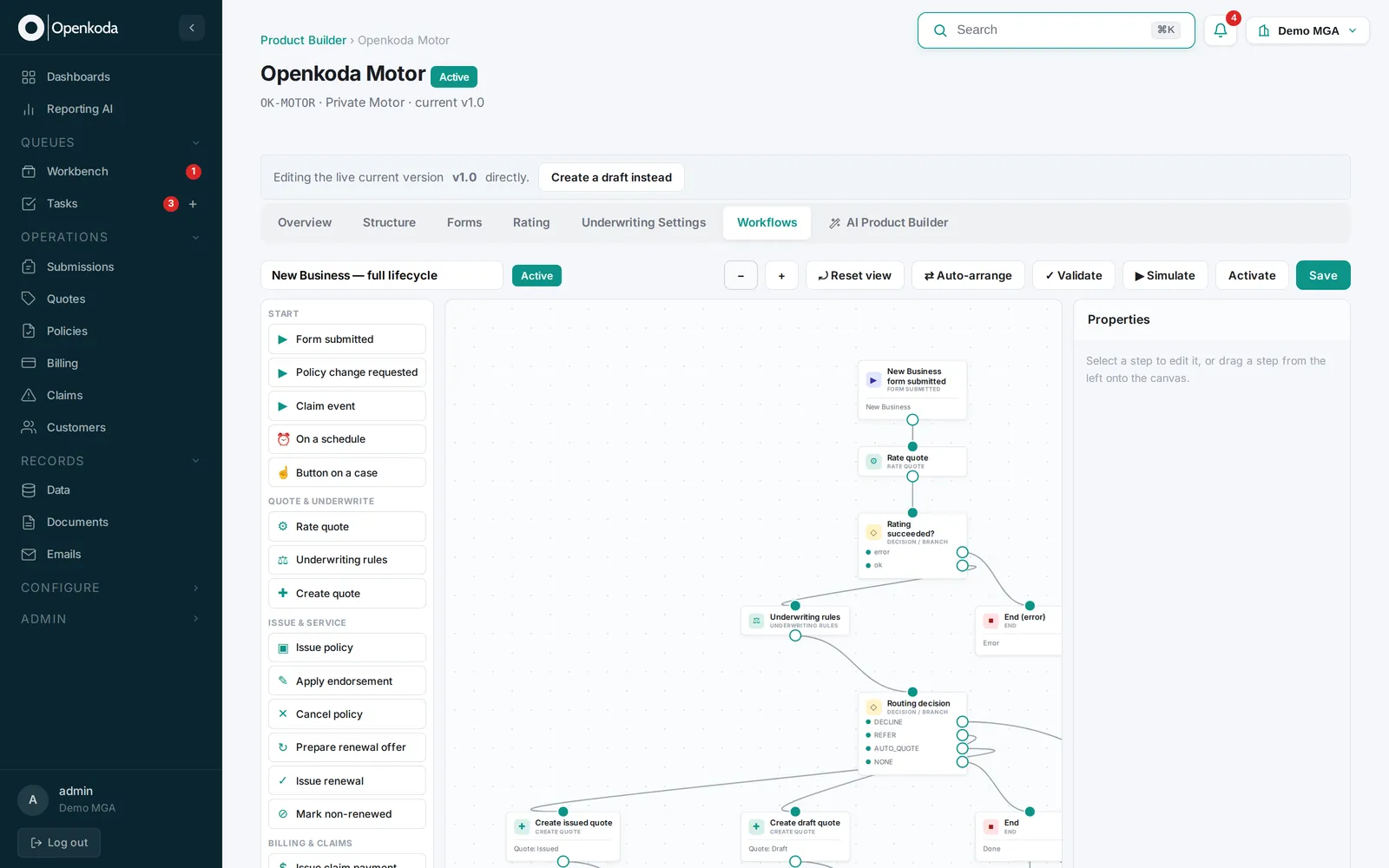
This is the design of Openkoda's insurance automation engine. Openkoda is a highly customizable, AI ready policy administration system, and its workflows run on the same records as policy, rating, billing and claims.
A step can rate a risk, evaluate underwriting rules, issue, endorse or renew a policy, generate documents, send email, or call AI to summarize or classify. Runs are versioned, so cases in flight keep the version they started on, and a whole flow can be simulated before it goes live.
The trade-off is real.
Openkoda does not carry the decades of accumulated functionality that Guidewire or Duck Creek do, and on a feature count it does not win.
What it gives instead is full code ownership and customization with no ceiling: the data model, workflows and screens change to fit the process, rather than the process bending to the platform. The step-by-step tutorial shows a claim acknowledgment being automated end to end.
The six below span all three forms: an RPA platform, a process platform with insurance applications, three core systems with automation built in, and an insurance document AI. None of them publishes pricing except Openkoda.
| Vendor | Type | What it automates | Deployment |
|---|---|---|---|
| UiPath | RPA and agentic automation | FNOL triage, submissions, endorsements, reconciliation | On-prem, hybrid, cloud, air-gapped |
| Openkoda | Policy administration system | Quote, issue, endorse, renew, documents, billing | Managed cloud or on-premises |
| Appian | Process platform | Underwriting and claims workflows | Not stated on the insurance page |
| Guidewire | Core suite | Claims and policy workflows in InsuranceSuite | Guidewire Cloud |
| Duck Creek | Core suite | Billing, claims straight-through processing | SaaS on Microsoft Azure |
| Bevaya (Roots Automation) | Insurance AI | Document intake across underwriting, claims, servicing | Customer's own cloud |
UiPath sells RPA and agentic automation that runs across a carrier's existing systems rather than replacing any of them. Its insurance page names carriers and brokers as buyers, and its examples include robots that update Guidewire after AI classifies an endorsement.
Key features:
Best for: carriers and brokers with several legacy systems and no plan to replace them soon.
Openkoda is a highly customizable, AI ready PAS for insurers, MGAs, brokers and insurtechs, founded in 2022 and based in Wrocław, Poland.
Automation is part of the core system rather than an add-on: the workflow engine covers submission, quote, underwriting, issuance and renewal, and scheduled steps run renewals, reminders and dunning. The AI Product Builder applies product changes from plain-language instructions, reviewed before they go live.
Pricing is published on the pricing page: the Business plan, which includes the workflow, product and rating builders, is $2,000 a month on an annual contract, and AI runs on a separate subscription from $500 a month. A focused first deployment can target around three weeks.
Key features:
Suits MGAs and carriers that want automation and policy administration in one system they control.
Appian is a process automation platform with packaged insurance applications: Connected Underwriting for P&C and life, Connected Claims for intake, handling and triage with AI agents, a Life Underwriting Workbench and self-service portals. It names top-tier carriers, MGAs, MGUs and regional specialty insurers as buyers. Appian says customers pay for the automation and AI capabilities they use, without publishing figures.
Key features:
Best for: carriers that want a process layer over an existing core system.
Guidewire's InsuranceSuite is a core system for P&C carriers, and its automation runs inside the suite on Guidewire Cloud. Its developer documentation describes an Autopilot Workflow Service whose reference implementation automates a personal auto glass claim end to end, and its recent cloud platform release adds an agentic framework, with agentic FNOL in early access.
Key features:
Best for: Tier 1 and Tier 2 carriers already on, or moving to, Guidewire Cloud. Teams weighing a lighter option can read our Guidewire alternatives comparison.
Duck Creek, headquartered in Boston, delivers its P&C policy, billing, claims and rating applications as Duck Creek OnDemand, a SaaS platform on Microsoft Azure. Its automation is most specific in billing, with rules-based invoicing, collections and payment matching, and in claims, where it offers straight-through processing and automated coverage verification. Our comparison of P&C insurance billing software covers its billing product in more detail.
Key features:
Best for: P&C insurers that want a managed SaaS suite and accept its upgrade schedule.
Roots Automation now trades as Bevaya, and its InsurGPT engine reads insurance documents: submissions, loss runs, schedules of values and ACORD forms on the underwriting side; FNOL, medical bills, legal demands and invoices in claims; endorsements, certificates and premium audits in servicing. It is built for P&C carriers, brokers and TPAs, and runs in the customer's own AWS, Azure or Google Cloud account.
Key features:
Best for: carriers and TPAs whose bottleneck is reading documents rather than moving data between systems.
Start with the process, not the vendor. Take one flow that costs real hours today, a commercial submission or a claim acknowledgment, and ask each vendor to automate it in the demo with your documents rather than theirs.
Then ask where the logic will live. If the answer is a bot driving your core system, ask who maintains it when that system is upgraded. If it is a workflow inside the core system, ask whether your own analysts can change it, and whether a change applies to cases already in flight.
Ask what happens to the exceptions, since that is where the people you are keeping will spend their time.
Finally, check who owns the result. A workflow built inside a vendor's SaaS suite moves when the vendor's release schedule says so, and leaves with you only if the contract allows it.
Submission intake, rating and quoting for rule-based risks, policy issuance and documents, renewals, billing and collections, first notice of loss, simple claims settlement and bordereaux reporting. Complex commercial underwriting and disputed claims stay with people, with automation preparing the file.
Where a core system has no API and will not be replaced soon, yes: a bot is the quickest way to remove rekeying. Where the policy system can run workflows itself, automation on the record is easier to change and to audit.
It depends on the scope and on how many systems are involved. A single workflow inside an existing policy system can go live in weeks; automating across several legacy systems is a longer program. Openkoda targets around three weeks for a focused first deployment, with scope agreed upfront.
Billing is where a missed installment turns into a cancellation notice with a legal deadline. Nine P&C billing systems compared on bill types, delivery and pricing.
A policy administration system decides how fast business changes reach the policies you write. Key 2026 features, a buyer's checklist and 10 systems compared.
MGA policy administration software has to handle binders, referrals, bordereaux and commission for every capacity provider. What to look for, and 10 systems compared.
Book a live, personalized demo with our product team - tell us your use case and see the platform work with your data. No commitment.