How to Choose the Right Policy Administration Software in 2026
A policy administration system decides how fast business changes reach the policies you write. Key 2026 features, a buyer's checklist and 10 systems compared.
Billing is where a missed installment turns into a cancellation notice with a legal deadline. Nine P&C billing systems compared on bill types, delivery and pricing.

A commercial property insured misses the second of ten installments. In Florida, the carrier now has a clock to run: section 627.4133 of the state's insurance code requires “at least 10 days’ written notice of cancellation” when the reason is nonpayment of premium. Other states set their own periods.
Whether that notice goes out on day one, with the right wording, to the right address, depends almost entirely on the billing system.
Search for insurance billing software and half of what comes back is medical claims billing for clinics. This roundup is the other half: premium billing for property and casualty carriers and MGAs.
P&C insurance billing software issues premium invoices, runs payment plans, collects and allocates payments, chases delinquent accounts through to cancellation for nonpayment, and settles commissions and refunds. It sits beside the policy administration system and keeps the receivable in step with every endorsement, renewal and cancellation on the policy.
Who sends the invoice is the first thing that splits one billing system from another. Under direct bill the insurer bills the policyholder; under agency bill the agency does, and the insurer's ledger has to reconcile a statement rather than individual payments.
Direct Bill vs Agency Bill: Who Does What
Account bill and list bill group several policies or members on one invoice.
The insurance billing system glossary entry covers the mechanics in more depth. This post is about choosing one.
Feature lists from billing vendors read alike, so test these against your own book rather than a demo script.
The delinquency sequence is where those criteria meet a regulator. Each step below is a document, a date and a ledger entry, and a reinstatement has to unwind all of them.
From Missed Installment to Cancellation
The sequence a billing system runs when premium goes unpaid.
Notice period: Florida Statutes s. 627.4133. Other states set their own periods; sequence illustrative.
The nine systems below are listed with what each vendor states on its own site. Where a vendor does not publish something, the entry says so.
BillingCenter is the billing application in Guidewire's InsuranceSuite, alongside PolicyCenter and ClaimCenter. Guidewire's product page lists direct, agency, account and list billing in one platform, and commission handling that covers traditional, tiered and flat-rate structures.
Guidewire describes it as suitable for any size of insurer across personal, commercial and specialty lines, and cites more than 150 customers in 19 countries. Delivery is on Guidewire Cloud, though customer material on the same page still refers to self-managed installations.
Key features:
Best for large and mid-size carriers already on, or moving to, PolicyCenter. The limitation is the usual one for a suite application: BillingCenter is at its strongest inside InsuranceSuite, and pricing is not public. Our Guidewire alternatives comparison looks at the suite as a whole.
Openkoda is a highly customizable, AI ready policy administration system, and billing and payments is one of its ready modules rather than a separate purchase. Payment plans are monthly, quarterly or annual, configured per product. Invoicing, reminders, payment retries and cancellation for nonpayment run on rules the carrier or MGA sets, and every billing account carries its invoices, statements and aging.
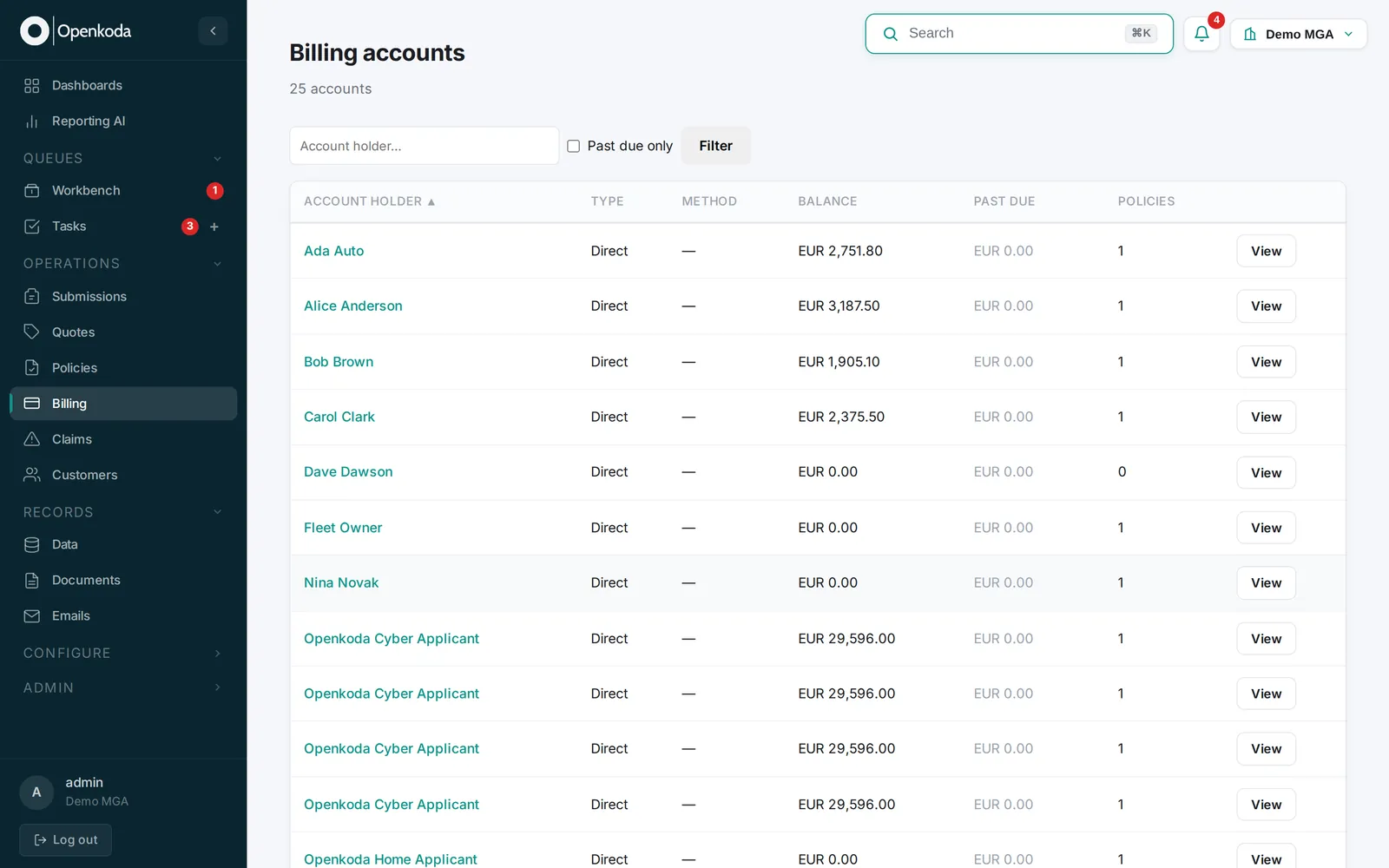
Because billing runs on the same platform as policy and claims, a mid-term endorsement changes the amount owed without an interface between two vendors' systems. Commissions are tracked and settled alongside billing.
BillingCenter and Duck Creek Billing carry years of accumulated billing functionality, and Openkoda's published module does not list agency bill statement reconciliation, list bill or lockbox processing. On Openkoda those are configuration or integration work to scope before signing. What a team gets in return is full code ownership and no ceiling on customization: the billing rules, data model and notices are reshaped to the business, and the configuration and data can be exported at any time.
Pricing is published on the pricing page: $2,000 a month for the Business plan and $4,000 for Enterprise, on annual contracts, with no per-seat, per-policy or percentage-of-premium fees. Stripe card payments are listed in the Enterprise plan. An On-Premise plan is priced to scope.
Key features:
Suits MGAs and carriers that want billing inside their PAS, predictable costs and the freedom to change how billing works without a vendor change request.
Duck Creek sells billing as a SaaS product on an API-first architecture, updated continuously through what the company calls Active Delivery. Its product material describes installment plans with recurring payments, automated cancellation and reinstatement driven by a business rule engine, automated producer commission calculations, and payment by ACH, cards, digital wallets and real-time payments.
The company is based in Boston. Duck Creek has announced that PURE Group, the high-net-worth personal lines insurer, is replacing an on-premises billing system with Duck Creek Billing, delivered through Duck Creek OnDemand.
Key features:
Best for P&C carriers that want billing as a managed SaaS service. Duck Creek's billing material does not spell out its direct and agency bill support or carrier size, and pricing is not public.
OneShield Billing is the billing and receivables component of OneShield Enterprise and OneShield Market Solutions. The product page has one of the more detailed lists in this roundup: agency and direct bill at policy and account level, configurable delinquency plans, mid-term rescheduling, the sequence from late notice to notice of cancellation, suspension and moratorium processing, disbursements and write-offs, and built-in commission management.
Moratoria are a real test after catastrophes. After Hurricane Milton, Florida's Office of Insurance Regulation issued Emergency Order 400386-24 on 16 October 2024: across 37 counties, deadlines on policyholders moved to 10 December, and insurers could not cancel or nonrenew a policy there without the policyholder's written request or agreement. A billing system that cannot hold a whole geography's delinquency cycle turns an order like that into manual work.
“OneShield Billing provides PMA the ability to adapt the premium billing system to accommodate changing business models.”
Susan Hendricks, VP of IT, PMA Companies
OneShield was founded in 1999 and is based in Marlborough, Massachusetts. Best for growth-stage insurers and MGAs across personal, commercial and specialty lines. The billing page does not state the deployment model or pricing.
Insurity took a different route in February 2026: rather than license billing software, it announced a service that runs payments, collections and reconciliation for the carrier, covering direct bill, agency bill and more complex billing structures, with lockbox through a third-party partner.
“Our customers are in growth mode. They want to issue more policies, not manage billing infrastructure.”
Jatin Atre, President, Insurity
The release names smaller carriers, mutuals and MGAs as the audience and claims a lower total cost than running billing in-house, with cost per transaction falling as volume grows. No price is published.
Best for carriers that want billing operations off their payroll as well as off their servers. The trade-off is control: a shared service runs on the provider's processes, and changes to how collections work go through that provider.
BillingCore is the billing component of EIS OneSuite, next to PolicyCore and ClaimCore, and EIS says it also works with a third-party PAS. Its billing page describes it as a SaaS platform with invoicing at any frequency, group list bill or individual premium accounting, fixed or variable broker and agent commissions, and a broker portal for commission statements.
Delinquency handling covers automated notices, refunds, tolerance checks and payment suspension. Retroactive repricing is listed too, which matters for group and payroll-based commercial lines where exposure is known only after the period ends.
Key features:
Best for insurers with group or list-billed business. Pricing is not public.
Majesco sells two billing products for P&C. The one worth singling out is CoreConnect Billing, which Majesco describes as purpose-built for MGAs, MGUs and specialty carriers, handling program-driven billing, delegated authority and multi-party settlements.
An MGA collects premium on behalf of one or more capacity providers, keeps its commission, and settles the rest through bordereaux on each carrier's schedule. A carrier billing system built around one insurer's receivable does not model that without customization.
Carrier Billing vs MGA Billing
Typical scope; delegated authority agreements vary.
Capabilities listed include invoicing, adjustments, collections, rules-driven premium and payment logic, and reconciliation, on a cloud-native architecture. Majesco is based in Morristown, New Jersey. Installment, commission and cancellation detail is not itemized on the page, and pricing is not public.
Best for MGAs and program administrators with delegated authority. Our roundup of MGA policy administration software covers the systems these billing modules attach to.
Socotra Billing is a separate module beside Socotra Policy in the Socotra Insurance Suite. Its product page is built around a double-entry ledger, with each transaction previewable, reversible and auditable.
The workflow list is long: renewals, cancellations, reinstatements with or without a gap, grace periods, delinquencies, invoicing holds, write-offs, overpayments and underpayments, and temporary suspensions. Socotra names more than ten integrated payment processors, including FIS, One Inc, Paymentus and Stripe, and lists lines from personal and commercial through embedded insurance, telematics and parametric.
Best for insurtechs and carriers building digital or embedded products that need billing exposed through APIs. Socotra does not state commission handling, deployment detail or pricing on the page.
Diamond Billing is the billing module of Insuresoft's Diamond platform. The vendor page lists agency and direct bill, user-defined pay plans with installments and down payments that can be changed mid-term, automated nonpayment cancellations and reinstatements, payment by card, EFT, check, cash and lockbox, and tax and fee calculation on invoices.
In April 2026, Input 1 announced that it had embedded its billing and payment infrastructure in Diamond for VGM Insurance Services, which was moving onto the platform. Tera O'Hare, VGM's SVP of Technology, said that “maintaining billing continuity was critical to this transition”.
Best for regional P&C carriers that want billing and policy from one mid-market vendor. Deployment model and pricing are not stated on the billing page.
| System | Built for | Bill types stated by vendor | Delivery | Pricing |
|---|---|---|---|---|
| Guidewire BillingCenter | Insurers of any size, all P&C lines | Direct, agency, account, list | Guidewire Cloud | Not public |
| Openkoda | MGAs, carriers wanting billing inside the PAS | Per-product payment plans | Managed cloud or on-premises | From $2,000/month |
| Duck Creek Billing | P&C carriers | Installments; bill types not itemized | SaaS | Not public |
| OneShield Billing | Insurers and MGAs | Direct, agency, policy and account level | Not stated | Not public |
| Insurity Billing-as-a-Service | Smaller carriers, mutuals, MGAs | Direct, agency, complex structures | Managed service | Not public |
| EIS BillingCore | Insurers with group business | List bill, individual | SaaS | Not public |
| Majesco CoreConnect Billing | MGAs, MGUs, specialty carriers | Program and multi-party | Cloud-native | Not public |
| Socotra Billing | Digital and embedded insurers | Installments; bill types not itemized | Cloud | Not public |
| Insuresoft Diamond Billing | Regional P&C carriers | Direct, agency | Not stated | Not public |
Eight of the nine do not publish a price. For the policy systems these modules attach to, see our list of P&C insurance software vendors, the wider guide to core systems, and how to choose policy administration software.
Under direct bill, the insurer invoices the policyholder and collects the premium, then pays the agent's commission. Under agency bill, the agency invoices and collects, keeps its commission and remits the net premium to the insurer. Billing software has to reconcile both, often for the same carrier.
Yes, and several vendors here sell billing on its own: EIS says BillingCore runs with third-party policy systems, and Insurity's service is built for that case. The cost is a permanent integration that has to carry every endorsement, cancellation and reinstatement between the two.
Usually. An MGA bills on behalf of capacity providers, settles with each of them on its own schedule and keeps its commission in between, which is a multi-party ledger rather than a single insurer's receivable. Majesco's CoreConnect Billing is built for this, and MGA software with billing in the same system avoids reconciling the bordereau against a separate ledger.
Most vendors quote privately, and suite billing is usually priced as part of a core system contract. Openkoda publishes its prices: the full platform, billing included, starts at $2,000 a month on an annual contract.
A policy administration system decides how fast business changes reach the policies you write. Key 2026 features, a buyer's checklist and 10 systems compared.
MGA policy administration software has to handle binders, referrals, bordereaux and commission for every capacity provider. What to look for, and 10 systems compared.
An insurance CRM tracks clients, pipeline and renewals. It does not rate an endorsement or bill an installment. Six CRMs compared, and where the policy record lives.
Book a live, personalized demo with our product team - tell us your use case and see the platform work with your data. No commitment.