9 Best Insurtech Platforms in 2026
A breakdown of the leading insurtech platforms in 2026, from core systems like Guidewire and Duck Creek to Openkoda, Socotra, Foliume, and HealthEdge.
Why classic custom insurance software builds run long and costly, and how Openkoda's ready-to-use foundation cuts development time and cost by up to 60%.

Insurance is changing fast. New products, embedded distribution, real-time risk data, and rising customer expectations all push carriers and insurtechs to build software that fits their business – not the other way around.
Custom insurance software development promises that fit. For insurers, bespoke software solutions simplify traditionally complex and highly regulated processes such as underwriting, claims processing, risk assessment, and customer service. By automating routine tasks, software improves accuracy, reduces human error, and frees up employees to focus on strategic activities that require human insight.
That all sounds great but this whole process also brings long timelines, technical risk, and a maintenance burden that can slow growth just when you need speed.
First of all there's the issue of finding a reputable vendor. Choosing a vendor for custom insurance software is rarely about raw coding skills. It's about domain fluency. Many capable software houses can ship a web app; far fewer understand how a quote becomes a policy, how commissions flow across channels, or how an audit trail must look to satisfy regulators. Without that context, projects drift. Requirements balloon. Integrations with core systems, accounting, and rating engines take longer than planned, and compromises creep into the design.
There's also the "invisible half" of the work: compliance, data retention, permissions, and operational reporting. These aren't optional in insurance - they're table stakes.
A greenfield build looks appealing until you account for everything beyond the user stories. Before a single quote is generated, a team must design and implement authentication, authorization, user and role management, audit logs, admin consoles, configuration management, environments and CI/CD, monitoring, alerting, backups, and security hardening. None of this creates business differentiation – yet it can consume months and a sizable chunk of the budget.
So you've decided to take advantage of professional insurance software development services. What can you look forward to? Let's divide the entire process of insurance software development into five key phases.
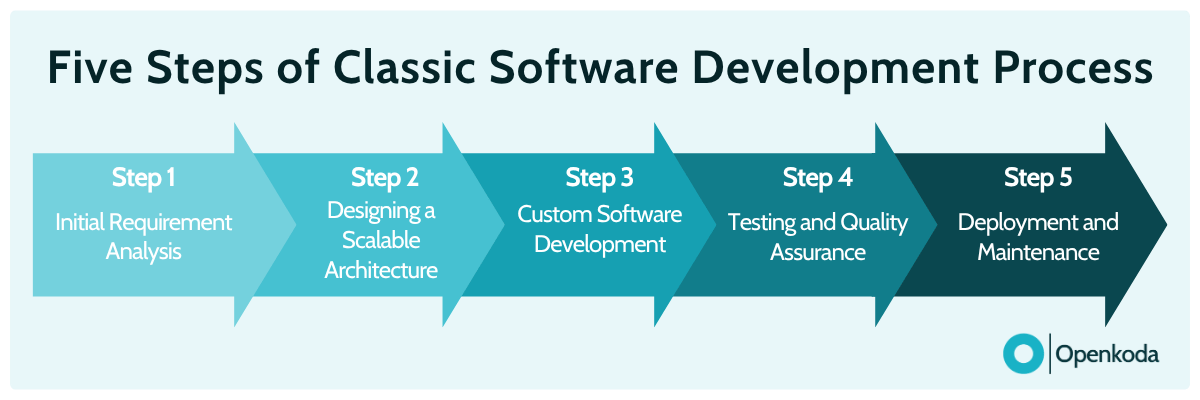
The first step is to gather detailed information about your needs as an insurer. In this phase, you and your stakeholders - such as business leaders, IT teams, and end-users - work together to define the project's scope, identify core functionalities, and prioritize features.
To clarify your objectives, ask yourself:
This analysis is crucial in ensuring that the software addresses the unique challenges and opportunities of the company, from regulatory compliance to customer-specific demands. Once you have done that, you can start searching the insurance software development market to find the right vendor to help bring your vision to life.
Architecture design isn't a quick workshop – it involves security reviews, data-classification decisions, integration strategies for legacy systems, and non-functional requirements (availability, performance, disaster recovery). Approaches like microservices, multitenancy, and well-designed RESTful (or event-driven) APIs can help components evolve independently. But each choice adds design work, proof-of-concepts, and governance approvals. This is a common underestimation point: the "thinking time" and review cycles are real effort, not overhead you can wish away.
Now comes the brunt of the work. Developing core functionality in a modular, insurance-specific system is both time-consuming and technically complex. Unlike out-of-the-box solutions, custom software development involves writing and testing each module independently, while ensuring seamless interaction between components.
For example, modules for underwriting, policy issuance, and claims automation must be self-sufficient yet interoperable. This is where many decision-makers underestimate cost and time. Beyond coding, you're funding:
Testing is a crucial and time-intensive phase in developing your insurance software, going beyond standard quality assurance. At this stage, you'll conduct thorough functional, performance, and compliance testing to ensure every module is accurate, resilient, and reliable in real-world conditions. Because insurance data is highly sensitive and subject to strict regulations, testing must cover a wide range of scenarios to confirm how the system handles edge cases and safeguards against data breaches.
At last, there's software deployment. It is usually a gradual and ongoing process. A careful deployment plan is essential to ensure minimal disruption, especially when integrating with legacy systems or external platforms. Even with CI/CD pipelines to expedite updates, each deployment step involves precise coordination, thorough verification, and real-time monitoring.
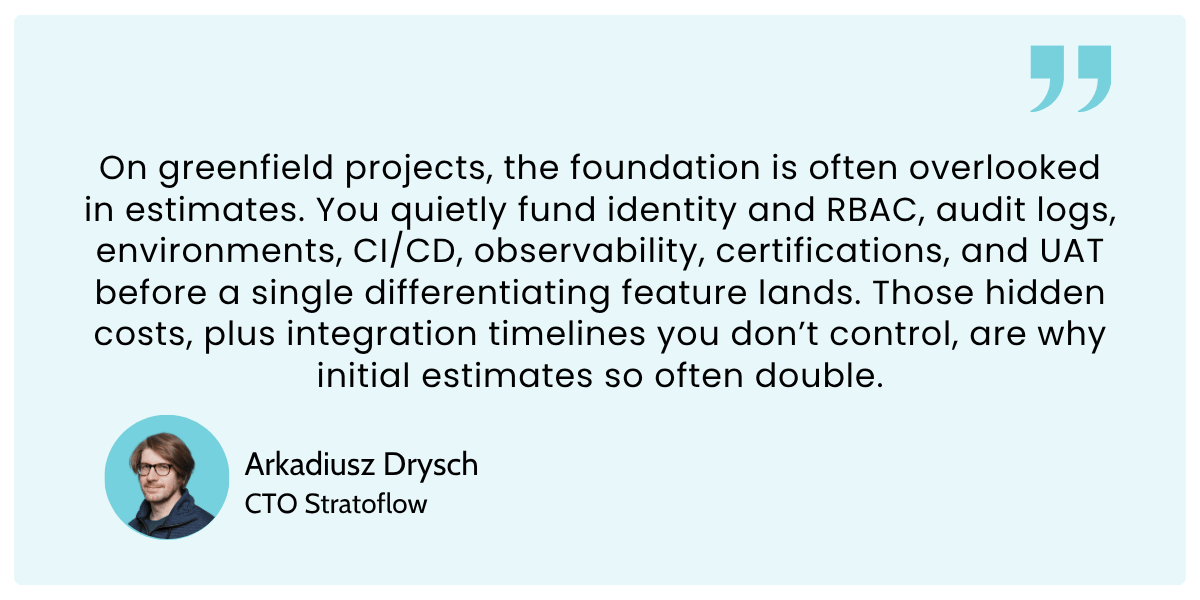
Coming out of the classic development steps, the pattern is hard to miss: a greenfield build absorbs months of effort before it delivers visible business value. Foundations like RBAC, audit trails, environments, CI/CD, observability, and security hardening quietly eat the early sprints. Domain complexity and external integrations then add dependencies and certification windows you don't control. Testing, UAT, and performance tuning extend timelines further, and the first months after go-live are often a second budget of fixes, training, and hypercare.
Many managers underestimate these costs because they don't appear on the initial feature list – but they're unavoidable in custom insurance software projects.

So that's, in a nutshell, how a classic custom insurance software development works. Unfortunately, this approach can be both time-consuming and expensive.
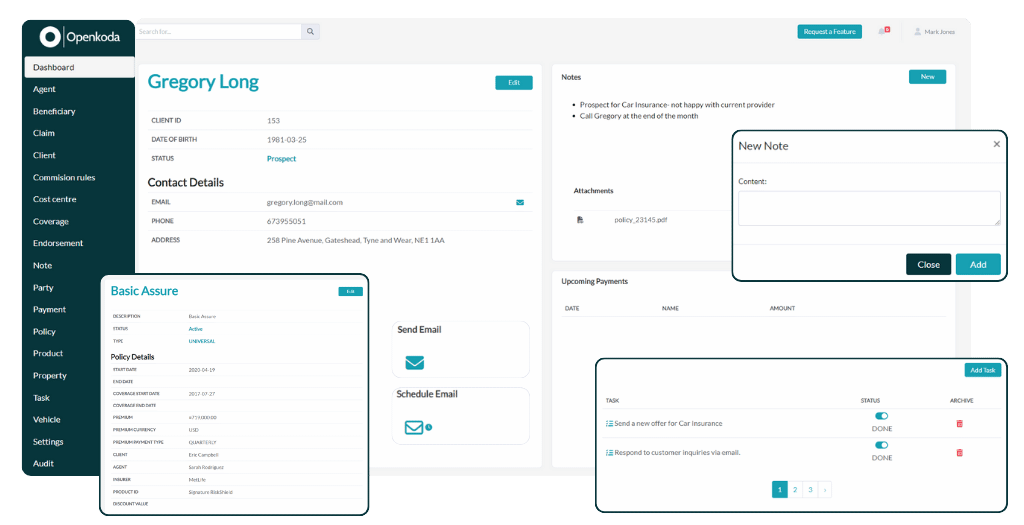
Openkoda offers a powerful alternative for insurers seeking a more efficient way to develop and deploy custom insurance solutions. With its flexible and scalable framework, Openkoda allows insurers to build custom applications faster without sacrificing quality or functionality. By leveraging pre-built modules and components, it minimizes the need for extensive coding from scratch, significantly accelerating the entire development process.
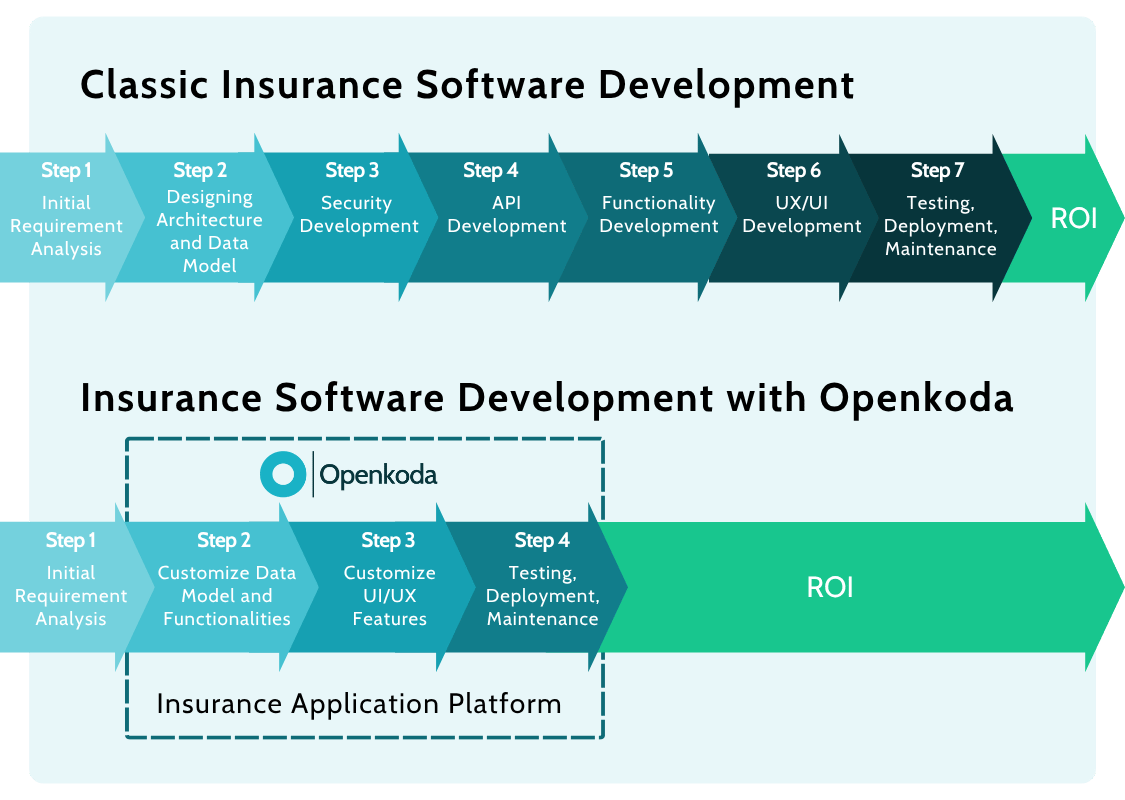
Openkoda can reduce the time and costs of insurance software development by up to 60%.
How does it achieve this? The key lies in eliminating the need to start from scratch when building custom insurance solutions. Openkoda offers insurers a ready-to-use foundation that can be tailored to meet their specific business needs.
Let's say you want to build custom claims management software. With Openkoda, you gain access to a claims management software template that includes all the essential functionalities such systems require, such as role-based privileges, authentication, dashboards, automation, an admin panel, and much more. These foundational features typically take significant time and effort to develop from scratch, but with the Openkoda platform, they're already pre-built for you.
You can use this robust foundation to easily extend, integrate, and customize your application, transforming it into your own unique insurance solution without limitations and vendor lock-in. This allows you to focus on the features that provide the most value to your organization.
Additionally, you won't need to deal with proprietary technologies or programming languages. The Openkoda platform is configured rather than coded, so your business team owns day-to-day change and developers step in only where you want them to.
Openkoda aims to modernize legacy insurance systems by providing a scalable and extendable framework upon which insurers can build their brand-new tailored software architecture for maximized efficiency.
If you choose to work with an insurance software development company, the cost of creating custom insurance software can vary significantly based on the project's scope, features, and complexity. Key factors influencing these costs include:
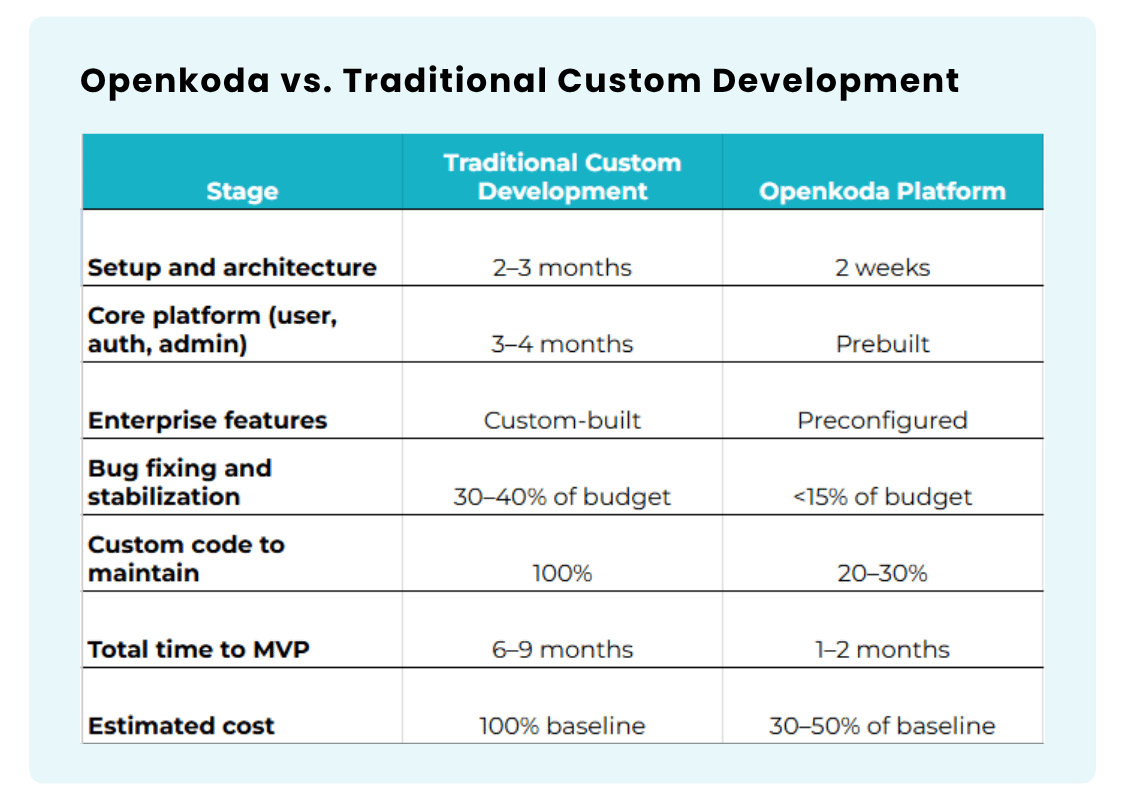
A greenfield project typically spends its early budget on foundations - RBAC, audit, admin UI, environments, CI/CD, observability, security hardening - before a single business feature goes live. That pushes MVP timelines into the 6–9 month range and creates a larger surface area to stabilize post-launch. With Openkoda, those foundations are in place from day one, so teams move straight to product logic and integrations, bringing MVPs into the 1–2 month window in many cases.
Upfront cost follows the same pattern. Starting from scratch means paying for the platform and the application; Openkoda means paying mostly for the application layer. In practice, clients often see initial build costs land at roughly 30–50% of a comparable greenfield baseline.
To better understand the scope of insurance software development services, let's explore the key systems an insurance business might want to develop. We'll also look at the foundation Openkoda provides for each of them.
Claims management software is a critical component of the insurance ecosystem. It enables insurers to handle claims efficiently, from initial notification to settlement. The software automates the claims process, ensuring accurate data collection, timely communication and proper assessment of claims. This reduces administrative burden and helps minimize errors, ultimately leading to faster resolution times and improved customer satisfaction.
For the vast majority of insurance companies, efficient claims management is critical because it has a direct impact on the customer experience and operational costs. An insurance company that operates in unique niches, such as insuring rare collectibles (e.g., vintage cars or fine art), may opt for custom claims management software to handle highly specialized workflows, such as detailed appraisal integrations or niche-specific risk assessments, that are not supported by generic solutions.

Insurance policy management software is a type of document management software designed to manage the entire lifecycle of an insurance policy, from quoting to renewal and cancellation. Compared to claims management software, which focuses on efficiently handling claims from initiation to resolution, insurance policy management software is designed to manage the entire lifecycle of an insurance policy and is a much more comprehensive solution when it comes to handling insurance processes.
This software centralizes policy information and provides insurers with a single view of customer data, policy status, and related documentation.
Learn how to build custom policy management application in 5 minutes using Openkoda
Custom embedded insurance software integrates insurance products into third-party platforms, creating a more seamless experience for consumers. Judging by recent examples, embedded insurance is a hot trend in the industry today because it allows insurers to be present at the point of sale, making coverage options readily available when customers need them most.
The idea behind embedded insurance is to remove friction and create a more convenient, integrated customer journey. By embedding insurance offerings directly into other services – such as e-commerce platforms or travel booking sites – insurers can reach customers at the point of need. This type of software requires flexibility and strong API integration capabilities to connect with multiple partners.

For insurers, embedded insurance opens new distribution channels, increases customer convenience, and drives higher conversion rates by meeting customers where they are on their digital journey.
Custom underwriting software uses data analytics, AI, and machine learning to assess risk and make informed underwriting decisions. By automating parts of the underwriting process, this software can improve accuracy, reduce manual tasks, and ensure consistency in risk assessments. Insurers benefit from faster underwriting decisions, better risk management, and reduced processing times.
In an industry where accurate risk assessment is fundamental, custom underwriting software enables insurance companies to improve their pricing models and more effectively mitigate potential losses.

Customer relationship management (CRM) software is essential to building and maintaining strong relationships with policyholders. Custom insurance CRM systems are tailored to the specific needs of insurers, allowing them to manage customer interactions, improve insurance operations, track leads, and personalize communications. A well-designed CRM system helps insurers understand customer preferences, anticipate their needs, and deliver targeted marketing campaigns.
Effective CRM systems are critical to fostering customer loyalty, improving service quality, and driving business growth by providing actionable insights into customer behavior.

In the fast-changing and digitalizing insurance industry, one-size-fits-all solutions often fall short. Custom software gives your business a competitive edge by tailoring systems to your unique needs. Here are the key benefits of choosing custom insurance software solutions:
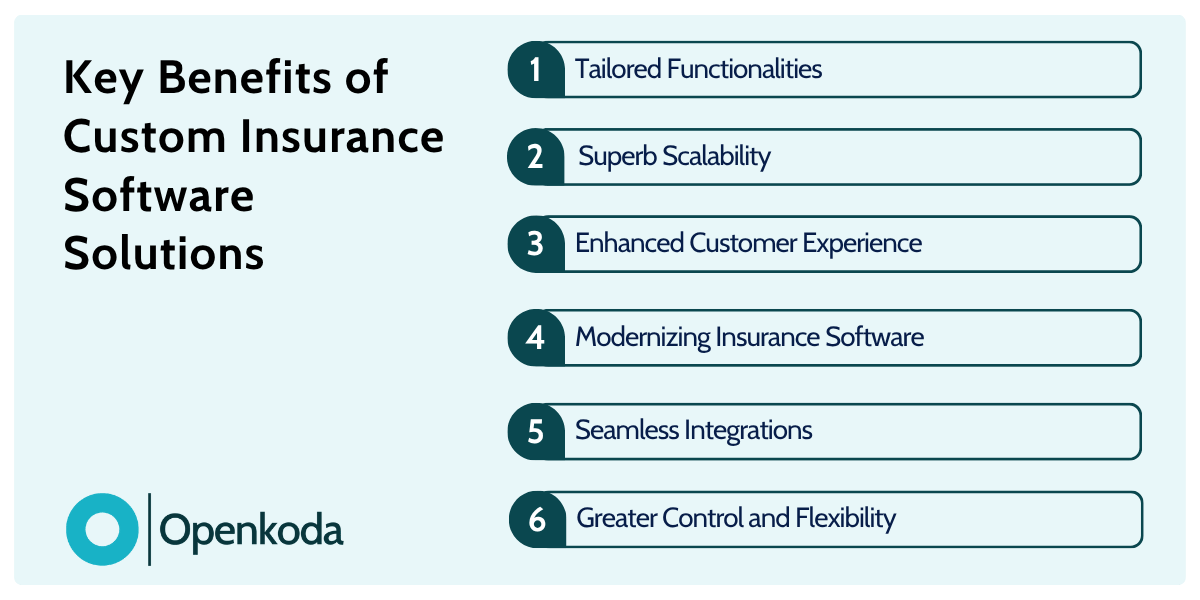
Custom software lets insurers design features and functionalities tailored to their unique business challenges. Unlike off-the-shelf solutions, custom systems can be precisely aligned with your company's specific requirements, leading to more efficient operations and a higher return on investment. Custom insurance software is unfortunately very costly to develop and takes a lot of time and effort.
But there's another option - a middle ground. The Openkoda insurance software development platform gives you the best of both worlds. It combines the cost efficiency of ready-made systems with the customizability and ownership of fully bespoke solutions.
As insurance companies grow, so do their software needs. Custom software solutions are built for scalability, enabling your system to expand with your business without major rework or the limitations of legacy systems. This means you can easily add new features, integrate with additional systems, or manage larger data volumes as your needs evolve.
Custom solutions empower insurers to deliver seamless and personalized customer journeys. With systems like claims management software, customer portals, and policy management tools, you can leverage your data to the fullest, reduce response times, and offer tailored products that meet each customer's unique needs.
Custom insurance software development modernizes legacy systems in the insurance industry by addressing specific business needs, enabling seamless integration with modern technologies, and enhancing scalability and adaptability. Openkoda goes a step further by offering an enterprise platform that accelerates the development of modern insurance applications, empowering companies to update their legacy systems with greater efficiency.
With Openkoda, insurance companies can streamline the launch of new insurance products and distribution channels, ensuring a smooth transition from outdated systems to cutting-edge solutions.
Integration is crucial for insurance companies, especially larger ones. Custom software can be built to seamlessly integrate with your existing systems, minimizing disruptions and creating a unified IT ecosystem. This ensures that all parts of your business work together efficiently.
With custom software, insurers have full control over their system's features, updates, and modifications. This level of control ensures that the software evolves based on the business's changing needs, without being dependent on third-party vendors or dealing with licensing restrictions.
Custom insurance solutions allow companies to stand out in a competitive marketplace. By developing unique features and offering superior service through tailored systems, insurers can differentiate themselves from competitors and build strong, lasting customer relationships.
The insurance industry handles highly sensitive customer data, making security an absolute priority. Custom software provides insurers with the ability to implement tailored security protocols designed to address their specific needs. This includes features such as advanced encryption, secure authentication methods, and regular security updates to protect against evolving threats.
By designing solutions that align with both internal policies and regulatory requirements, insurers can significantly reduce the risk of data breaches, safeguard customer trust, and ensure compliance with industry standards.
Selecting the right partner for your insurance software development is critical to ensuring the success of your project. A great starting point is Clutch, a platform that provides verified reviews and ratings of top software development companies. Look for firms with experience in the insurance industry, a strong portfolio of relevant projects, and positive client testimonials.

Consider their technical expertise, especially in areas such as regulatory compliance, scalability, and integration with third-party services that are critical to insurance software. In addition, evaluate their approach to communication and project management to ensure a smooth collaboration.
If you decide to build your system with Openkoda, we can further simplify the process. Our development team specializes in customizing and extending Openkoda's robust foundation into a full-fledged insurance application tailored to your business needs. This approach not only accelerates development, but also ensures a cost-effective solution that meets the unique requirements of the insurance market.
With our expertise, you can quickly transform Openkoda's powerful framework into a customized, enterprise-class application.
Custom insurance software solutions provide insurers with the flexibility and functionality needed to stay competitive in today's marketplace. However, the cost and time associated with development can be a significant barrier. Platforms like Openkoda offer a great way to reduce costs and speed up the development process, making custom insurance solutions more accessible to a wider range of companies.
A breakdown of the leading insurtech platforms in 2026, from core systems like Guidewire and Duck Creek to Openkoda, Socotra, Foliume, and HealthEdge.
The best claims management software solutions for 2026, comparing Openkoda, Duck Creek, FileHandler, Guidewire ClaimCenter, Origami Risk, and Snapsheet.
A 2026 rundown of the leading insurance policy administration systems, from Guidewire and Duck Creek to Openkoda, with strengths and ideal use cases.
Book a live, personalized demo with our product team - tell us your use case and see the platform work with your data. No commitment.