UK MGA Insurance Market Report 2026
UK MGAs wrote about £7.2bn of premium in 2025, up a fifth. Lloyd's, the FCA, the PRA and the capital behind MGAs spent the same year deciding how much of it to trust.
What an insurance agency management system is, its key benefits and features, and how to build your own bespoke platform with Openkoda.

Agency Management Software AMS is the software designed to handle the day-to-day tasks that keep an agency running – organizing client data, managing policies, processing claims, and streamlining communication with both carriers and customers.
Think of it as a central hub where all the essential information and processes converge.
For insurance agencies, time and accuracy are everything.
Unlike generic CRM or ERP systems, insurance agency software is built specifically for the needs of the insurance sector.
That means it doesn't just track clients – it understands policy renewals, commission structures, underwriting workflows, and the compliance requirements unique to the industry. In other words, it is tailored to the data types and workflows of the industry.
It is also worth mentioning that in 2025, modern AMS platforms often go beyond simple record-keeping.
They integrate with carriers, offer customer self-service options, and automate repetitive insurance agents tasks like document generation or reminders for policy renewals.
By consolidating all these functions into one place, an AMS reduces operational silos and gives agencies a single source of truth.
For most independent agencies, and the carriers that depend on them, an Agency Management System (AMS) is the key operating system of the business – its software core.
By 2025, adoption of agency management systems is nearly universal.
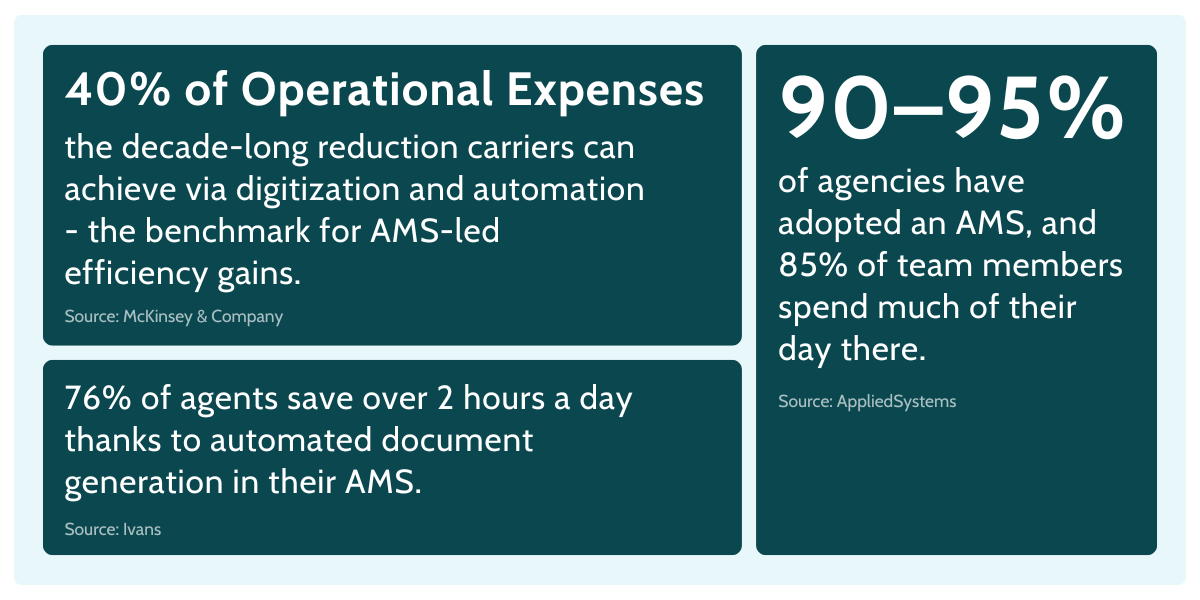
In the U.S., more than 9 out of 10 independent agencies report using an AMS. Even among smaller agencies, the Big "I" Agency Universe Study shows penetration rates above 80%.
So, how do agencies actually use these systems in practice?
Most rely on the AMS for their core day-to-day tasks. Around 70 percent use it for eDocs and messages, more than 65 percent for billing and claims inquiries, roughly 60 percent for endorsements, and between 50 and 67 percent for quote bridging across both Personal and Commercial Lines.
Another clear trend is the growing importance of integrations.
In 2025, no AMS can stand on its own. Agencies increasingly depend on connected tools that plug into the system and extend its functionality. E-signature solutions are used by about 71 percent of agencies, personal-lines rating platforms by 57 percent, and integrated texting tools by 31 percent, according to Catalyit's 2024 research.
These figures highlight a broader reality: modern insurance agency management system has become a connected hub that anchors the agency's wider digital ecosystem – if you are still not using one your are missing
Implementing an Agency Management System can completely reshape how an agency operates.
Instead of juggling multiple disconnected tools and manual spreadsheets, everything lives in a single, organized environment.
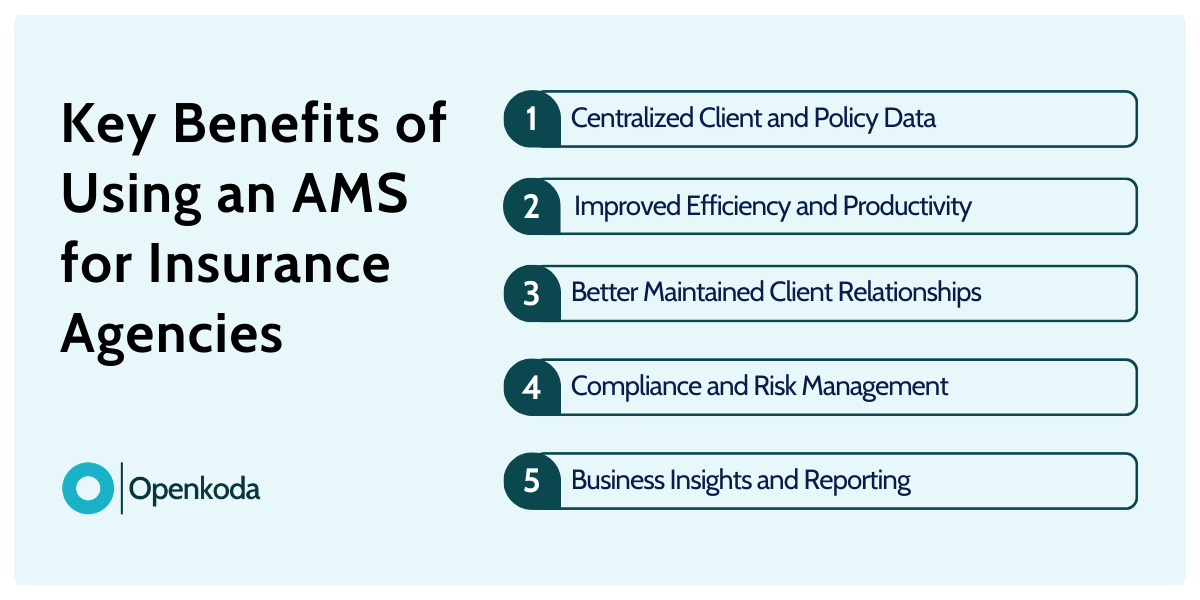
Benefits of such move will be visible in virtually all aspects of daily work of your insurance agents and agency principals as well.
Below we've picked some of the key benefits.
An important element of any good AMS is policy management software.
It keeps all client information, policy details, and communication history in one place.
Agents no longer need to dig through emails, shared drives, or paper files to find a piece of information.
With everything centralized, agencies reduce duplication, avoid mistakes, and have a complete view of their customer relationships.
By automating repetitive tasks – like generating renewal notices, producing policy documents, or syncing data with carriers – an AMS frees up valuable time.
Agents spend less effort on administrative work and more on building relationships and growing the book of business.
Clients today expect quick answers and smooth service.
With an AMS, independent insurance agents can instantly pull up policy details, track claims, or process changes during a single call.
Some systems even provide customer portals, where clients can self-service basic tasks, further improving satisfaction and loyalty and building client relationships that can last.
Regulation is and always been a major factor in the insurance industry.
AMS platforms help independent agencies stay compliant by keeping thorough records, managing document retention, and ensuring data security.
This reduces the risk of penalties while also building trust with carriers and customers.
Most modern AMS solutions come with built-in reporting and analytics.
Agencies can track performance metrics, monitor revenue streams, identify which lines of business are most profitable and make data driven decisions. These insights support better strategic decision-making and long-term planning.
With our AMS system I can see the whole client story in seconds: policies, notes, claims, billing. That clarity wins retention. I cannot imagine my work without it.
Aaron Keaton, Agency Operations Manager
For many agencies, the real impact of an agency management system shows up in the small, everyday tasks.
Think about a typical morning at a mid-sized insurance agency.
Agents start by checking upcoming policy renewals. Instead of flipping through spreadsheets or email threads, they open the AMS dashboard, which immediately highlights all renewals due this week. Automated reminders are already sent to clients, so the agent can focus on follow-up conversations rather than chasing deadlines.
When a client calls with a question about their coverage, the agent can pull up the entire account history in seconds.
All policy details, past claims, and communication logs are stored in one place. This not only saves time but also strengthens client relationships, because the client feels recognized and well-served instead of being asked to repeat their history.
The same applies to document management. Certificates of insurance, policy documents, and claims forms are automatically generated and stored in the system.
Independent agents no longer waste hours searching shared drives or re-creating documents from scratch. Instead, everything is neatly organized, secure, and easy to share with clients or carriers.
By reducing administrative friction, an agency management system allows teams to spend more time on revenue-generating activities and less time on clerical work. This balance is what makes agencies more efficient, responsive, and competitive in a digital-first insurance market.
A good agency management system should make it easier to win business, service accounts, and understand how the agency is performing. The real test is how well its features work together: can a producer move from an initial enquiry to placement and renewal without repeatedly entering the same information?
When comparing insurance agency management software, look for these capabilities:
For a meaningful demonstration, give vendors a real agency scenario: an upcoming renewal with several market approaches, a mid-term change, and a commission discrepancy. Following that account through the system will reveal more than a tour of individual screens.
While the advantages are clear, not every agency management software solution fits the needs of modern insurance agencies. Choosing the wrong tool can actually slow operations down instead of improving them.
One of the biggest issues agencies face is vendor lock-in. Many platforms limit flexibility, making it difficult - or extremely costly - to migrate data, integrate new tools, or switch providers. This leaves agencies stuck with a system that no longer serves their needs.
Another common problem is user-based pricing.
As an agency grows and hires new agents and insurance professionals, costs can skyrocket. What looked affordable for a team of five becomes much less attractive for a team of fifty. This kind of pricing structure punishes business growth rather than supporting it.
Scalability is another concern. Some solutions work well for smaller firms but quickly run into performance or customization limitations as business expands. Agencies that adopt these tools often find themselves searching for a replacement system just a few years later.
These challenges highlight why it's important to carefully evaluate any agency management system before committing. The wrong choice can lead to unnecessary costs, wasted time, and operational frustration.
Agency management combines relationship management with detailed insurance administration. Producers need to track opportunities and placements; account handlers need reliable policy records; finance teams need visibility into commissions and payments. A customizable policy administration system can bring these activities together around the same client and policy data.

Openkoda is a highly customizable PAS that can be configured around an agency’s sales, servicing, and administrative workflows. For agencies placing business with carriers, it provides a central record of clients, placements, policies, and claims. Where an agency holds delegated authority, it can also support direct policy issuance, endorsements, and renewals. Explore Openkoda for brokers and agencies.
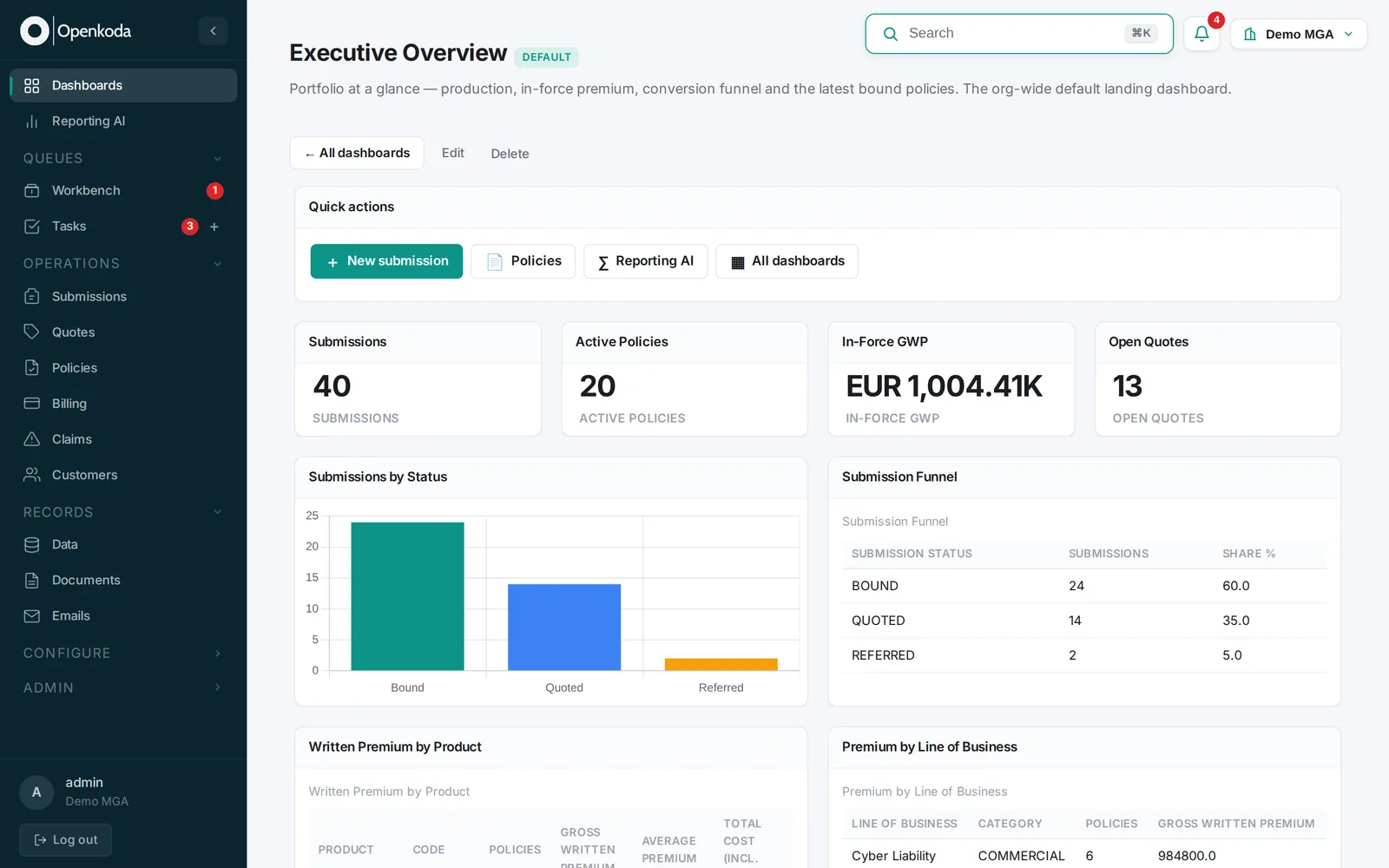
Openkoda’s connected modules support both everyday agency operations and more specialized distribution models:
These capabilities form part of Openkoda’s integrated PAS feature set, which can be configured to match the agency’s operating model.
Openkoda’s AI features address several time-consuming agency tasks. Document reading can extract information from submission attachments and prefill records for staff to confirm. AI steps within configured workflows can summarize information or draft client correspondence. These capabilities are available through a separate Openkoda AI subscription. Openkoda AI features.
Reporting AI also lets agency teams ask questions about their book in plain language. For example:
“Show policies renewing in the next 30 days, grouped by producer.”
Using the agency’s recorded policy and producer data, Reporting AI generates the report and displays the query behind it. The team can inspect the results, save the report, or export it to Excel. How Reporting AI works.
For an agency, the practical benefit is a system that can reflect its own renewal routines, placement processes, and service responsibilities. Openkoda provides the insurance functionality, while configuration and custom extensions shape how the team uses it.
Insurance agencies face growing pressure to work faster, stay compliant, and deliver better client experiences.
An agency management system – especially one tailored with tools like Openkoda – can provide real benefits business by bringing efficiency, flexibility, and control to daily operations.
The agencies that invest in adaptable systems today will be better prepared to meet tomorrow's challenges.

UK MGAs wrote about £7.2bn of premium in 2025, up a fifth. Lloyd's, the FCA, the PRA and the capital behind MGAs spent the same year deciding how much of it to trust.

Surplus lines grew 10.4% in 2025 while filings outran premium in 2026. What specialty products ask of a PAS, and five tests to run before you buy one.
Six of the best policy management software systems for 2026, split by what they actually do: insurance policy administration, or internal policy governance.
Book a live, personalized demo with our product team - tell us your use case and see the platform work with your data. No commitment.