Specialty Insurance Products: Market Trends, Challenges and Technology
Surplus lines grew 10.4% in 2025 while filings outran premium in 2026. What specialty products ask of a PAS, and five tests to run before you buy one.
Most of a new insurance product is standard policy administration. Scope the 80/20 split and spend the build budget on what makes the product different.

A new insurance product has two halves. There is the idea, which is where the value to the customer comes from, and there is the system that has to administer it once someone buys.
The second half is where most of the budget goes, and it is the half that decides how quickly the first one can change.
Investment in insurance technology has picked up again. Gallagher Re reported $2.44 billion of global insurtech funding in Q2 2026, the highest quarterly total since Q2 2022, though large rounds accounted for much of it, so the headline is concentrated investment rather than uniform growth. Gallagher Re’s Q2 2026 report.
AI adoption has broadened faster than AI deployment. EIOPA’s February 2026 survey of 347 insurers across 25 countries found nearly two-thirds actively using generative AI, with most still at proof-of-concept stage. EIOPA’s generative AI survey.
The gap between those two facts is the practical problem. Plenty of capital and plenty of pilots, and a long way still to travel between a working idea and a product that customers can buy and the business can service.
So you want to launch a new insurance product. What do you need?
Two things: the idea and the technology. The first creates value for the customer. The second decides whether you can deliver it, and how cheaply you can keep changing it.
Good product ideas come from somewhere specific: a risk nobody is writing yet, a channel nobody is selling through, or an experience customers have stopped tolerating.
New risk classes are the clearest example right now. AI liability went from a coverage debate to an underwritten line during 2026. HSB, part of Munich Re, launched AI liability insurance for small and medium-sized businesses on 18 March 2026, covering bodily injury, property damage, and personal and advertising injury arising from a business’s use of AI, which general liability policies often exclude.
All types of businesses are using AI to do things more quickly and efficiently.
Timothy Zeilman, global head of product ownership, HSB
It is not an isolated launch. Testudo went to market in January 2026 with Gallagher Re and MIT, aimed at larger enterprises deploying generative AI. Armilla and Chaucer followed in February with a structure pairing cyber and technology E&O against a standalone AI liability policy. Three products, three different answers to the same question about who pays when a model gets it wrong.
That is what an emerging risk looks like from a product team’s side: the exposure is real, nobody has settled on the wording, and the first movers are learning from live claims.
A product does not always have to reinvent the coverage. Sometimes the breakthrough is in how it reaches the buyer.
Embedded insurance is the clearest case: cover offered inside a transaction the customer is already completing. Travel platforms at checkout, e-commerce warranties, usage-based cover in a rental app.
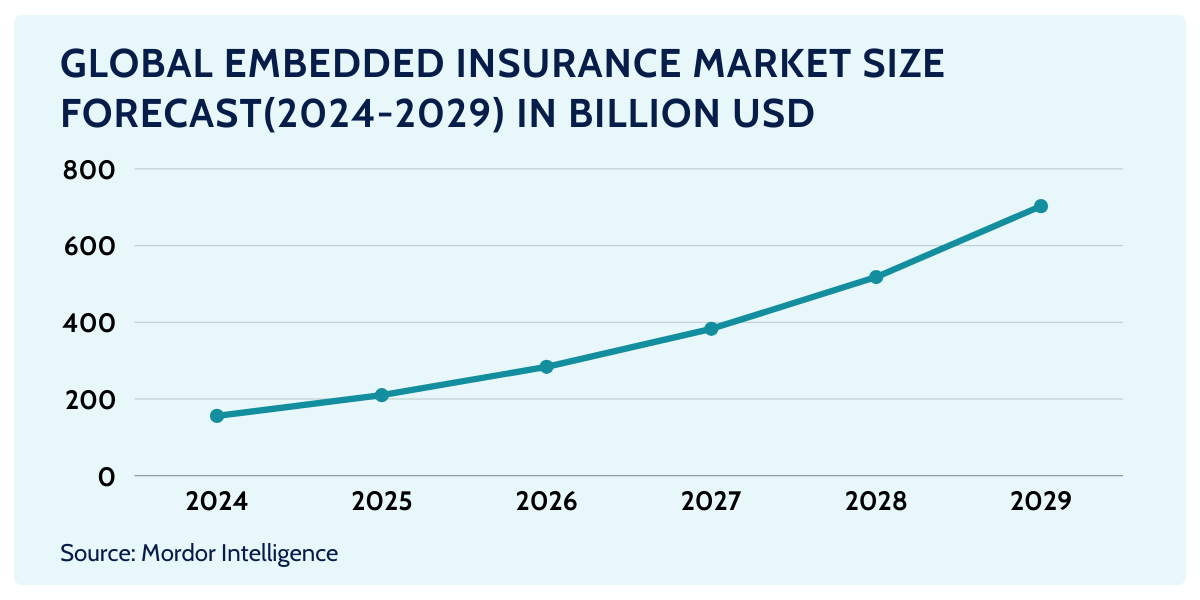
The scale is visible in carriers’ own reporting. Chubb told shareholders that more than 250 digital partners distribute through Chubb Studio, inside those partners’ own customer experiences rather than alongside them.
What customers want from that cover is more specific than “convenience”. Cover Genius and Gather surveyed 1,392 consumers across seven countries in 2026: 75% said they would buy more protection if payouts were automatic, and 71% said they would switch platform to get it.
What Buyers Say They Want From Embedded Cover
Two consumer findings and one carrier programme, all reported in 2026.
Cover Genius and Gather, 2026 Embedded Protection Report, 1,392 consumers across seven countries; Chubb 2025 letter to shareholders.
Those are stated preferences rather than observed behaviour. But they point somewhere useful, because automatic payment is a product design decision, not a marketing one. It requires a defined trigger, a verified data source, and a servicing path that runs without a handler opening the file.
AI belongs in a product idea when it changes what the customer gets, not when it appears in the pitch.
The useful applications are narrow and specific: pricing that reflects how an asset is actually used, intake that reads a document instead of asking the customer to retype it, a claim that pays on a measured event rather than an assessment. Each of those changes the proposition. A chatbot bolted to the front of an unchanged process does not.
The test is whether removing the technology would change what you are selling. If it would not, it is a feature of the website rather than the product.
A strong idea sets the direction. The system decides whether it can be delivered and, more importantly, how cheaply it can be changed afterwards.
That is where the first real constraints appear: time and cost.
Insurance products are not standard software. They have to carry risk modelling, underwriting rules, claims handling, regulatory compliance, fraud controls, and financial records, all of which have to agree with each other on every transaction.
The layers add up. A wrong technology choice early shows up later as rewrites, reconciliation work, and a launch date that keeps moving.
Before committing to a multi-month custom insurance software development project, ask whether the application really needs to be built from the ground up.
Start by listing everything it must do. Look beyond the distinctive product idea and map the operations needed to support it:
In many projects, that requirements list describes a policy administration system with specialized products, integrations, and custom workflows.
Apply an 80/20 lens to the scope: if roughly 80% is familiar insurance operations and the remaining 20% creates your differentiation, starting with a customizable PAS deserves serious consideration. The split is a planning rule of thumb; your requirements assessment should establish the actual balance.
Openkoda supports this approach. It is a complete, highly customizable PAS with ready modules for insurance operations. Your implementation starts with working functionality that can be configured and extended around your business.

Imagine an MGA launching cyber insurance for small professional services firms.
The proposed application needs a tailored risk questionnaire, pricing based on business characteristics, referrals for submissions outside appetite, and an integration with an external cyber-risk data provider. Brokers need a branded submission journey, while the MGA needs policy servicing, billing, documents, and reporting to its capacity provider.
The specialist requirements are important. But they sit alongside a substantial amount of familiar insurance administration.
| Requirement | Building the application from scratch | Working with the Openkoda team |
|---|---|---|
| Policy administration | Develop policy records, transactions, endorsements, renewals, and history | Configure the existing policy lifecycle around the cyber product |
| Specialist application questions | Build forms, validation, conditional questions, and data storage | Configure product fields and application forms |
| Pricing and underwriting | Develop rating logic, referral rules, work queues, and decision records | Configure rating tables, formulas, rules, and the underwriting workbench |
| External cyber-risk data | Build the provider connection and its interaction with the application | Scope the provider integration and connect its results to the configured workflow |
| Policy documents and billing | Build or integrate document generation, invoicing, and payment processes | Configure existing document and billing modules |
| Capacity-provider reporting | Build data extraction, reporting formats, and submission tracking | Configure bordereaux reporting around the agreed carrier requirements |
| Testing | Validate newly built components and the complete insurance journey | Validate configuration, extensions, integrations, and the complete insurance journey |
| Where development effort goes | Across the entire application and its specialist requirements | Primarily into requirements beyond the PAS’s existing capabilities |
The Openkoda approach draws on its existing policy administration, distribution, and bordereaux reporting capabilities. The external cyber-risk connection would be a separately scoped integration.
This changes the project’s economics. A greenfield budget has to cover both the standard insurance functionality and the specialist proposition. Starting with a ready PAS leaves more of that budget for the product, the underwriting approach, and the distribution experience that actually distinguish the business.
It also changes what the team can review early. Underwriters and operations staff can work through a configured insurance journey and find gaps before those gaps become assumptions embedded in custom software.
The first step is to establish how much of your application Openkoda already supports, and exactly where customization is needed.
The Openkoda team includes experienced insurance technology professionals, with custom development services available for requirements beyond standard configuration.
A focused engagement follows five practical steps:
Openkoda supports insurance product launches measured in weeks. A focused implementation can target around three weeks, with the schedule agreed during scoping. Extensive migration, complex integrations, or substantial bespoke development will affect that timeline.
The practical advantage is that the project begins with an operational PAS, so implementation concentrates on making it fit.
Openkoda provides ready insurance functionality that can be customized around your products and operations.
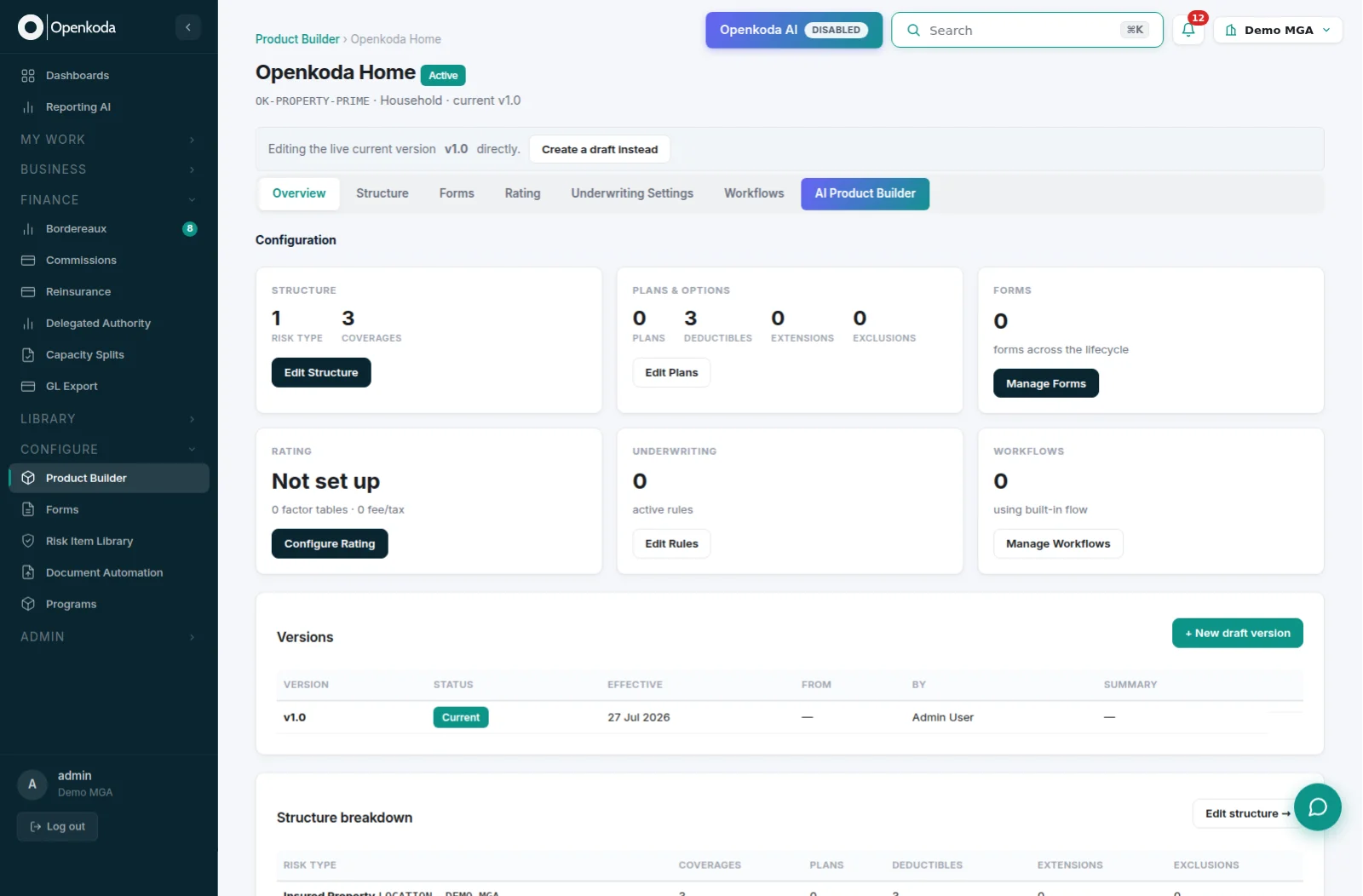
Five capabilities are particularly useful for shortening an implementation.
Those capabilities sit on role-based access, audit trails, data isolation, and exportable configuration and data. Deployment is managed cloud or your own environment.
Plan selection matters: portals, multi-organization support, and certain integrations are Enterprise capabilities, while AI features use a separate subscription. The published plans distinguish these from scoped customization work.
The benefit of a customizable PAS continues once policies are being written.
Returning to the cyber MGA, suppose underwriting wants to add an optional coverage and move a referral threshold. The team drafts the supported changes in the AI Product Builder, inspects the proposed configuration, and approves the new product version.
Operations can revise the associated workflow at the same time, adding an approval step or requesting another document before issuance.
Reporting AI handles the other half, questions such as:
How many cyber submissions were referred this month, grouped by broker and referral reason?
Where those fields are captured, the report gives the team a starting point for reviewing submission quality or bottlenecks.
That is the cycle worth designing for: launch the product, watch how it performs, and make controlled changes in the same system.
Starting with a customizable PAS suits:
A requirements assessment should also identify any essential capability that falls outside the PAS’s model. Those gaps decide whether targeted development is enough, or whether a broader custom build is justified.
Before commissioning a new insurance application, establish how much of it already exists in a modern PAS.
When the requirements center on policy administration with specialist workflows, starting from a configurable system reduces the amount of software you have to create and then maintain. It leaves your team more room for product design, underwriting, and distribution, and a shorter route to testing the proposition in the market.
Surplus lines grew 10.4% in 2025 while filings outran premium in 2026. What specialty products ask of a PAS, and five tests to run before you buy one.
Six of the best policy management software systems for 2026, split by what they actually do: insurance policy administration, or internal policy governance.
What to actually test in a mutual insurer's policy, claims, billing, portal and reporting systems, and which platforms are worth a shortlist.
Book a live, personalized demo with our product team - tell us your use case and see the platform work with your data. No commitment.