Specialty Insurance Products: Market Trends, Challenges and Technology
Surplus lines grew 10.4% in 2025 while filings outran premium in 2026. What specialty products ask of a PAS, and five tests to run before you buy one.
What digital transformation really means for insurers in 2026: drivers, benefits, common roadblocks and real-world examples across the value chain.

Digital transformation in insurance extends far beyond digitizing paper forms or launching customer portals. At its core, it involves rethinking how insurance products are developed, delivered, and serviced - leveraging modern technology to drive operational efficiency, create customer value, and unlock new business models.
This encompasses automating underwriting processes, implementing AI-based fraud detection, and offering usage-based insurance via connected devices. It also includes foundational shifts: integrating legacy systems with cloud platforms, adopting APIs for more agile partnerships, and developing scalable software architectures that allow insurers to iterate quickly.
The key insight is that digital transformation is not a one-off initiative but an ongoing strategy - a fundamental reshaping of how insurers operate and compete in a connected, fast-moving world.
Several converging factors pressure insurance companies to evolve. First, traditional operating models are reaching their limits. Legacy systems are expensive to maintain, difficult to adapt, and slow to integrate with new tools, hindering innovation particularly for specialized insurance products or embedded models.
Second, regulatory landscapes are evolving, demanding more transparency, real-time reporting, and better risk modeling - requirements nearly impossible to meet without digital infrastructures.
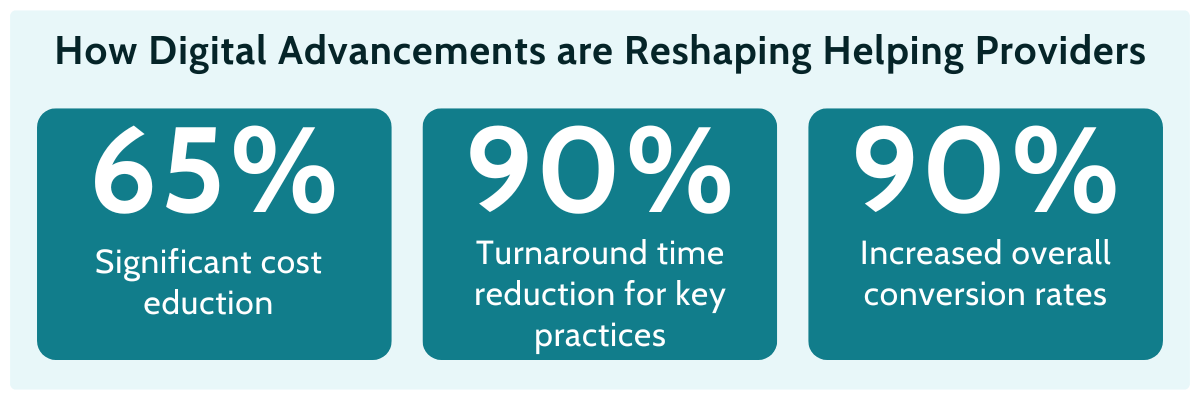
Third, insurtechs and digital-native startups are raising customer expectations through sleek, intuitive experiences with flexible policies and rapid service. Traditional insurers must respond or risk losing relevance.
Finally, forward-thinking executives understand that embracing digital transformation is about growth, resilience, and offering differentiated value.
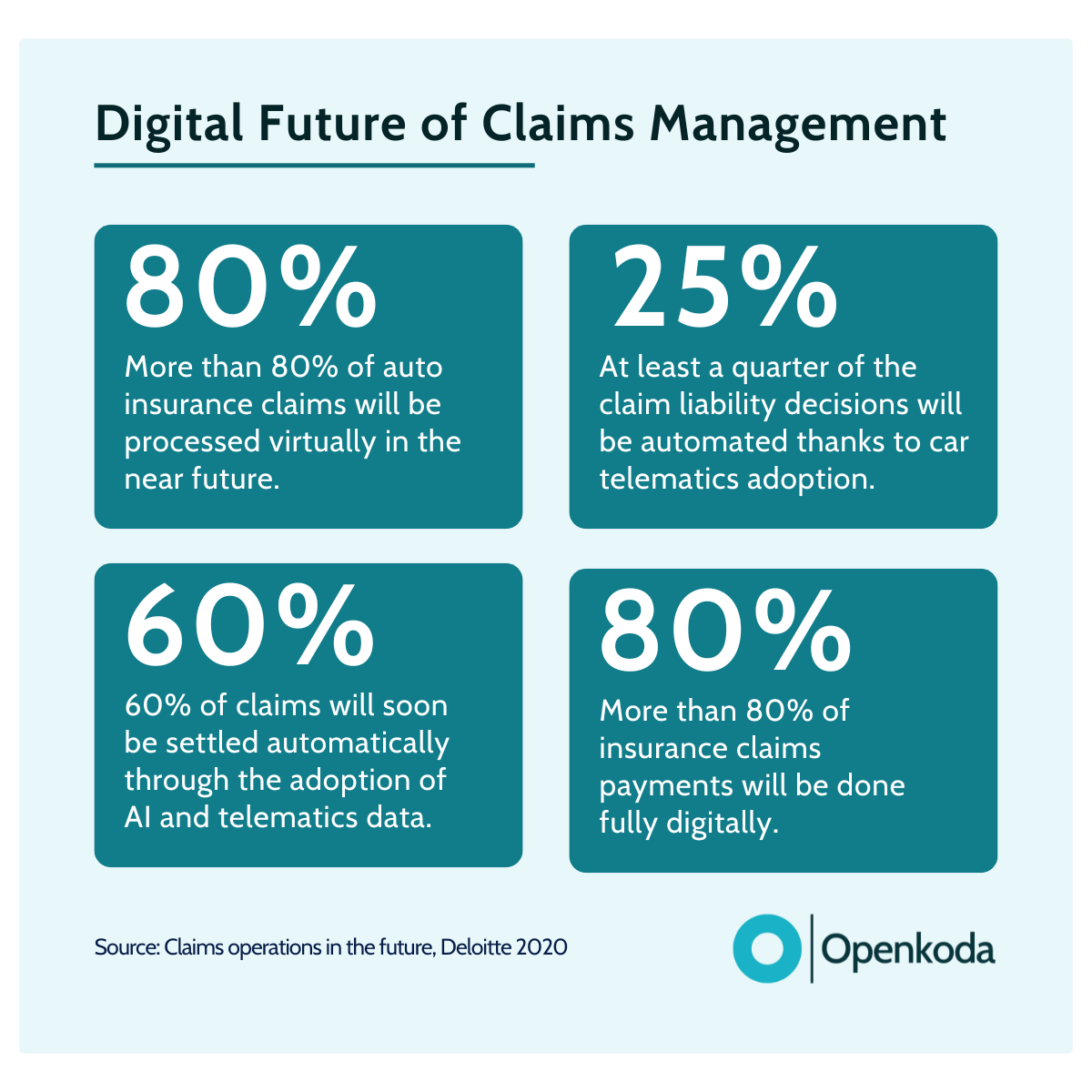
Insurance companies actively seek solutions enabling faster innovation and better customer service, particularly in segments relying on complex or highly specialized products where agility and configurability are critical. "89% of companies have already adopted or plan to adopt a digital-first business strategy."
Looking ahead, "74% of insurance executives worldwide have identified digital transformation and technology adoption as their top strategic priorities" - ranking it above ESG initiatives and talent acquisition.
The primary driver for digital transformation is changing consumer behavior. People expect the same digital convenience from their insurer as from their bank or favorite e-commerce platform. This means modern mobile apps, self-service portals, real-time policy management and updates, and fast, transparent claims handling.
There are five general dimensions to consider - though which should take priority depends on each insurer's specific situation. Rarely do these dimensions operate in isolation; most require attention and investment for successful transformation.
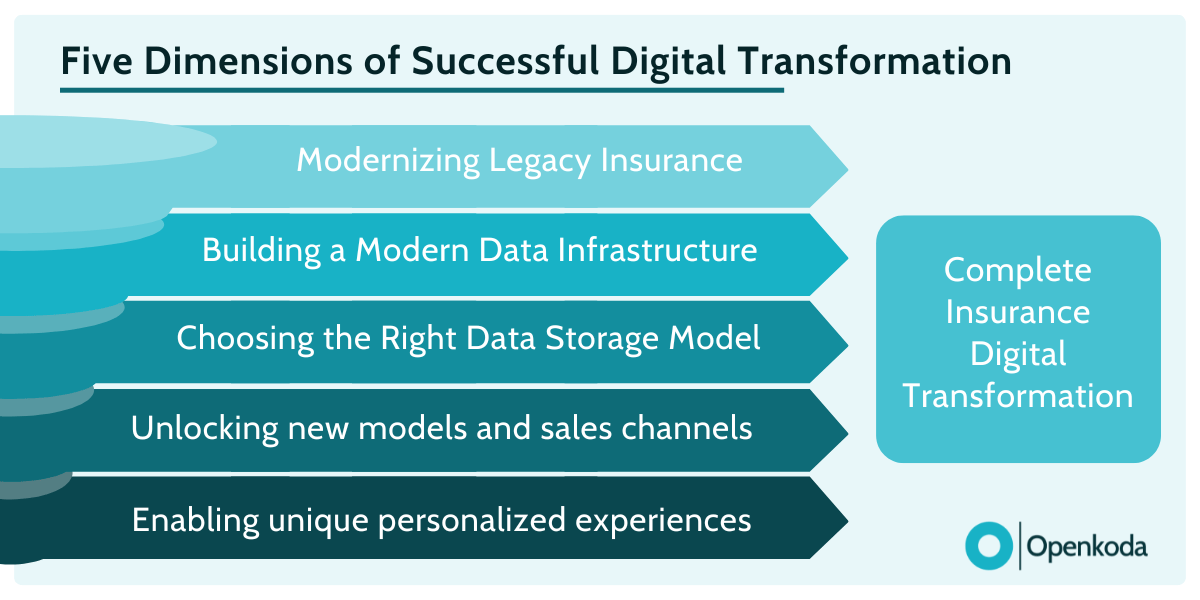

Most established insurers rely heavily on legacy core systems - rigid, monolithic platforms deeply embedded in underwriting, claims, and policy administration processes. While stable, these systems weren't designed for today's speed and flexibility requirements.
Insurance software modernization doesn't require ripping everything out. An incremental approach - building API layers around core systems, gradually decoupling services, or leveraging middleware - allows insurers to innovate without risking operational disruption.
Data is the backbone of digital transformation - but only if accurate, accessible, and actionable. A key enabler is multitenancy, particularly in platforms serving multiple insurance lines or partner programs.
A multitenant architecture allows insurance professionals to manage separate data environments while maintaining centralized control and scalability. Combined with streaming data pipelines, AI-ready analytics engines, and strict data governance models, this approach supports both agility and compliance.
While cloud infrastructure offers advantages - faster deployments, seamless scalability, and reduced maintenance - it's not always the default answer in insurance. In certain regulated markets where data sovereignty or auditability are concerns, on-premise deployment is still a legal or practical requirement.
Cloud economics must be carefully considered. As cloud costs rise and usage scales, pricing models can undermine the long-term ROI of cloud-native solutions. For insurers with predictable workloads and in-house IT capacity, on-premises or hybrid models can provide greater cost control and regulatory clarity.
With the right tech stack, insurers can tap into emerging opportunities such as embedded insurance, usage-based products, digital affinity programs, and dynamic bundling. These models allow insurance to be sold as a service, integrated into everyday transactions and platforms - from booking engines to subscription services.
This requires a flexible application core - one that easily adapts to different product configurations, APIs, and front-end experiences. Insurers with composable systems can experiment, partner, and pivot quickly, unlocking distribution channels unreachable with rigid, traditional platforms.
True personalization goes beyond marketing automation. It should touch pricing models, product design, and real-time engagement.
For insurers, this means having proper data flows, decision engines, and feedback loops. A digitally transformed organization delivers contextual, meaningful experiences while gathering insights to constantly refine them.
When implemented with clear objectives and the right technology partners, insurance digital transformation delivers measurable business value across the insurance value chain.
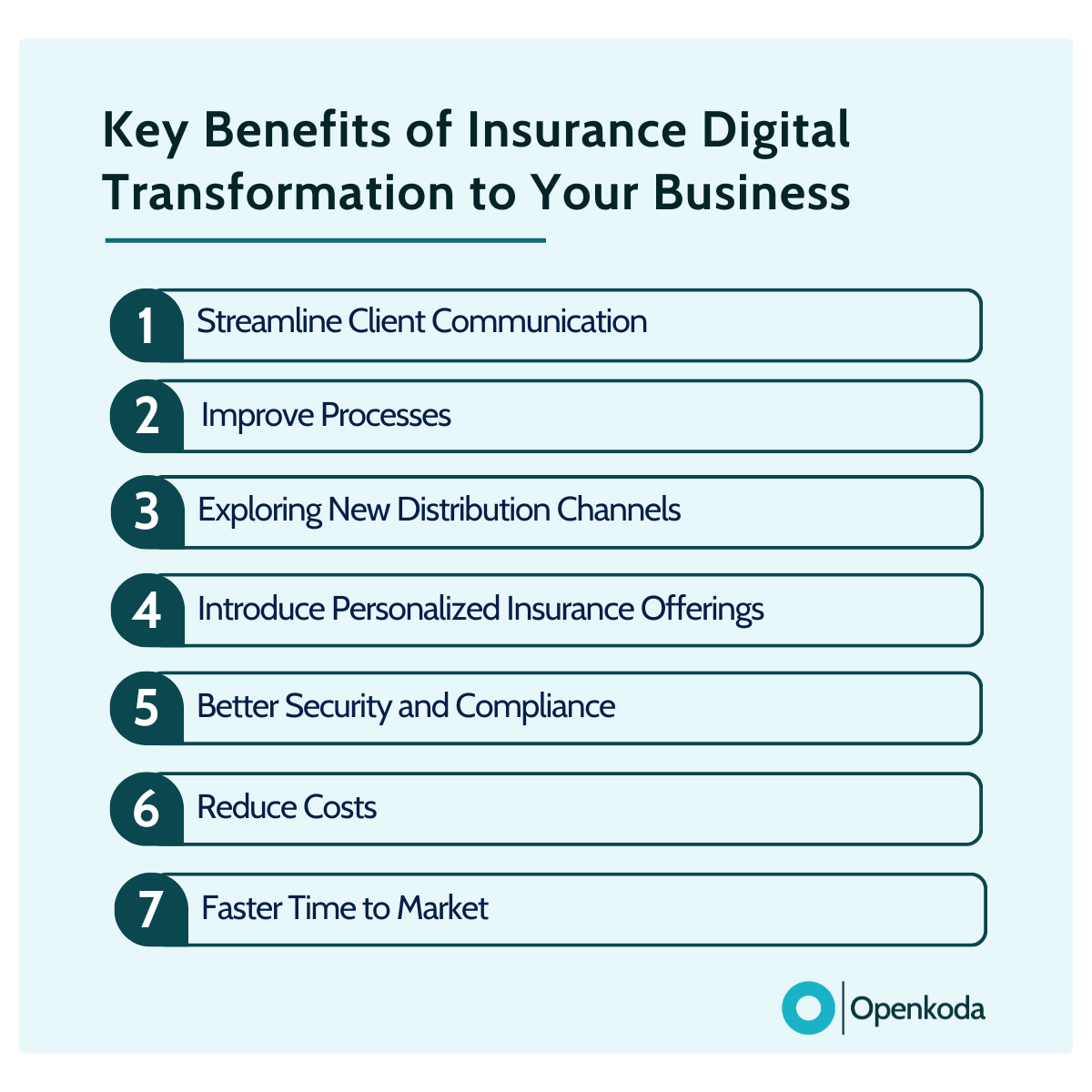
Customers expect consistent, timely interactions across multiple touchpoints - email, chat, apps, and voice. Digital transformation enables insurers to centralize communication channels, automate follow-ups, and personalize messaging at scale. This creates smoother client experiences and better operational visibility for teams.
Operational inefficiencies often hide in routine processes - claims handling, policy administration, and document verification. These areas benefit most from automation. With digital workflows and intelligent rules engines, insurers reduce friction, cut manual processes, and improve accuracy. It's about making the process smarter, not just faster.
One of the most transformative aspects of going digital is reimagining distribution. Traditional models built around agents, brokers, and direct sales are giving way to integrated, real-time channels offering insurance products exactly when and where customers need them.
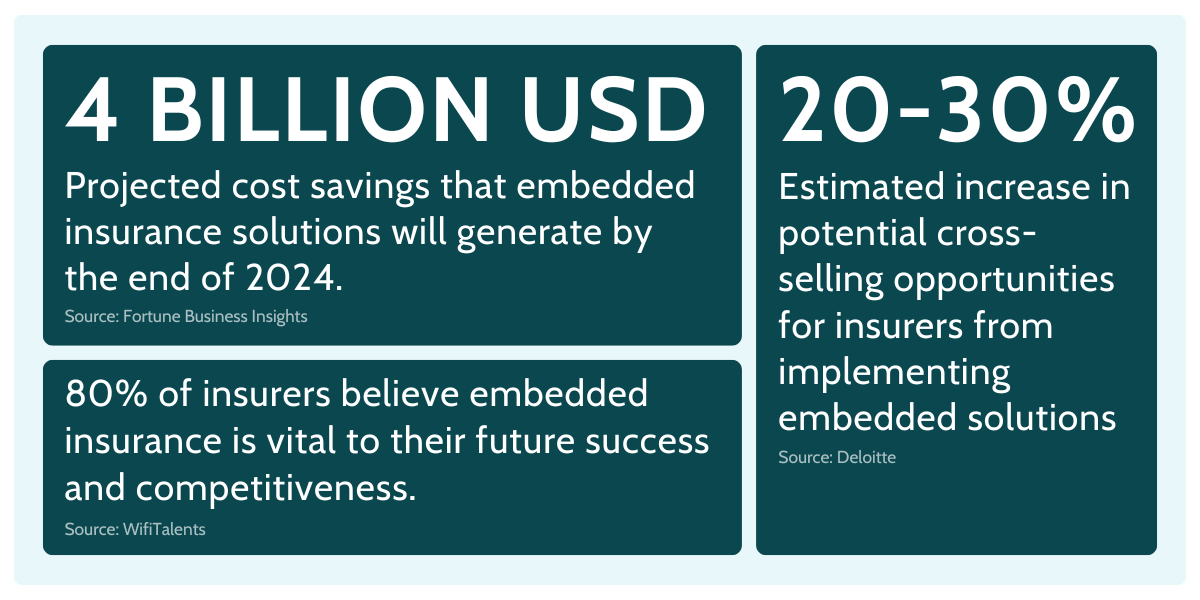
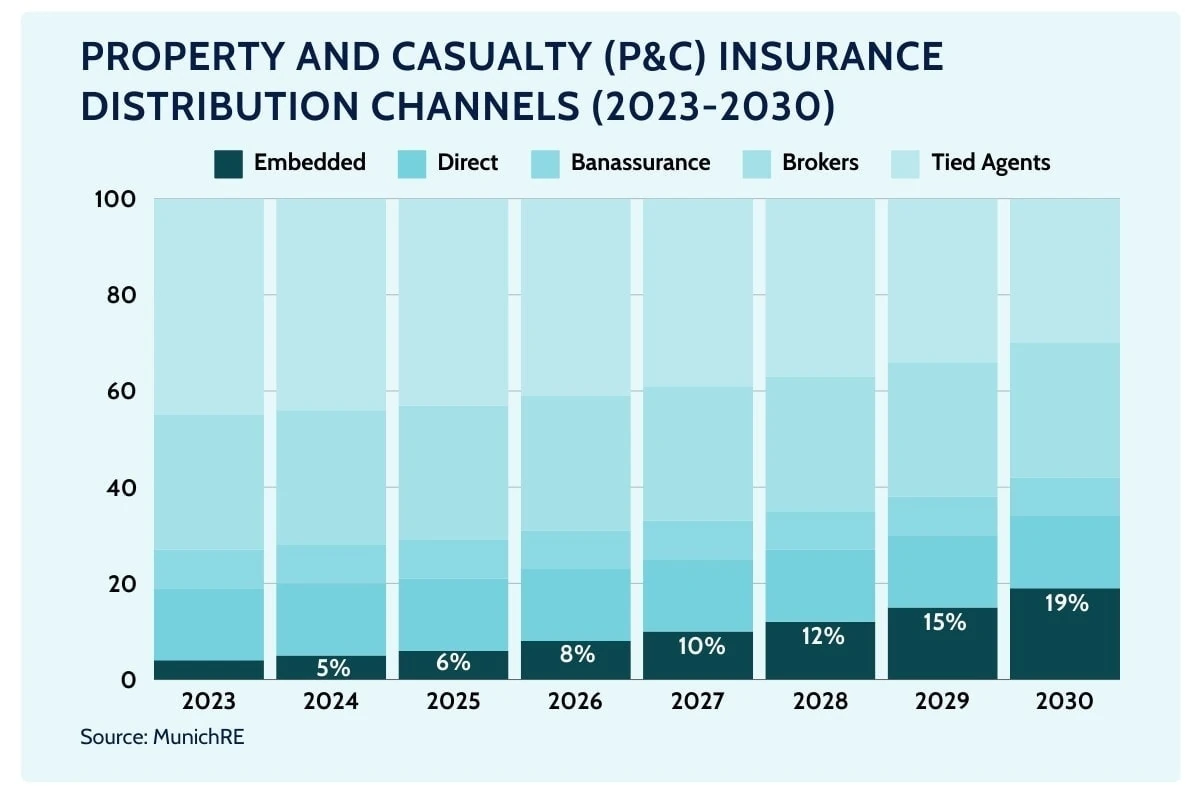
Embedded insurance exemplifies this shift. Instead of forcing customers to seek coverage separately, insurers can embed products directly within non-insurance platforms - such as travel booking sites, e-commerce checkouts, mobility apps, or fintech services. "Embedded insurance is on track to account for 15% of global gross written premiums by 2033", representing an estimated $1.1 trillion - up from 3–5% today.
Beyond reach, embedded partnerships demonstrate cost efficiency. In the UK, embedded insurance partnerships have demonstrated potential to reduce customer acquisition costs by "up to 75%", from £200 to £50 per policy.
In 2026, policyholders expect more than one-size-fits-all coverage. They want insurance adapting to their lifestyle, needs, and risk profile - instantly. By leveraging AI, behavioral data, and modular product design, insurers deliver hyper-personalized offerings such as dynamic pricing, usage-based coverage, or on-demand micro-policies. Personalization drives loyalty and long-term growth.
Insurance companies handle highly sensitive data, from personal health records and financial details to biometric identifiers and behavioral insights. Digital transformation offers an opportunity to build robust security and compliance frameworks directly into system architecture - rather than layering them afterward.
Compliance becomes significantly easier to manage. With digital workflows and auditable event trails, insurers automatically log user actions, enforce approval chains, and maintain full transparency over sensitive processes such as claims adjustments or policy cancellations. This supports internal governance and makes external audits faster and more reliable.
Frameworks like GDPR, Solvency II, and IFRS 17 require insurers to maintain strict control over customer data processing, storage, and reporting. Digital transformation platforms achieve this by centralizing data flows and standardizing information collection and sharing across systems - eliminating silos and reducing human error.
Cost reduction remains a strong incentive for many digital transformation initiatives. By automating repetitive tasks, migrating to cloud infrastructure, and enabling self-service tools, insurers dramatically reduce operational costs.
However, it's important to remember this isn't just about cutting costs. It's about reallocating resources to innovation, customer experience, and growth initiatives - cost savings being a byproduct of improved productivity and team performance rather than the primary goal.
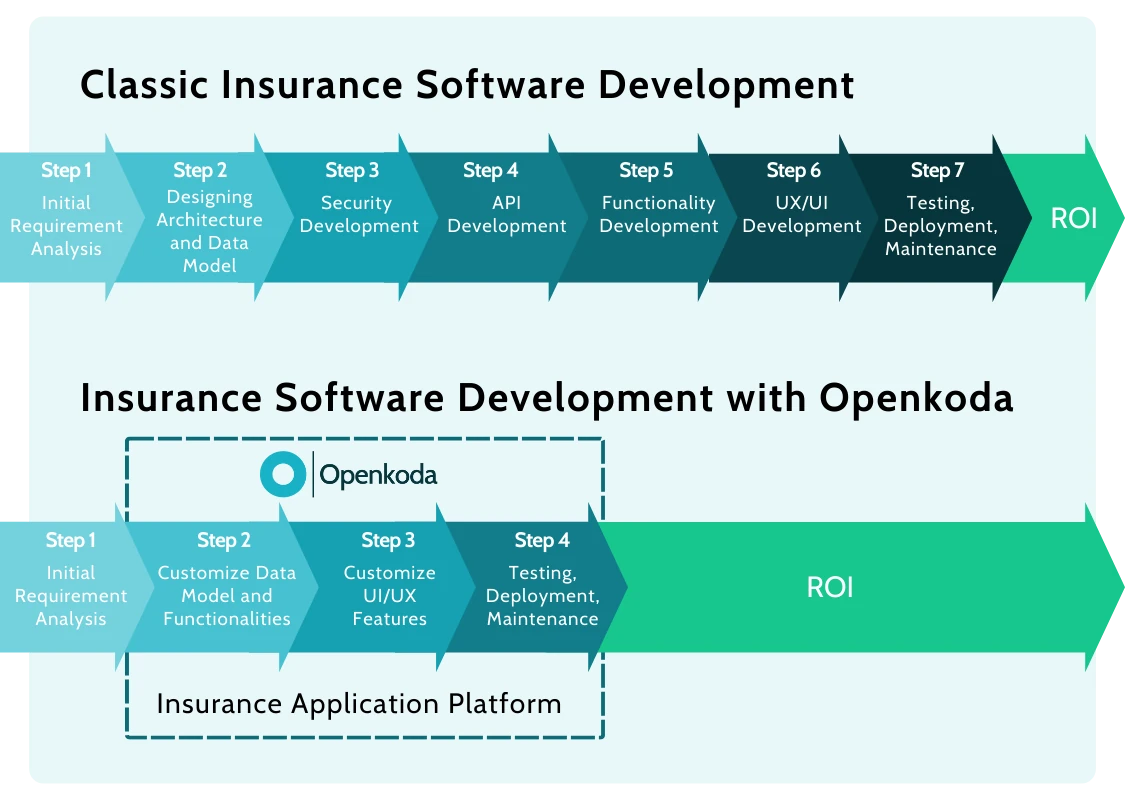
Time is a competitive advantage. When insurers identify new opportunities - be it a market segment, product category, or distribution partner - they need to move fast. Traditional core systems often stand in the way, requiring months of development before a product launches.
Platforms like Openkoda become impactful here. Built with speed and flexibility in mind, they provide ready-made components, customizable templates, and modular building blocks tailored to insurance workflows. Whether launching a new claims experience, configuring a travel insurance quote form, or embedding a product into a partner's app, such platforms help teams move from concept to deployment in weeks - not quarters.
Digital transformation lays groundwork for long-term scalability. Legacy systems often struggle under this weight, built for stability rather than adaptability. As insurers grow - organically, through M&A, or by entering new markets - these older systems become bottlenecks. Maintenance costs rise, technical debt accumulates, and innovation slows.
Scalability isn't just about infrastructure; it's how quickly a business adapts its digital ecosystem to evolving needs. Platforms support scalability at both system and product levels. Their modular architecture allows insurers to add new features or lines of business incrementally, without affecting core operations. New claim process flows or white-labeled client portals can be built and deployed independently using reusable components and microservice-ready approaches.
Despite clear strategic and operational benefits, the path forward isn't always smooth. While digital leaders reap agility and customer centricity rewards, many insurers struggle with transformation realities.
Why? Because successful transformation requires more than technology. It requires alignment across systems, people, culture, and compliance.
Digital transformation challenges long-standing workflows, alters reporting lines, and disrupts decision-making. In organizations where change management is weak or leadership isn't fully aligned, resistance can quietly stall progress - despite investment in tools or external consultants. Every organizational level must understand why and how changes and investments occur.
Many insurers operate on platforms never designed to interface with modern APIs, real-time data processing, or cloud-native applications. These systems may use outdated languages, lack documentation, and carry years of deeply intertwined business logic.
Even simple integrations - such as connecting a claims engine to a customer portal - can turn into months-long projects fraught with risk and exceptions.
Talent presents a two-sided challenge. Many insurers struggle finding professionals understanding outdated programming languages, middleware platforms, and homegrown systems running critical processes. These legacy skill sets are increasingly rare, and losing internal expertise poses serious operational risk.
Second, even when organizations commit to transformation, they face a hurdle: finding software development partners who genuinely understand the insurance industry. Generic IT providers may bring technical skills, but without deep insurance knowledge - data models, policy lifecycles, compliance requirements - project failure risk increases dramatically.
Insurance is one of the most heavily regulated industries worldwide. Every digitalization step must be vetted against local and international standards, from GDPR and PCI-DSS to Solvency II, IFRS 17, and various national insurance authorities.
This complexity means every introduced tool, updated system, and insurance API integration must include built-in safeguards - security, traceability, access control, and reporting.
Claims management is one of insurance's most resource-intensive areas. From initial submission to validation and resolution, the process involves multiple departments, disparate systems, and significant manual intervention.
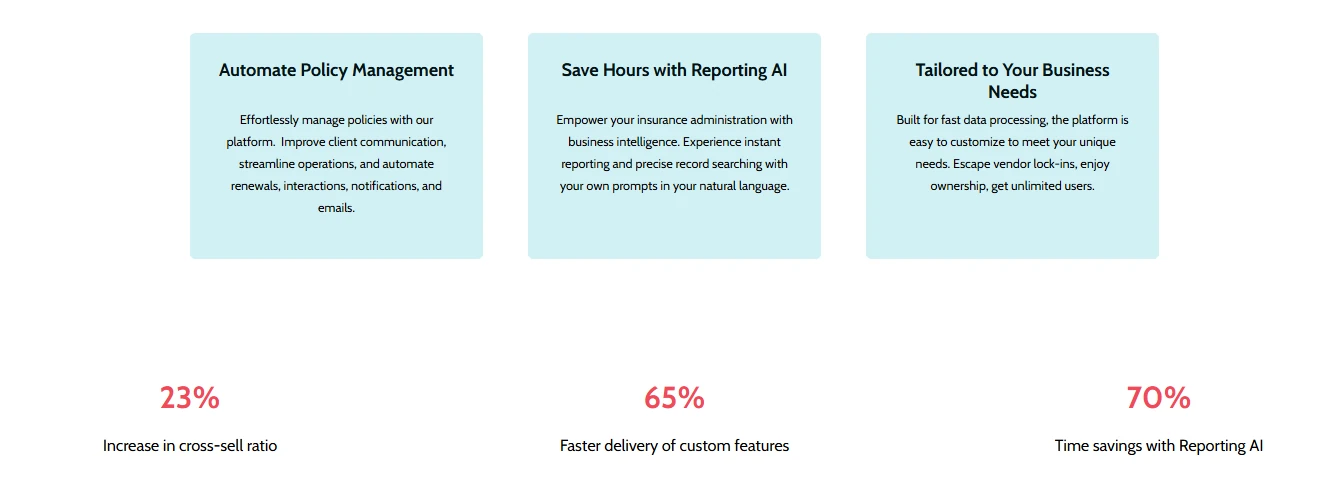
This is particularly challenging for insurers operating in niche markets, where out-of-the-box solutions cannot handle complex data types and processes. Bespoke approaches become the only viable option.
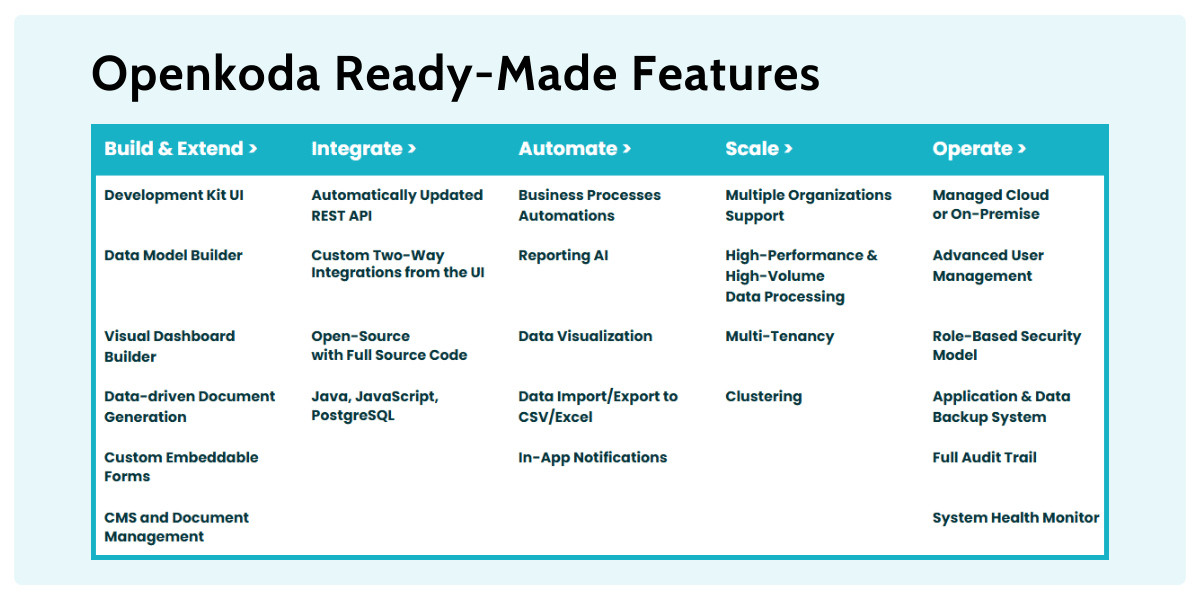
Typically this process takes months of meticulous planning, development, and testing, costing tens or hundreds of thousands of dollars. But what if there were a way to speed up this process by up to 60% and have a working prototype in minutes?
With Insurtech development platforms like Openkoda, it's entirely possible. The usual process starts with intuitive data model setup. Fields such as claim number, status (approved, denied, in process), claim description, and policy reference can be added with a few clicks - no engineering team needed.
Once core structure is in place, the platform lets you design the front-end experience equally quickly. Want a custom dashboard showing key metrics and recent claim statuses at a glance for improved analytics? It's available. Need filters so teams quickly drill down to specific cases? A couple clicks and it's live.
While speed is a headline feature, long-term flexibility is what truly stands out. The platform scales as business evolves. As claims volumes increase or workflows grow more complex, you can easily:
The key value? You can have a working MVP of a custom claims management application in minutes rather than weeks, easily customized further as needs arise.
Embedded insurance is reshaping how insurance reaches customers - offering more contextual, convenient experiences. With Openkoda, launching embedded solutions is incredibly fast and easy to integrate with any insurance platform or e-commerce site.
Car insurance is a natural fit for embedded distribution. When someone buys a car online, visits a dealership website, or browses financing options, they're already primed to consider coverage. Offering a tailored quote right there, as part of that journey, eliminates friction and dramatically increases conversion likelihood.
The process involves four key steps:
Launching an innovative insurance product is rarely one-and-done. From pilot phase to post-launch, insurers constantly tweak: pricing formulas, discount rules, eligibility criteria. Maybe they're responding to market feedback, optimizing profitability, or adapting to partner requirements.
Static systems don't work. If every change requires a development sprint or full system deployment, time-to-market and responsiveness disappear. Dynamic pricing solves this, giving product teams, actuaries, and business owners the ability to modify rules in real-time without touching core code. It transforms an insurance product from a rigid offering into a living, evolving business asset.
Implementing dynamic pricing is much faster - even for non-technical users. The platform lets you build custom pricing logic using straightforward, readable code snippets updateable, testable, and deployable on the go.
The approach includes:
For building or scaling modern insurance products, dynamic pricing becomes essential. With platforms like Openkoda, you get flexibility without sacrificing control, security, or speed.
With incredible growth in digital platforms and artificial intelligence, the insurance sector is at a major inflection point. "67% of insurance firms are significantly accelerating their digital transformation initiatives". Those still relying on legacy systems might get left behind very rapidly.
What matters now is executing this transformation with proper, clear vision. In coming years, one defining competitiveness factor will be personalization.
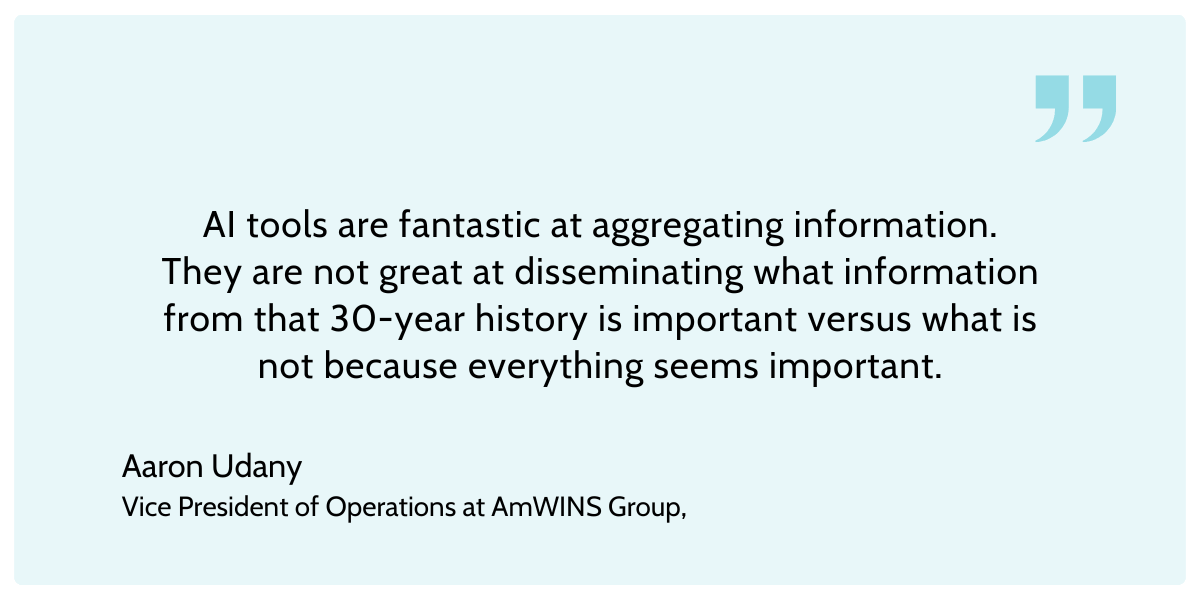
According to industry projections, "by 2026, nearly half of all insurers will differentiate primarily on their ability to deliver hyper-personalized products and services" delivered at convenient touchpoints.
Artificial intelligence will continue expanding its insurance role. Already, "79% of insurance executives expect AI to fundamentally change how they acquire customer insights" and engage across the policy lifecycle.
Most forward-thinking carriers won't stop at AI chatbots or intelligent routing. They'll apply machine learning in underwriting, claims triage, fraud detection, and even dynamic product creation - streamlining decision-making while elevating precision.
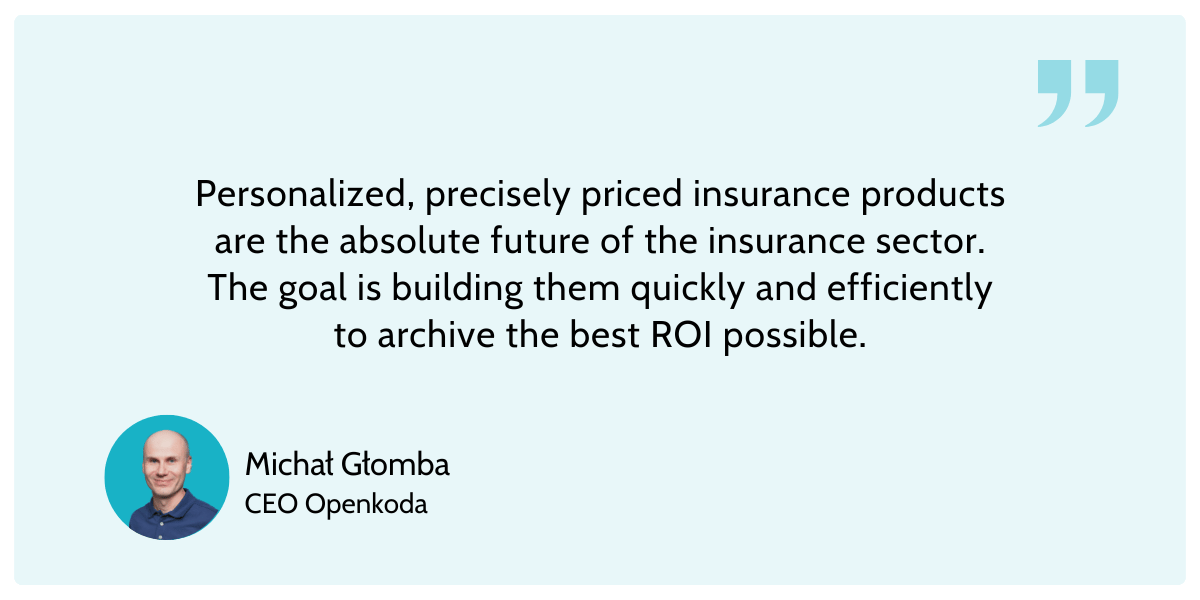
Digital transformation is no longer optional - it's the foundation for future-ready insurance organizations. As technology reshapes customer expectations, product delivery, and operational models, insurers must move from incremental improvements to holistic reinvention. Those who act decisively today will define the market standards of tomorrow.
Surplus lines grew 10.4% in 2025 while filings outran premium in 2026. What specialty products ask of a PAS, and five tests to run before you buy one.
Six of the best policy management software systems for 2026, split by what they actually do: insurance policy administration, or internal policy governance.
What to actually test in a mutual insurer's policy, claims, billing, portal and reporting systems, and which platforms are worth a shortlist.
Book a live, personalized demo with our product team - tell us your use case and see the platform work with your data. No commitment.