UK MGA Insurance Market Report 2026
UK MGAs wrote about £7.2bn of premium in 2025, up a fifth. Lloyd's, the FCA, the PRA and the capital behind MGAs spent the same year deciding how much of it to trust.
The best claims management software solutions for 2026, comparing Openkoda, Duck Creek, FileHandler, Guidewire ClaimCenter, Origami Risk, and Snapsheet.

Claims management software is a digital solution used by insurance companies to handle, process, and track insurance claims throughout their lifecycle – one of the key processes in the day-to-day operations of every insurer.
It helps automate and organize tasks such as claim intake, assessment, documentation, communication, and settlement.
The traditional approach to claims processing often involved spreadsheets, siloed systems, and manual paperwork.
This not only made the process slow and error-prone but also left little room for visibility and scalability.
In contrast, today's claims management software is built to centralize data, automate workflows, and support direct communication between claims adjusters, underwriters, policyholders, and third-party providers.
Why does this matter in 2026?
Because the volume, velocity, and variety of claims keep rising.
Claims are also getting slower to settle on the cases that reach a workshop. The J.D. Power 2025 U.S. Auto Claims Satisfaction Study, published on 3 November 2025 and based on 9,455 customers who settled a claim between September 2024 and August 2025, put the average cycle time for a repairable vehicle at 19.3 days, down from 22.3 a year earlier.
That improvement is not quite what it looks like. Fewer claims were filed at all.
The more sensors a car carries, the longer the claim takes
Average cycle time for repairable vehicles, US auto claims, by vehicle technology.
J.D. Power 2025 U.S. Auto Claims Satisfaction Study, 3 November 2025
The spread inside the average is the part that matters when you are choosing software. A car built before 2015 with no driver-assistance hardware is back with its owner in 17.9 days. A 2019 or newer vehicle carrying three or more ADAS features takes 21.5 days, because sensor calibration, parts availability and a longer estimate cycle all add time to the same claim.
Meanwhile total losses rose from 24% to 27% of auto claims, and 26% of customers now carry a deductible of $1,000 or more. Satisfaction among total-loss customers fell 9 points. Both shifts push work toward valuation, negotiation and settlement rather than repair tracking.
Auto insurance customers have made several adjustments to their policies in an effort to reduce costs - such as opting for higher deductibles, dropping rental coverage, avoiding filing claims and, in some cases, foregoing collision coverage altogether.
Mark Garrett, director of global insurance intelligence at J.D. Power
For a claims team, that is the operating picture the software has to fit: fewer but heavier claims, more of them written off, and customers who already feel worse about the outcome before anyone picks up the file.
What's more, these days claims routing tools often goes beyond simple file-tracking and document management – in 2026 insurers can embed AI that flags potential fraud, auto-routes tasks to the next specialist and even pre-fills damage estimates using computer-vision models, making their claims management solutions real power tools for the whole organization.
Before the vendor-by-vendor comparisons, it helps to ground ourselves in the capabilities that separate a modern claims platform from the legacy stacks many carriers are still retiring.
Below are six functions you'll see referenced again and again in 2026 product brochures – and, more importantly, in board-room ROI discussions.
With insurers under increasing pressure to improve operational efficiency, reduce cycle times, and meet rising customer expectations, choosing the right claims management software is more important than ever.
The market in 2026 offers a strong mix of established platforms and flexible newcomers – each catering to different needs, from enterprise-level insurers to agile insurtechs.
Here are some of the best claims management solutions currently on the market for you to choose from:

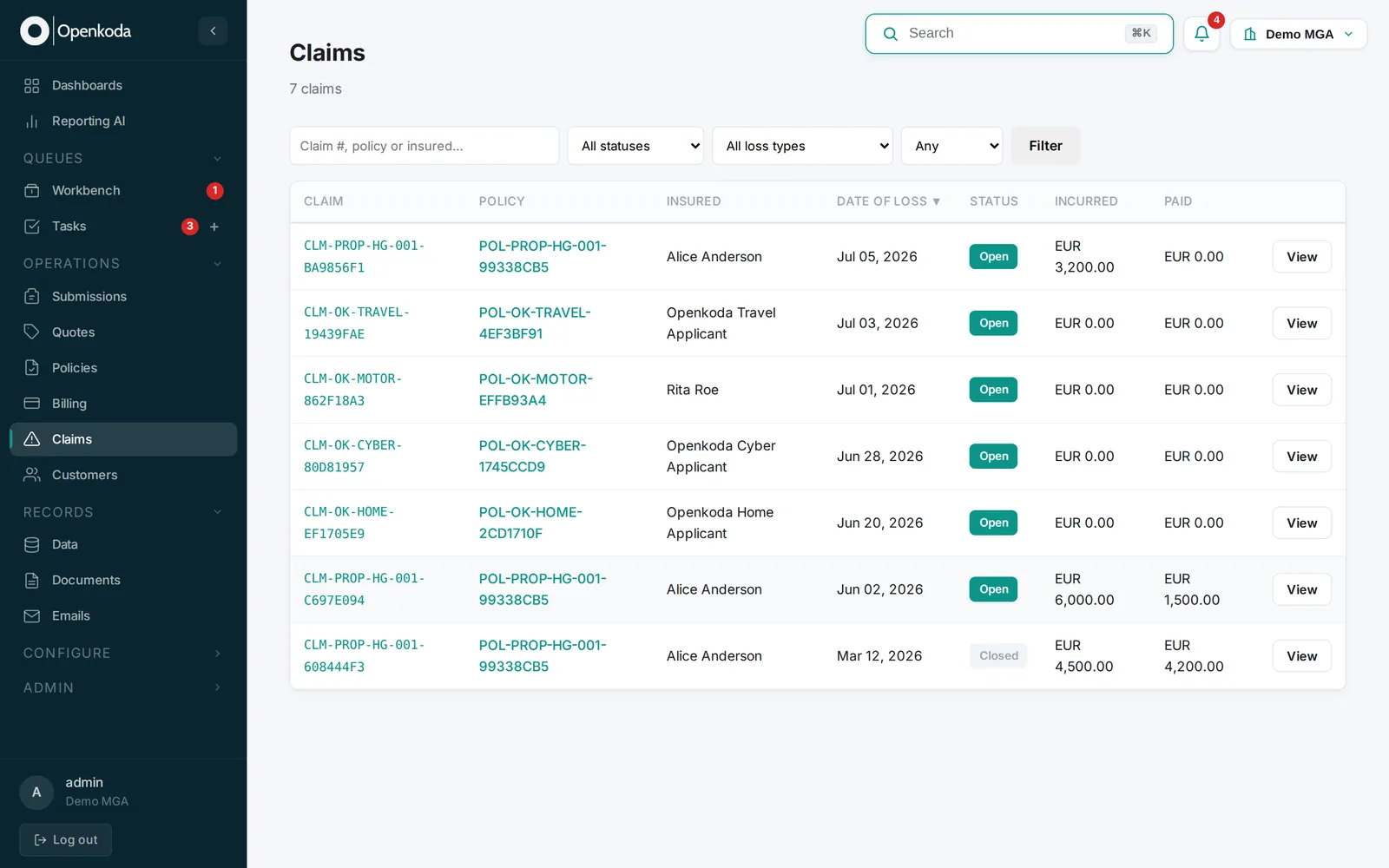
Openkoda is a highly customizable policy administration system (PAS) that includes an integrated claims management module. It brings claims handling together with policy administration, underwriting, billing, documents, and reporting, giving teams a connected system for day-to-day insurance operations.
Its claims module can be shaped around the way an insurer handles different losses. Teams configure claim types, statuses, routing rules, and workbench layouts, along with coverage checks and reserving thresholds. Straightforward cases can follow automated rules, while complex claims reach the appropriate adjuster for review.
The visual workflow engine for insurance automation lets teams build custom processes with triggers, conditions, actions, and approval steps. A workflow can generate correspondence, send an update, and wait for an approval before continuing. Processes can be tested before activation, while cases already underway retain their workflow version.
Key Features
Best For

Duck Creek Claims is a comprehensive, cloud-native claims management platform that helps insurers streamline operations and reduce manual processes from FNOL all the way to settlement.
With direct integrations, real-time claims data, and low-code configurability, it's built to boost operational efficiency and lift customer satisfaction
It's designed to modernize legacy systems, automate repetitive tasks, and let insurers focus on higher-value work – making the claims process faster, more accurate, and more transparent for both staff and policyholders
Key Features
Best For

FileHandler, also known as FileHandler Enterprise, is a legacy claims management software that insurance providers and third-party administrators (TPAs) have used for decades.
It supports the entire claims cycle – from first notice of loss (FNOL) through case resolution and final payments – within a single platform, helping reduce claims cycle time and simplify the oversight of claim activities
Key Features
Best For

Guidewire ClaimCenter is a widely adopted claims management software designed for property and casualty (P&C) insurance providers managing personal, commercial, and workers' compensation lines.
Unlike more lightweight or general-purpose platforms, it offers a highly structured architecture designed to support complex claims operations.
What sets ClaimCenter apart is its native integration with Guidewire's broader InsuranceSuite – including policy, billing, and underwriting modules.
Key Features
Best For

Origami Risk offers a unified, cloud-native SaaS platform that combines claims administration with policy, billing, risk, and analytics modules.
What sets Origami apart is the platform's convergence of claims management with broader risk and policy administration capabilities.
That unified data model enables insurers to manage claims lifecycle end‑to‑end while accessing rich analytics and workflow automation – all without switching environments.
Key Features
Best For

Last but not least we have Snapsheet Claims Platform. It is a cloud-native, modular system that focuses on simplifying auto and property claims workflows – from virtual appraisals to payment delivery.
Originally known for its innovation in virtual auto appraisals, Snapsheet has expanded its capabilities to serve insurers handling residential and commercial property claims with the same digital-first mindset.
For property insurers looking to streamline claims across multiple vendors and adjusters without building a complex system from scratch, Snapsheet offers a clean, API-ready alternative.
Key Features
Best For

UK MGAs wrote about £7.2bn of premium in 2025, up a fifth. Lloyd's, the FCA, the PRA and the capital behind MGAs spent the same year deciding how much of it to trust.

Surplus lines grew 10.4% in 2025 while filings outran premium in 2026. What specialty products ask of a PAS, and five tests to run before you buy one.
Six of the best policy management software systems for 2026, split by what they actually do: insurance policy administration, or internal policy governance.
Book a live, personalized demo with our product team - tell us your use case and see the platform work with your data. No commitment.