Insurance Rating Engine
What an insurance rating engine is, the must-have features to look for, the benefits of centralizing pricing logic, and how to integrate it with your stack.
How parametric insurance pays out on predefined event triggers instead of assessed losses, how it compares to traditional cover, and its key benefits.

A parametric insurance policy is a type of alternative risk transfer solution that pays out when a predefined event threshold is met – not when the insurer adjusts an actual loss.
Unlike traditional insurance, a parametric policy doesn't require damage inspections, long investigations, or proof of the actual loss sustained.
Instead, it is triggered by objective data such as wind speed, rainfall level, earthquake magnitude, or temperature readings. This makes it a fast, efficient tool for organizations exposed to large-scale, hard-to-predict physical risks.
Parametric insurance works by linking the payout directly to a measurable event.
Once the trigger level, say, a Category 4 hurricane with wind speeds above 130 mph, is confirmed by an independent data source, the payment is issued automatically.
For example, a hotel chain located in coastal regions may use a parametric insurance policy that activates when hurricane wind speeds exceed a certain threshold. Even if the property suffers only minimal damage, the immediate payout helps them manage operational disruption, emergency staffing, or evacuation expenses far faster than a traditional claim process would allow.

Parametric insurance coverage can be applied across many industries, especially those facing weather-driven volatility or operational interruption.
It's particularly valuable where traditional products struggle to quantify losses or verify them quickly.
As climate change accelerates and weather-related risks become harder to forecast, the differences between traditional insurance and parametric insurance have become increasingly important.
Many businesses now face climate risks that cause widespread disruption long before a physical loss can even be assessed. In these situations, traditional indemnity policies may respond slowly or may not respond at all, creating gaps that parametric insurance offers to close with speed, transparency, and predefined triggers.
For risk managers navigating increasingly unpredictable natural disasters and natural catastrophes, parametric insurance has become a powerful complement to traditional policies.
While the traditional market still plays a crucial role in providing broad coverage for the actual damage incurred, the parametric model adds something different: speed, liquidity, and the ability to act the moment an event occurs.
This makes it especially valuable for any business exposed to climate volatility, operational disruption, or fragile cross-border operations.
Here are the key benefits:

Building a parametric product takes more than a trigger and a payout.
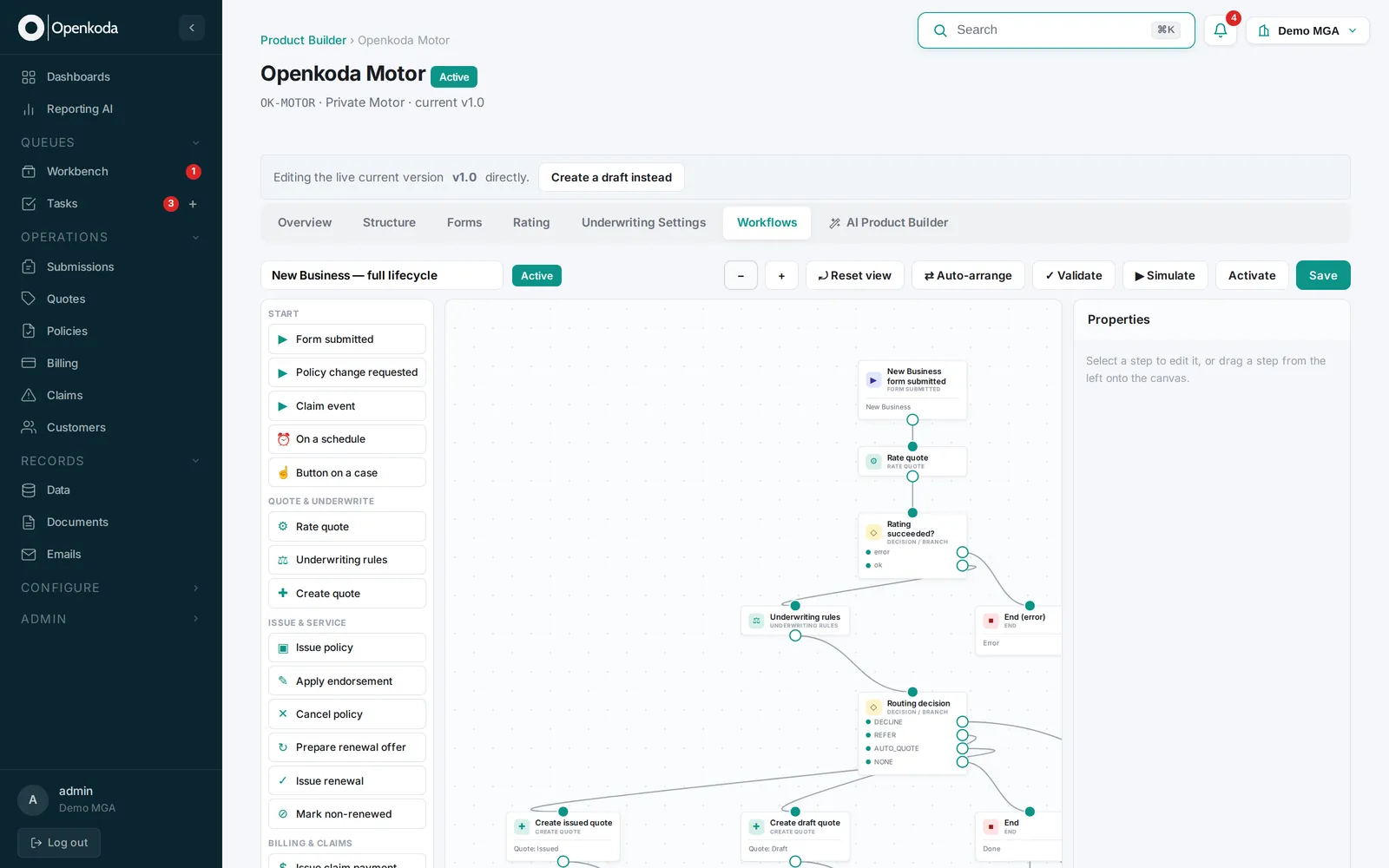
It depends on reliable data, a trigger designed against the exposure it is standing in for, and calculation logic that can read an environmental or operational signal and turn it into a payment. Because every business is exposed differently, to wind speed, rainfall, seismic activity or temperature, the setup has to be built for the specific product. A small mismatch between the trigger and the actual operational impact makes the cover less useful than it looks.
Openkoda is a policy administration system you configure rather than build, which is what makes it workable here. The data model, the workflows, the product definitions and the screens are all yours to shape, so a parametric product does not have to be forced into fields designed for indemnity cover.
In practice that means connecting the data sources you trust, automating event detection, and defining triggers and payout calculations exactly as the product requires. Everything from ingestion through to payout is configuration rather than a development project, so thresholds can be refined and new providers added as exposures change.
The same system still runs the ordinary parts: issue, endorsements, billing, claims and reporting. A parametric book does not need its own platform bolted on beside the one administering everything else.
Parametric insurance is no longer a niche concept – it's becoming a critical tool for organizations facing fast-moving environmental and operational risks.
Its ability to deliver transparent, data-driven payouts gives businesses the agility they need when traditional processes slow them down.
As climate pressures intensify, the combination of well-designed parametric models and flexible technology platforms will shape a more resilient future for insurers and their customers alike.
What an insurance rating engine is, the must-have features to look for, the benefits of centralizing pricing logic, and how to integrate it with your stack.
What marine cargo insurance covers, who needs it, the main policy types (ICC A/B/C, single voyage, open cover), and key contract requirements.

An insurer owned by the businesses it covers, the forms it takes, and what separates a captive from simply retaining the risk.
Book a live, personalized demo with our product team - tell us your use case and see the platform work with your data. No commitment.