How to Choose the Right Policy Administration Software in 2026
A policy administration system decides how fast business changes reach the policies you write. Key 2026 features, a buyer's checklist and 10 systems compared.
Open-source CRM, a simpler commercial CRM, or a policy administration system? Work out which problem you are solving before you compare vendors.

Searching for a Salesforce alternative usually starts with a practical concern: software costs, the effort required to make changes, or workflows that have become difficult to manage.
An open-source CRM may offer more control over hosting and customization. A simpler commercial CRM may better suit the sales team. An insurance business struggling with policy transactions may need to reassess its policy administration system instead.
Before comparing vendors, establish which problem you are trying to solve. That decision has a greater impact on the outcome than replacing one familiar product name with another.
Salesforce’s Sales Cloud supports lead management, sales pipelines, forecasting, and customer engagement. For insurers, MGAs, and brokers, those capabilities help manage relationships and distribution.
Difficulties arise when the implementation no longer matches the operation. To understand where a change would help, examine four areas:
Cost is the easiest of the four to model, because per-user pricing scales in a straight line whether or not the extra seats use the edition you are paying for across the whole org.
Salesforce Sales Cloud: monthly list cost rises straight with headcount
Total list price per month, billed annually, at three seat counts.
Salesforce Sales Cloud list pricing, September 2026
Those are list prices, before discounts, add-ons, or the Agentforce credits bundled into the upper tiers. The shape matters more than the exact figure.
The four areas are separate requirements. Source-code access, for example, does not automatically make everyday configuration easier. A system’s practical value depends on what your team can operate and maintain.
If the main requirements are contact management, opportunity tracking, customer interactions, and sales workflows, an open-source Salesforce alternative is worth evaluating.
Two examples:
Open-source software gives a technical team access to the code and more scope to manage its own deployment. The business still has to account for implementation, hosting, updates, support, and maintaining its customizations.
Compare the complete operating model. A lower licence bill is only useful when the resulting system also meets the team’s requirements at a sustainable support cost.
Some projects described as CRM customization turn out to contain substantial insurance administration.
Consider a broker requesting a mid-term change. Recording the request and assigning a follow-up task are customer-management activities. Applying an effective date, recalculating premium, updating coverage, generating an endorsement, and retaining the transaction history are policy administration functions.
That distinction matters when selecting software and when defining who owns which integration.
Salesforce itself offers an insurance policy administration module covering quoting, underwriting, issuance, endorsements, billing, and renewals. Evaluate the actual products and modules proposed for your business; the Salesforce name alone does not describe the implementation scope.
The same applies to the alternatives. A CRM with configurable fields can store policy information, but ask to see the required insurance transactions demonstrated before treating it as the system that administers the book.
| Main requirement | Approach worth evaluating |
|---|---|
| Better lead tracking, broker relationships, and sales follow-up | A CRM configured around the distribution team |
| Source-code access and control over CRM hosting | An open-source CRM with a clear maintenance model |
| Rating, underwriting, endorsements, renewals, and policy history | A dedicated PAS or an insurance-specific suite with those capabilities |
| Customer-facing teams lack accurate policy information | Integration between the CRM and the policy system |
| Slow changes to specialist products and servicing workflows | A configurable PAS assessed against real product changes |
A replacement project is not always necessary. If the CRM supports sales well but policy data arrives late, improving the connection to the PAS may solve the immediate problem.
Be explicit about which system owns each record and transaction. The CRM might manage a renewal conversation while the PAS calculates the renewal terms and issues the policy. Clear responsibilities prevent conflicting records and duplicated business rules.
A useful demonstration shows how the software handles your work after implementation, not during the sales cycle.
Ask the shortlisted providers to demonstrate:
Those exercises reveal the effort your team will inherit. They also separate functionality that exists today from work that still has to be commissioned.
For requirements centered on insurance operations, Openkoda belongs in the PAS evaluation rather than the CRM one. It is a commercially licensed, highly customizable policy administration system with ready insurance modules and AI-assisted configuration, covering rating, underwriting, policy servicing, claims, billing, documents, and reporting.
It is priced per instance rather than per seat, on published plans, and deploys to managed cloud or your own environment with exportable configuration and data.
Work management sits against the insurance records rather than in a separate tool, which is the part teams usually expect their CRM to provide.
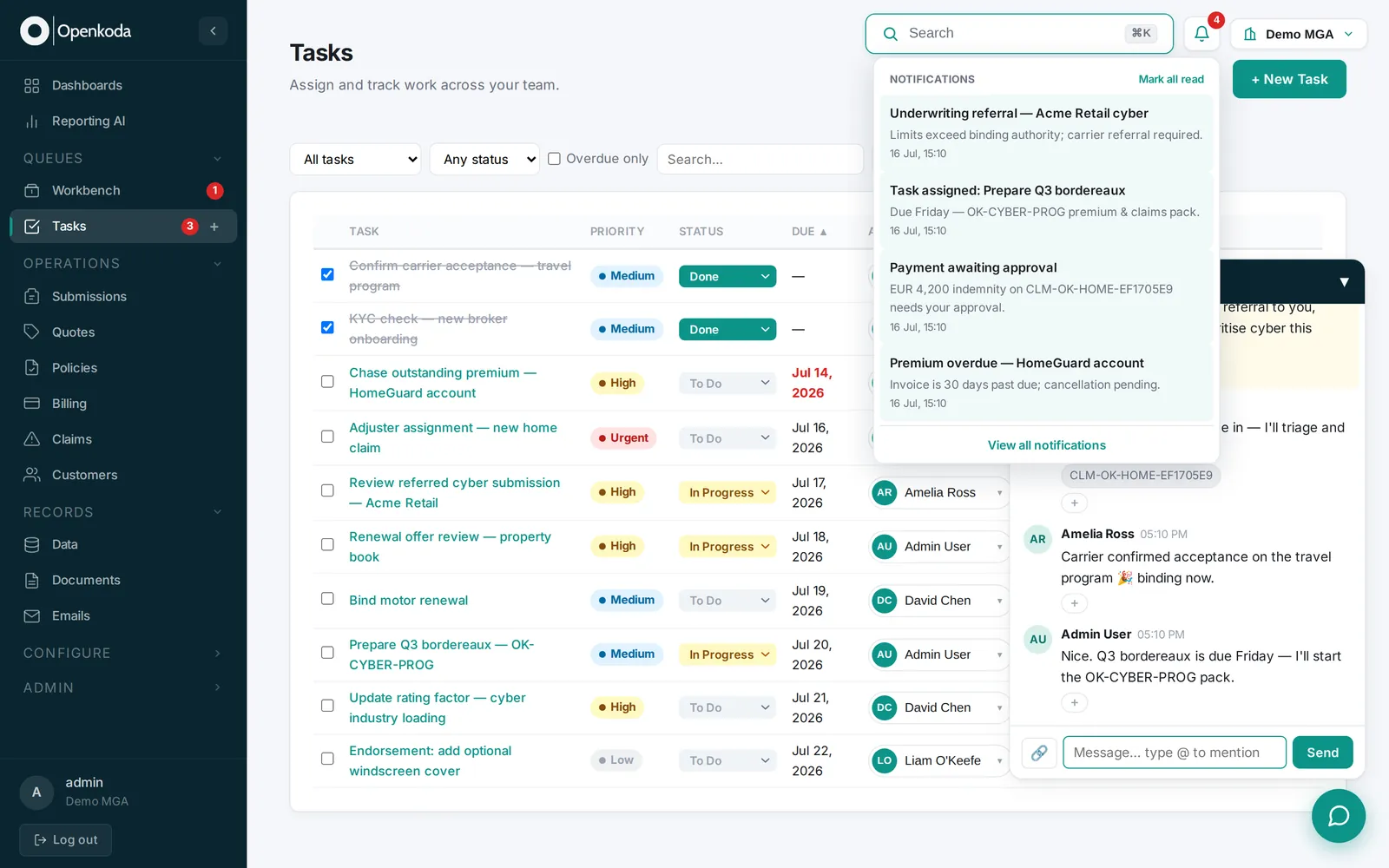
It can be assessed alongside whichever CRM your business chooses, with integrations scoped around the information and transactions the two systems need to share.
The strongest software decision starts with those responsibilities: give each system a clear job, verify the workflows, and compare the cost of keeping them working as the business evolves.
A policy administration system decides how fast business changes reach the policies you write. Key 2026 features, a buyer's checklist and 10 systems compared.
MGA policy administration software has to handle binders, referrals, bordereaux and commission for every capacity provider. What to look for, and 10 systems compared.
An insurance CRM tracks clients, pipeline and renewals. It does not rate an endorsement or bill an installment. Six CRMs compared, and where the policy record lives.
Book a live, personalized demo with our product team - tell us your use case and see the platform work with your data. No commitment.