UK MGA Insurance Market Report 2026
UK MGAs wrote about £7.2bn of premium in 2025, up a fifth. Lloyd's, the FCA, the PRA and the capital behind MGAs spent the same year deciding how much of it to trust.
Market size, ownership rates, the protection gap, product mix, and average costs shaping the global life insurance market in 2026.

The life insurance market is evolving fast: rates have reset, product economics have shifted, and customers are rethinking how much protection they actually need.
This article distills the latest market picture, who owns coverage (and who doesn't), how costs stack up, and what's changing in product design and distribution.
Our goal is simple – give you a clear, practical view of life insurance today so you can make better decisions tomorrow.
After two years of unusually strong growth, life insurance industry heads into 2026 as the largest slice of the global insurance pie and with solid (if moderating) momentum.
In 2024, life premiums climbed to about €2.9 trillion (~$3.1T) within a €7.0 trillion global insurance market, making life the single biggest segment worldwide.
Looking ahead, industry growth cools from "sprint" to "steady jog."
Swiss Re's latest outlook provides 2025F and 2026–27F growth rates, including a dedicated life line: global life premium growth 2.2% (2025F) and 2.5% (2026–27F), and total premiums 3.1% (2025F) and 2.3% (2026–27F).
Bottom line for 2026: higher rates have reset product economics in life insurance, lifting profitability and demand for savings-oriented policies; growth should remain positive, though less "hot" than 2023–2024. That sets the stage for how and what consumers are actually buying - our next section.
The sales mix has been shifting, especially in the U.S. (the world's largest individual life market). Here's the 2024 product breakdown by share of new premiums in the U.S. - a useful proxy for advanced markets:
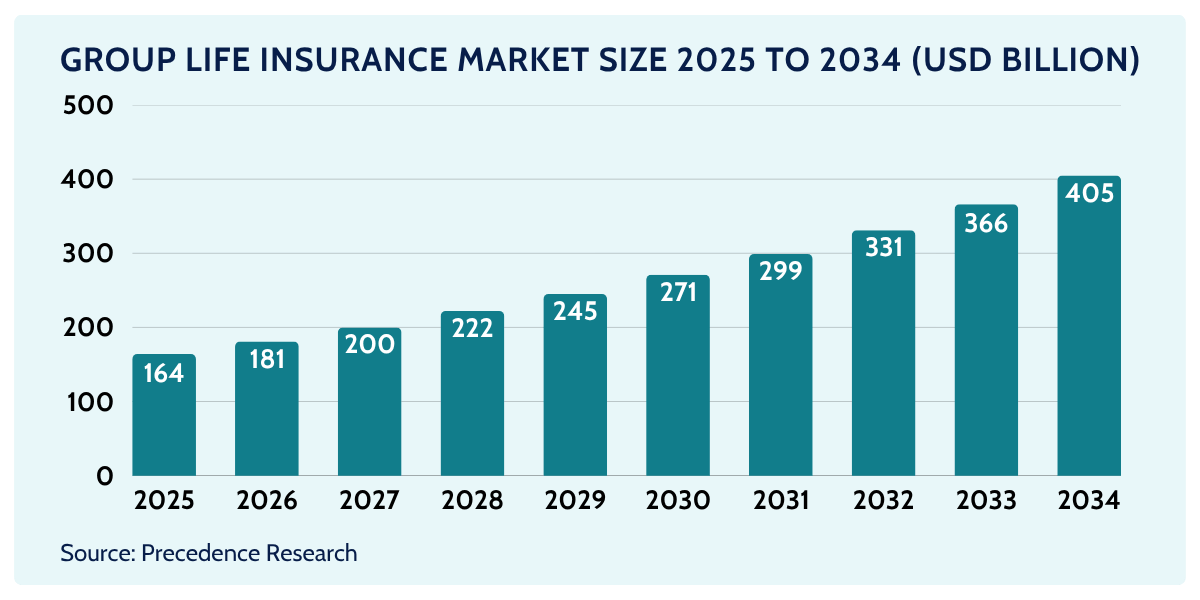
Most life premium globally still comes from individual policies (ordinary life). In mature markets like the U.S., individual life typically accounts for ~80% of life insurance premiums, with group coverage a smaller (but important) slice - mainly employer-provided term life.
Life insurance ownership varies widely by region, but one theme is consistent: many households still lack enough coverage even as intentions to purchase life insurance remain strong.
Measured globally, the mortality protection gap remains wide: Swiss Re estimates it at about $414 billion in premium-equivalent terms in 2023 - essentially the extra annual premiums households would need to close shortfalls in death-benefit protection.
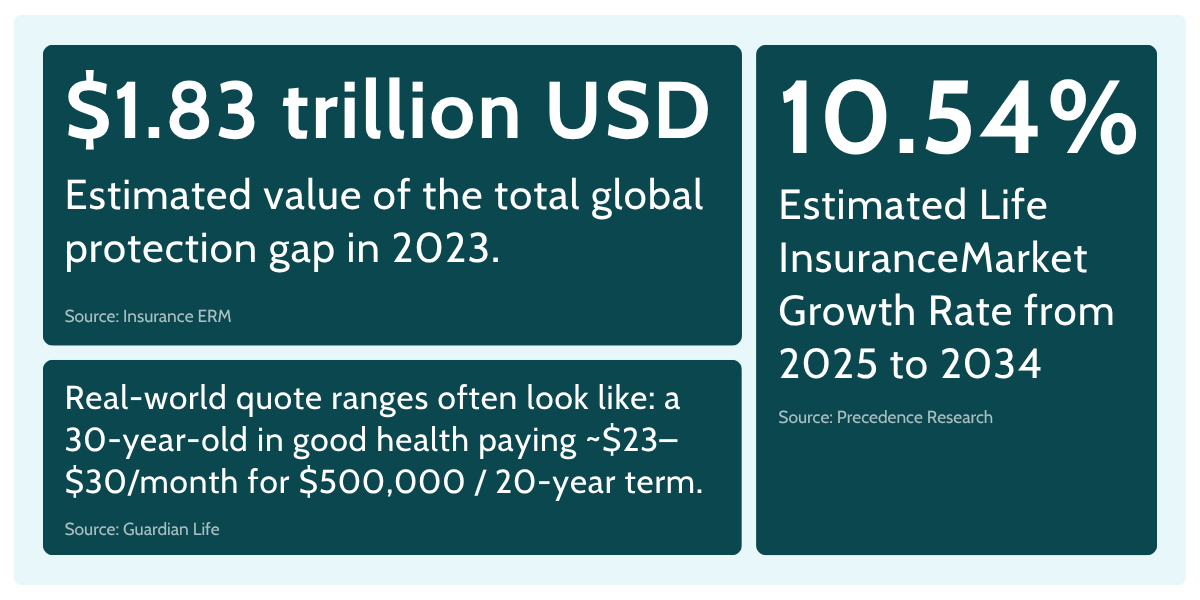
Looking across all major perils (mortality, health, natural catastrophes, crop), the total global protection gap reached a record ~$1.83 trillion in 2023, underscoring the scale of underinsurance worldwide.
In the U.S., this shortfall shows up in consumer intent: 42% of adults - about 102 million people - say they need life insurance or more of it, and over a third plan to buy life insurance in the next year, signaling both unmet need and purchase intent.
Younger generations tend to start with term coverage (often tied to mortgages and kids), while older cohorts are more likely to hold permanent life insurance policies.
The life insurance industry watches this age gradient closely because it shapes product design, advice, and the moment when consumers finally move from intent to purchased insurance.
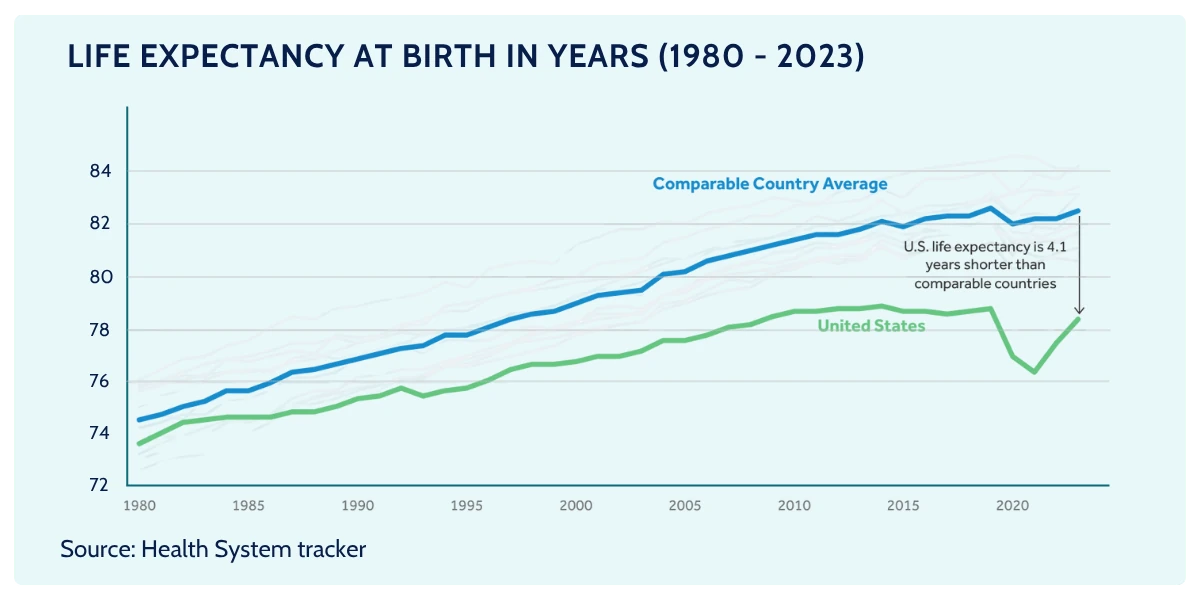
Life expectancy steers pricing, underwriting, and guarantees across the life insurance industry. The post-pandemic rebound in longevity is gradually reshaping assumptions behind both protection and savings-type life insurance products.
In today's life insurance market, consumers are choosing among a spectrum of life insurance policies that trade off cost, guarantees, flexibility, and investment risk. In the U.S. individual life insurance market, 2024 sales show that guarantees still matter while flexible, market-linked designs are gaining share: whole life accounted for 36% of new premium, term life for 19%, fixed universal life for 7%, indexed universal life for 24%, and variable universal life for 14%.
Term life is the purest form of life insurance coverage: a straightforward death benefit for a set period, typically 10–30 years. You're paying for protection, not savings.
That's why term is the go-to for income replacement, mortgages, and raising kids - it maximizes coverage per dollar and keeps decisions simple. Many contracts include a conversion option, so if life gets more complex you can exchange into a permanent policy without new medical evidence. For a lot of households, term is the on-ramp to lifelong planning.
Whole life is the opposite end of the spectrum: permanent coverage, level premiums, and guaranteed cash value growth set by the insurer (with potential dividends in participating contracts).
Think of it as a disciplined, long-horizon chassis - used for legacy goals, business planning, or simply avoiding the risk of going uninsured later in life. You're buying contractual certainty, and you pay for it. In return, you get guarantees that don't depend on markets and a policy designed to be held for life.
Between those poles sits the universal life family, which lets you dial the balance between guarantees and growth.
A traditional (fixed-rate) UL credits interest at insurer-declared rates and gives you levers to adjust premiums and the death benefit within limits. Indexed universal life links credits to an index (like the S&P 500) with caps and floors - appealing if you want some upside participation without full market risk. Variable universal life goes all-in on investment choice: cash values are invested in separate accounts tied to markets, with higher growth potential and higher volatility. The common thread is flexibility - but also more moving parts. These designs reward engaged policyholders who value control over funding patterns and accumulation, and they require careful monitoring.
So which fits? If you need the most coverage today, term usually wins on price and clarity.
If your priority is lifetime guarantees and a built-in savings element, whole life is built for staying power. If you want adjustable funding and targeted growth, the UL family offers knobs to turn - fixed UL for stability, indexed universal life for market-linked credits with floors, variable universal life for full market exposure.
Two realities dominate the life insurance market today: (1) term coverage is still extremely affordable for healthy buyers, and (2) permanent coverage (whole life and the UL family) costs much more because it's built for lifetime protection and cash value. Rates below are typical illustrations - not quotes - and they vary by age, health, smoker status, term length, coverage amount, and underwriting class.
The mood in life insurance moving into 2026 is steady.
Here are some key trends that will shape the next few quarters of the life insurance market.
With yields back to normal-ish, buyers still want the cost-efficiency of term and the certainty of whole life - but they're increasingly open to policies that credit interest more dynamically. That's why indexed universal life (upside with floors) and accumulation-focused designs keep gaining attention, while annuity-linked retirement solutions remain a growth engine for life insurers.
Life won't be sold only in a branch or an agent's office. Banks, fintech apps, and employer ecosystems are weaving simple, event-triggered protection into day-to-day financial journeys - think mortgage flows, payroll apps, or savings goals. Several strategists now see embedded insurance taking a material share of product distribution by the late 2020s, propelled by open finance data and real-time eligibility checks.
The signal in 2026 is less "shiny demo," more "measurable lift." Carriers report gen-AI helping draft clear customer communications, summarize medical files, and guide frontline staff - often with quality wins that beat human-only baselines. Over the next 12–24 months, expect targeted scale-ups in new-business intake, service, and compliance documentation, with governance and model-risk controls maturing in parallel.
Supervisors on both sides of the Atlantic are probing funded (asset-intensive) reinsurance used in bulk annuity and life blocks, tightening stress tests and asset-adequacy rules.
Term remains the most efficient way to secure meaningful protection now, while permanent options and the UL family add lifetime guarantees and flexibility as needs grow.
With ownership still uneven and protection gaps persistent, the industry's job is to keep products simple, accessible, and fairly priced.
For households, the smartest move is to match policy design to real goals, revisit coverage as life changes, and act - because the cost of waiting is almost always higher.

UK MGAs wrote about £7.2bn of premium in 2025, up a fifth. Lloyd's, the FCA, the PRA and the capital behind MGAs spent the same year deciding how much of it to trust.

Surplus lines grew 10.4% in 2025 while filings outran premium in 2026. What specialty products ask of a PAS, and five tests to run before you buy one.
Six of the best policy management software systems for 2026, split by what they actually do: insurance policy administration, or internal policy governance.
Book a live, personalized demo with our product team - tell us your use case and see the platform work with your data. No commitment.