How to Choose the Right Policy Administration Software in 2026
A policy administration system decides how fast business changes reach the policies you write. Key 2026 features, a buyer's checklist and 10 systems compared.
What policy administration software is, its core functionalities, common legacy challenges, and how to choose between custom and out-of-the-box solutions.

Good policy administration software fades into the background. It lets teams focus on products and customers instead of system limitations.
Michał Głomba, Founder of Openkoda
Policy administration software, often referred to as PAS, is a core insurance system designed to manage the entire lifecycle of an insurance policy.
That lifecycle typically starts with policy issuance and continues through endorsements, renewals, cancellations, and policy termination. In practical terms, PAS is the system of record for all policy information within an insurance organization.
At its core, policy administration software centralizes data and processes that were once scattered across spreadsheets, legacy tools, and manual workflows.
It ensures that policy details, coverage terms, pricing rules, and customer data are consistent, auditable, and available in real time. This is especially critical in insurance, where accuracy, compliance, and speed directly affect both operational efficiency and customer trust.
Modern PAS solutions go far beyond basic record-keeping.
They support digital distribution models, self service for customers and agents, and close collaboration between underwriting, operations, and customer support teams.
When implemented well, policy administration becomes an enabler of growth rather than a bottleneck, allowing insurers to launch new products faster, adapt to regulatory changes, and respond instantly to customer needs.
While implementations differ across insurers and product lines, most policy administration systems share a common functional foundation.
Below are the key capabilities that define a capable PAS in 2026.
Together, these functionalities form the operational backbone of policy administration.
They allow insurers to scale efficiently, maintain compliance, and deliver a smoother experience to both internal users and policyholders.
Choosing the right policy administration software is a strategic decision, not just a technical one. Our free ebook on choosing the right PAS turns it into ten questions to put to every vendor.
The platform you select will directly shape how fast you launch products, how efficiently teams work, and how well you support customer service across the policy lifecycle.
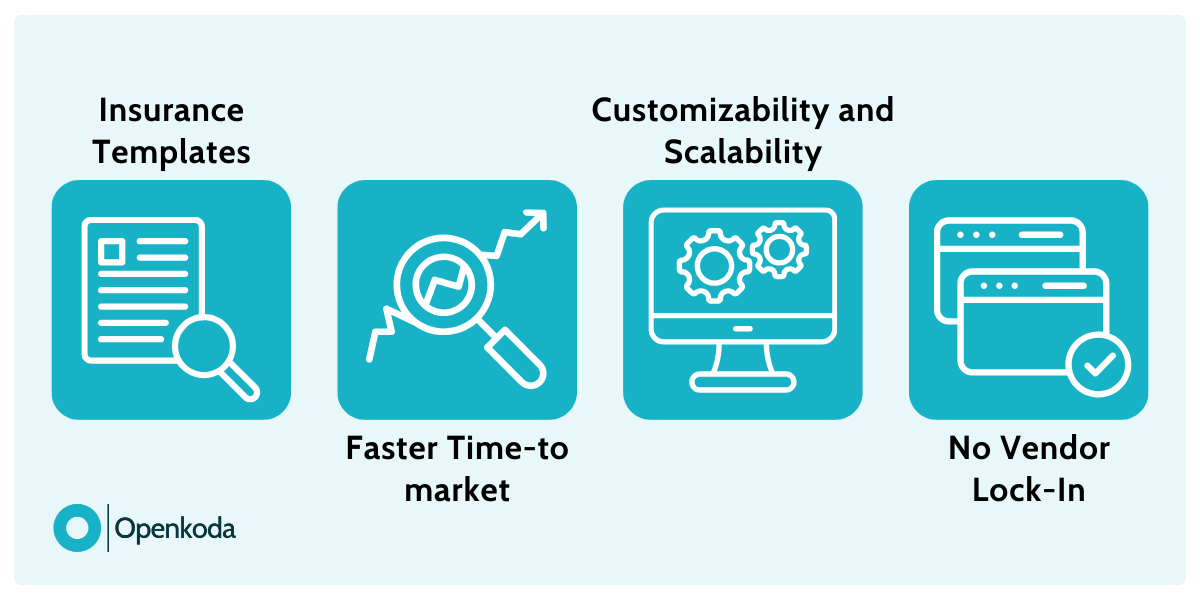
Many of the challenges insurers face today are not caused by policy administration itself, but by outdated PAS software that no longer aligns with how modern insurance operates.
Legacy policy administration systems were built for a different era, and carriers now feel the strain as expectations around speed, flexibility and digital access continue to rise.
A frequent pain point in insurance policy administration is limited integration capability.
Older policy administration systems were designed as closed tools, making it difficult to connect them with claims platforms, billing engines, data analytics, or external services. As a result, carriers often rely on custom interfaces or manual data transfers.
Many insurance legacy systems offer a fixed set of features with minimal room for adaptation.
Adjusting product logic, launching new insurance offerings, or changing policy rules often requires vendor involvement or costly development cycles.
For carriers, this rigidity makes it harder to respond to market changes and forces business teams to work around system limitations rather than with them.
Outdated user interfaces remain a surprisingly common issue in policy administration systems.
Complex screens, non-intuitive workflows, and poor usability slow down daily operations and increase error rates. When internal teams struggle with their tools, service quality suffers.
A useful policy administration system should accommodate how your business writes insurance, and let your team make changes as that business evolves. Adding a coverage, adjusting a referral threshold, or introducing a different customer journey should be manageable tasks.

Openkoda is a complete, highly customizable insurance PAS whose feature set brings product configuration, rating, underwriting, policy administration, claims, billing, and reporting into one system. Insurers and MGAs can tailor it to their products and workflows, with AI helping business users translate requirements into working configuration.
That gives product managers and underwriting teams a more direct role in shaping their software. Through Openkoda’s AI Product Builder, they can describe a product or request changes in plain language, inspect the proposed configuration, and approve it before application.
The scope includes coverages, limits, deductibles, rating formulas, underwriting rules, and workflows. Changes remain reviewable and versioned, with existing policies retaining the product version under which they were bound.
For a specialty insurer or MGA, this makes ongoing product development more practical. Teams can respond to broker feedback, refine appetite, and introduce product variations with less dependence on a development queue.
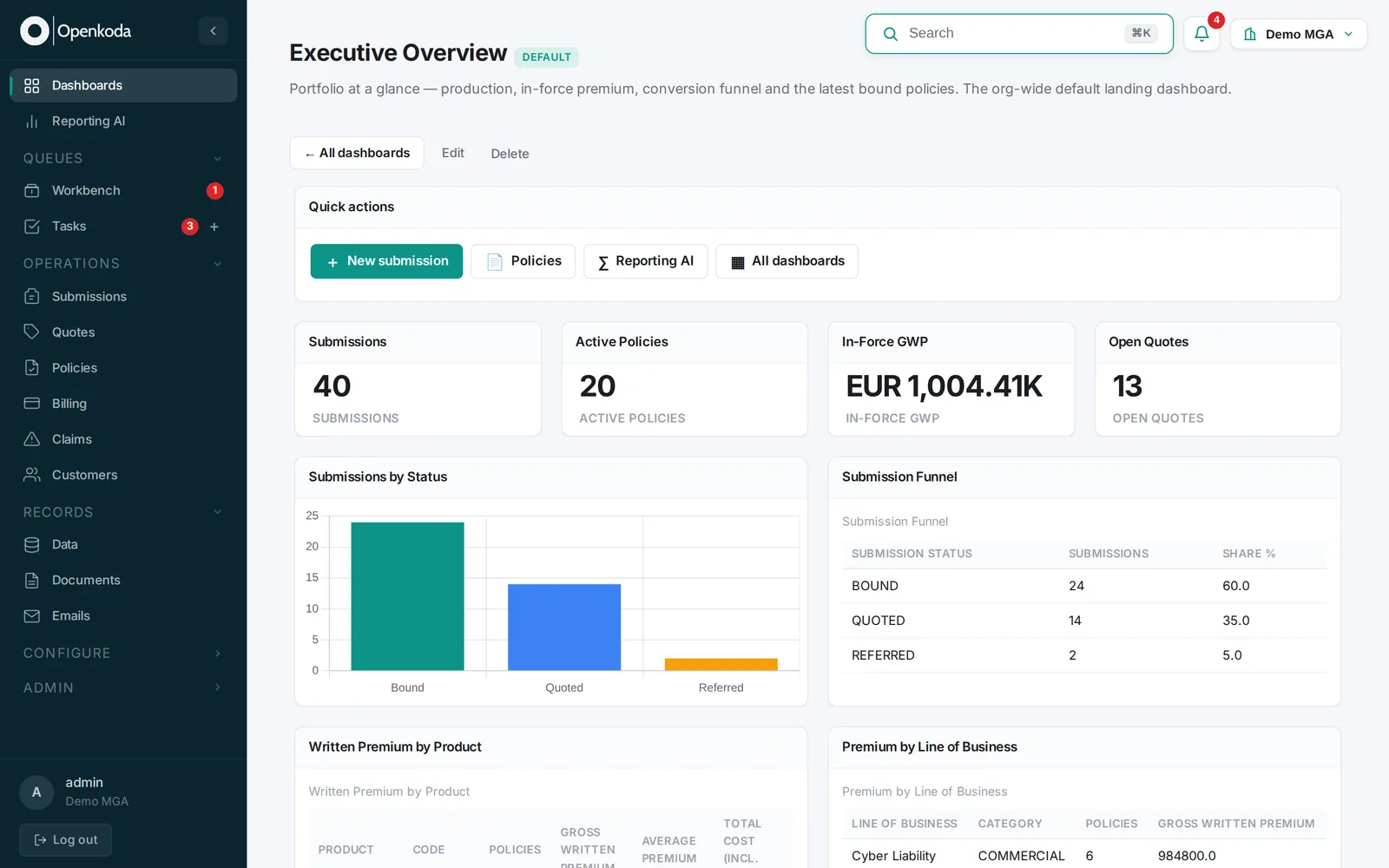
Imagine an MGA preparing an annual insurance product for commercial drone operators. Its underwriting team has agreed the coverage structure, rating approach, and referral criteria.
An illustrative starting instruction for Openkoda’s AI Product Builder could be:
Create an annual commercial drone insurance product with equipment damage, theft, and third-party liability cover. Make coverage limits and deductibles configurable. Refer applications with total equipment values above £25,000 to an underwriter, and require approval before those risks can be bound.
The team would then work through three stages:
After launch, the same approach supports further changes. The team might introduce another deductible option or revise an underwriting threshold, review the proposed update, and publish the appropriate product version. AI product configuration and versioning
The insurance expertise remains with the team. AI helps turn that expertise into configuration that can be inspected, tested, and refined.
The product you configure runs within an established PAS, with capabilities already available to support everyday insurance operations:
These features provide the operational structure around each product, allowing implementation work to concentrate on your requirements, integrations, and customer experience.
Openkoda’s AI capabilities also support the work that follows product configuration:
Openkoda Enterprise also includes an MCP server, which connects compatible AI assistants to the PAS. Staff can query information and request supported actions using their existing permissions, with changes previewed and confirmed before execution.
For insurance teams, the practical advantage is continuity: the product definition, operational workflow, policy record, and AI assistance work within the same environment. That creates a useful basis for launching products, learning from live operations, and making controlled improvements over time.
Modern policy administration software serves as a strategic asset for insurers.
Systems that support rapid new business onboarding and flexible product configuration enable companies to respond faster to market change and customer expectations. In the long run, insurers that treat policy administration as a core capability, not a constraint, are better positioned to grow, adapt, and innovate.
A policy administration system decides how fast business changes reach the policies you write. Key 2026 features, a buyer's checklist and 10 systems compared.
MGA policy administration software has to handle binders, referrals, bordereaux and commission for every capacity provider. What to look for, and 10 systems compared.
An insurance CRM tracks clients, pipeline and renewals. It does not rate an endorsement or bill an installment. Six CRMs compared, and where the policy record lives.
Book a live, personalized demo with our product team - tell us your use case and see the platform work with your data. No commitment.