Insurance Rating Engine
What an insurance rating engine is, the must-have features to look for, the benefits of centralizing pricing logic, and how to integrate it with your stack.
What a core insurance system covers, how policy administration, billing and claims fit together, and where the boundary with surrounding tools sits.

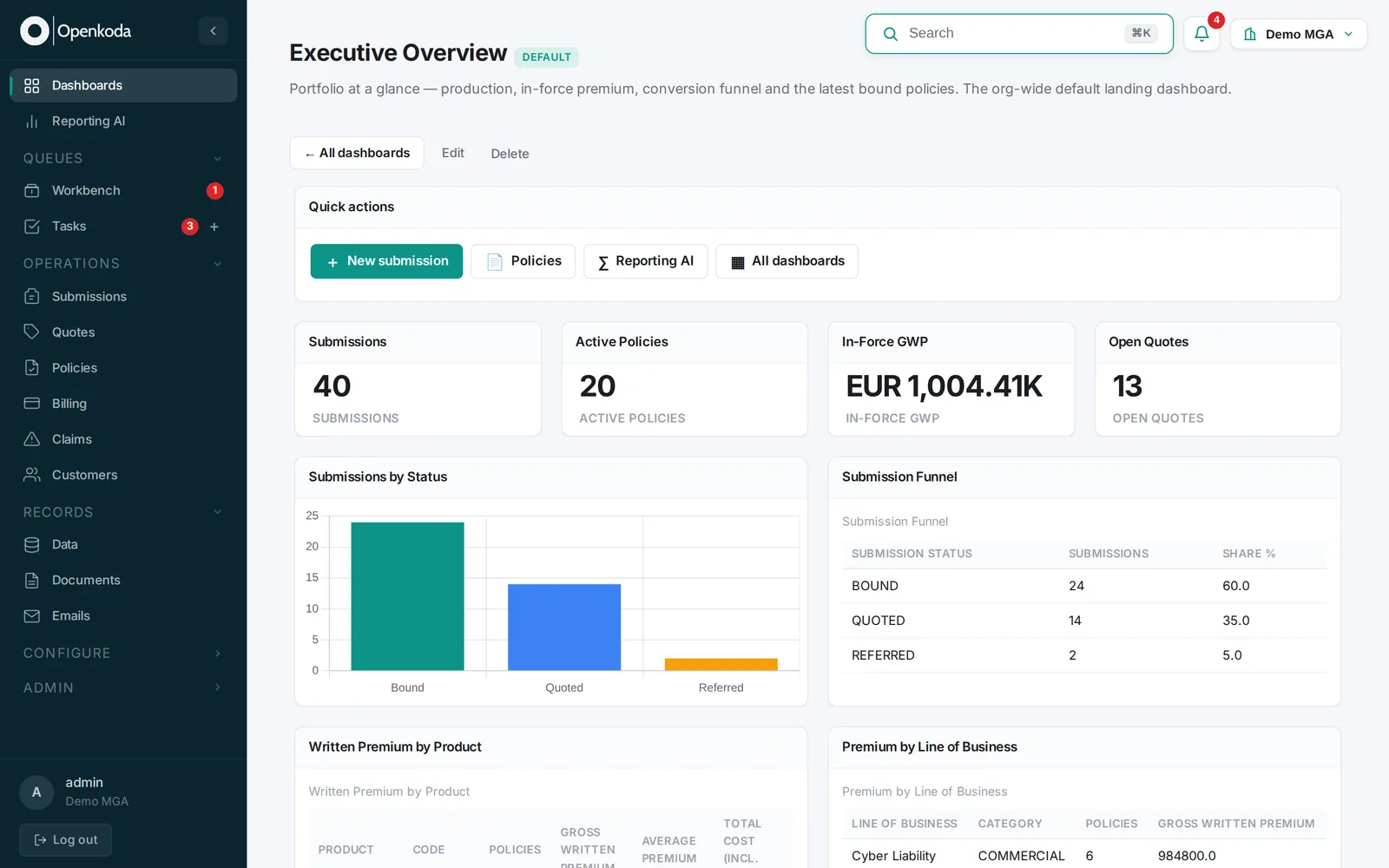
A core insurance system is the software that records and manages an insurer’s main insurance transactions. In property and casualty insurance, its central functions are usually policy administration, billing, and claims management.
The core keeps track of what has been insured, which terms apply, what premium is due, and what happens when a claim is reported. Other tools, such as customer portals and reporting dashboards, use that information to support the wider business.
The core provides the operational record of the insurance contract and the transactions connected to it. That role is often described as being a system of record.
For example, when an insurer adds a vehicle to a fleet policy, the core needs to record the vehicle, the effective date, the coverage change, and any premium adjustment. When a claim later arrives, the claims team needs to establish which coverage applied at the relevant time.
The policy, billing, and claims functions may be modules in one platform or separate applications connected together. The term does not require every function to share one database or run in one application. Guidewire’s core product structure illustrates the common grouping of policy administration, billing, and claims applications. Guidewire’s core insurance products.
A policy administration system manages the policy lifecycle. Depending on the product and implementation, this includes quote handling, binding coverage, issuing documents, making endorsements, processing cancellations, and preparing renewals.
The policy record normally contains the insured parties, covered risks, limits, deductibles, premium, and coverage dates. It also needs a history of changes.
This history is particularly important for insurance endorsements. A change made today might take effect on a different date, and a claim review may need an earlier version of the policy rather than its current state.
The insurance billing system manages amounts due and paid. Typical responsibilities include invoices, installment schedules, outstanding balances, refunds, and the billing consequences of policy changes.
It may connect to an external payment provider to collect money and to a finance system for accounting. Collecting a payment and recording how it settles a policy balance are related but separate jobs.
If an endorsement increases premium halfway through a term, billing must receive the adjustment and apply the appropriate payment schedule. Otherwise, the policy record and the customer’s invoice can disagree.
A claims management system supports the claim from its initial report through investigation, assessment, payment, and closure. The claim file may also remain relevant for recoveries, reopening, or later changes in the estimated cost.
The connection to policy administration helps the claims team retrieve the relevant contract and coverage information. The claims application then maintains its own operational details, such as assigned handlers, reserves, supporting evidence, and payment approvals.
Core platforms often include or integrate with other insurance capabilities:
These boundaries vary by platform. For example, Duck Creek describes policy and rating alongside billing and claims within its core offering, with additional capabilities connected around them. Duck Creek’s platform overview.
Consider a fictional insurer issuing property insurance for a small business.
Each step produces information another step may need. If the second location was added after the reported loss, looking only at the latest policy screen could lead to a mistaken assumption about coverage. Effective dates and transaction history allow the team to reconstruct what actually applied.
Several systems can hold customer and policy information without serving the same purpose.
| System | Primary role |
|---|---|
| Core insurance system | Manages the insurer’s policy, billing, and claims operations as a connected whole |
| Policy administration system | Manages policy contracts and their lifecycle; commonly one part of the core |
| Customer relationship management system | Tracks prospects, relationships, sales activity, and communications |
| Agency management system | Supports an agency’s book of business, often across multiple insurers |
| Customer or broker portal | Provides an interface for accessing information and submitting transactions |
A portal might let a customer request a coverage change. The underlying policy system still needs to validate and record the transaction. Similarly, a CRM can show that a renewal conversation happened without being the authoritative record of the renewed contract.
The term core describes a business role. Monolithic and composable describe ways of organizing the software that performs it.
A monolithic core groups many functions within a closely connected application. Shared data and a single deployment can simplify some operations, but changes may require testing and releasing the wider application.
A composable core connects components with defined responsibilities through interfaces. An insurer might use one application for policies, another for claims, and a separate rating service. Components can be changed more independently, provided their interfaces remain compatible.
An integrated suite is not necessarily a monolith: one supplier can provide several separately deployable applications. Likewise, buying products from several suppliers does not automatically make their integration reliable.
AWS’s insurance architecture guidance describes how events can connect separate policy-processing services. For example, a completed transaction can trigger a downstream process without placing all the logic in one application. AWS’s insurance policy processing architecture.
The practical tradeoff is coordination. Separate components need shared identifiers, clear responsibility for each record, and a way to detect and resolve failed updates. A policy transaction should not silently disappear between policy administration and billing.
No. Hosting and application structure are separate decisions. A core can run in an insurer’s own environment, in a cloud environment, or as a service operated by a provider.
Moving an existing application to the cloud does not necessarily change how its business functions are organized. AWS distinguishes replacement, re-platforming, and refactoring among the approaches to modernizing insurance applications. AWS’s insurance modernization overview.
Whatever the deployment model, the core needs to preserve accurate transactions, historical coverage information, and controlled access. These capabilities allow the insurer to explain a policy change, reconcile a payment, and establish which facts supported a claim decision.
What an insurance rating engine is, the must-have features to look for, the benefits of centralizing pricing logic, and how to integrate it with your stack.

What marine cargo insurance covers, who needs it, the main policy types (ICC A/B/C, single voyage, open cover), and key contract requirements.

An insurer owned by the businesses it covers, the forms it takes, and what separates a captive from simply retaining the risk.
Book a live, personalized demo with our product team - tell us your use case and see the platform work with your data. No commitment.