
Insurance Billing System
An insurance billing system is the financial backbone of any insurance tech stack.
It ensures that premiums are calculated, invoiced, collected, and reconciled accurately across products, channels, and customer segments. Without a reliable billing capability, even the best underwriting or claims process will struggle to deliver a seamless customer experience.
Insurance Billing System – General Definition
Insurance billing system manages the end-to-end billing processes associated with insurance policies. This includes generating invoices, handling payment processing, tracking receivables, and managing refunds or adjustments.
A modern insurance billing software solution does far more than issue invoices.
It supports multiple payment plans (monthly, quarterly, annual), enables flexible payment options (card, bank transfer, digital wallets), and allows policyholders to complete transactions in just a few clicks. Whether operating under a direct bill model (where the insurer invoices the customer directly) or through intermediaries, the system must remain accurate and synchronized with policy administration.
Importantly, the billing system is not just an accounting tool. It directly impacts customer satisfaction and operational efficiency. Late payment reminders, automated dunning, installment recalculations after mid-term adjustments, and real-time balance visibility all contribute to efficient billing. When billing runs smoothly, it reduces manual workload, improves cash flow predictability, and minimizes reconciliation errors across departments.
Insurance Billing Software: Key Element of Core Platforms
In modern insurance architectures, the billing function is tightly integrated with other core systems – particularly policy administration and rating engines.
This integration ensures that premium changes, endorsements, cancellations, and renewals are reflected immediately in billing schedules, eliminating inconsistencies and reducing risk.
What Should a Billing System Include? Key Features
In modern insurance architecture, billing is a critical layer of the insurance core platform.
Alongside policy administration and claims, billing operations ensure that revenue flows correctly and predictably through the organization.
A robust insurance billing software solution enables fully automated processes that streamline day-to-day financial workflows and reduce manual work. This is especially important in P&C insurance, where policy changes, endorsements, and installment adjustments frequently affect billing logic.
Key capabilities typically include:
- Automating invoicing across new business, renewals, and mid-term adjustments
- Flexible payment plans (monthly, quarterly, annual, custom schedules)
- Real-time tracking of premium collections and outstanding balances
- Automated handling of missed payments, reminders, and dunning workflows
- End-to-end management of core billing activities, including refunds and write-offs
- Secure payment processing with external provider and partner integrations
- Advanced financial reporting for finance, compliance, and executive teams
When embedded properly within the core suite, billing operations become a strategic driver of operational stability. They improve cash flow visibility, support compliance, and create a smoother experience for both customers and distribution partners.
Custom Insurance Billing Systems
For many insurers, especially those modernizing legacy environments, off-the-shelf tools are not always enough. Billing is deeply intertwined with underwriting logic, product design, distribution models, and regulatory requirements. That’s why it often becomes a central component of broader digital transformation initiatives.
Custom-built insurance billing software allows organizations to tailor workflows, automate complex calculations, and align billing logic precisely with business strategy. This is particularly important when replacing fragmented or outdated systems that limit flexibility and slow down innovation.
In modernization projects, billing is rarely treated as a separate module. Instead, it is developed as an integrated component of the broader insurance platform – connected to policy administration, claims, reporting, and financial systems.
Tools like Openkoda enable insurers to design and deploy configurable billing components within a scalable architecture, accelerating development while maintaining full customization and control.
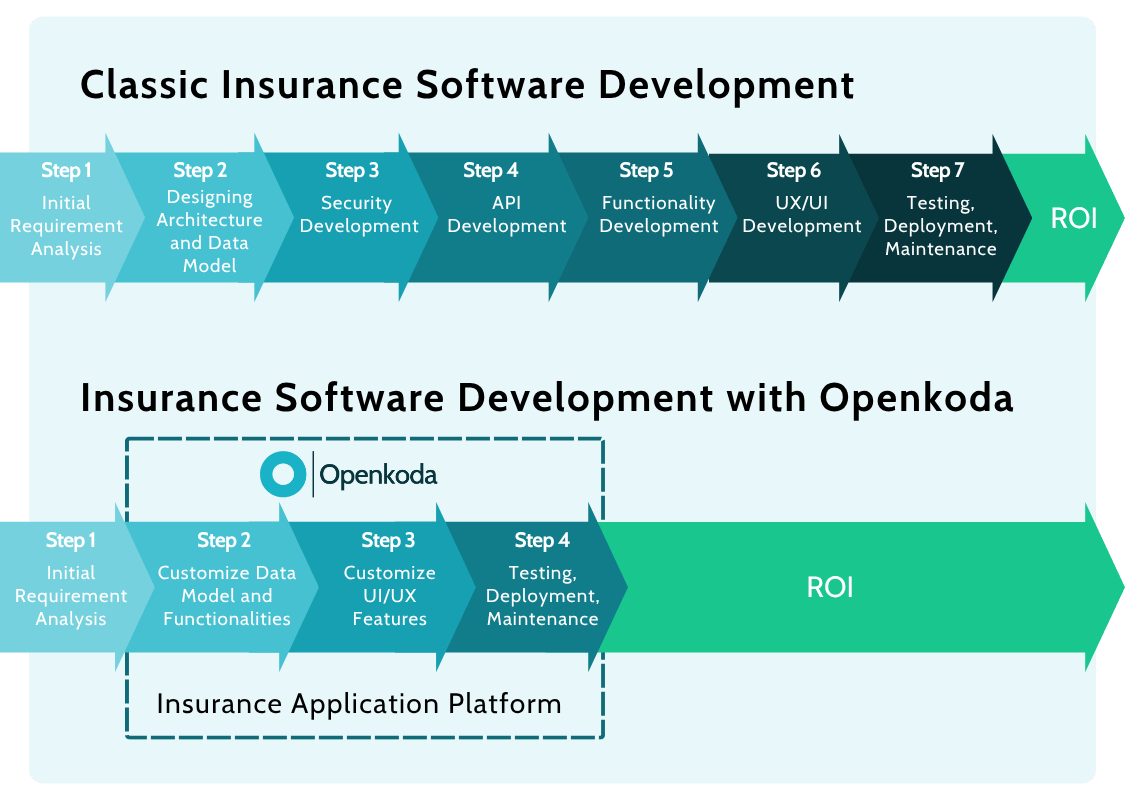
Ultimately, a custom billing system is not just about processing payments. It supports smarter cash management, adapts to evolving customer needs and market demands, and strengthens the insurer’s ability to deliver consistent, reliable, and responsive service.

